
When your body goes into anaphylaxis, you don’t have time to read a manual. Minutes matter. Epinephrine is the only thing that can stop a life-threatening allergic reaction before it kills you. Yet, studies show nearly 60% of people who need it don’t get it in time - not because they don’t have it, but because they don’t know how to use it.
What Happens During Anaphylaxis?
Anaphylaxis isn’t just a bad rash or a stuffy nose. It’s your immune system going into overdrive, flooding your body with chemicals that cause your airways to swell, your blood pressure to crash, and your heart to struggle. Symptoms can show up in seconds: hives, swelling of the lips or tongue, wheezing, vomiting, dizziness, or a feeling like you’re going to pass out. Without epinephrine, death can happen in under 30 minutes.Epinephrine - also called adrenaline - works fast. It tightens blood vessels to raise your blood pressure, opens your airways so you can breathe, and stops the runaway allergic response. It’s not a cure, but it’s the only thing that buys you time to get to the hospital.
Which Auto-Injector Do You Have?
There are a few brands on the market, but they all work the same way: inject epinephrine into the outer thigh. The most common is the EpiPen. Others include Auvi-Q, Adrenaclick, and the newer Neffy nasal spray. You need to know which one you’re holding because the steps vary slightly.- EpiPen: The most widely used. Has a bright orange tip. You push it into your thigh until you hear a click.
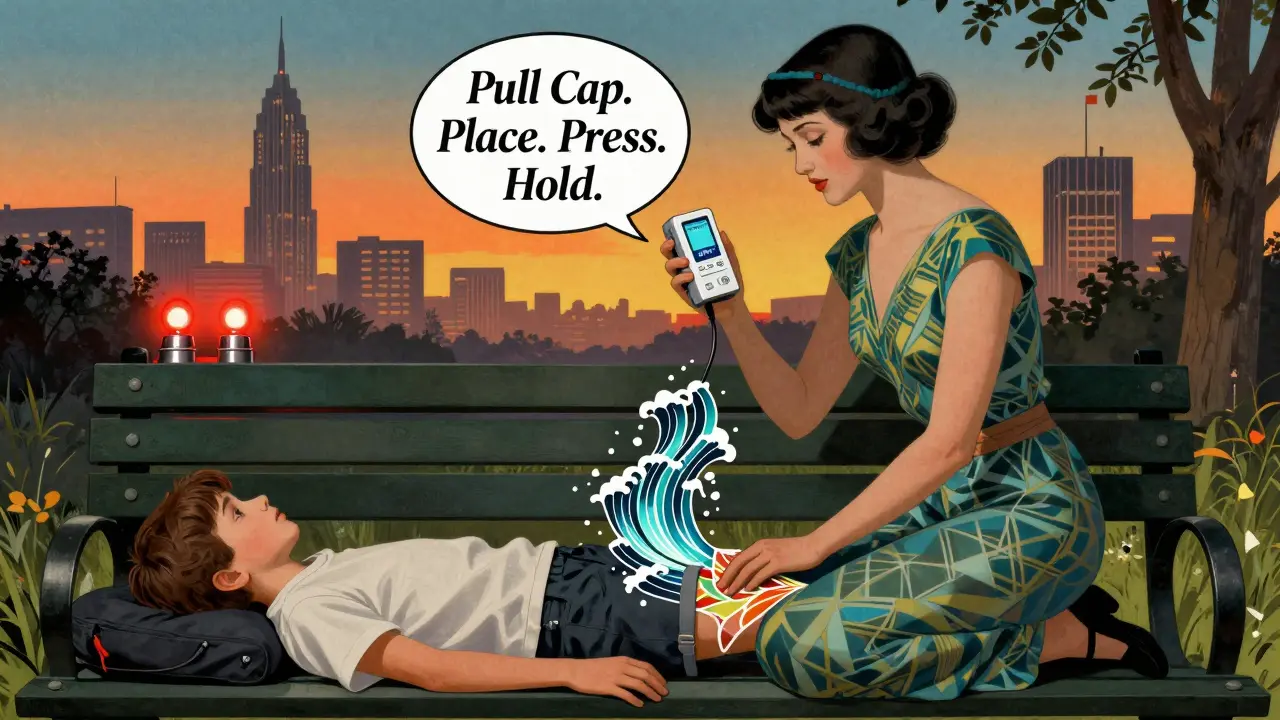
- Auvi-Q: Smaller, rectangular, and talks to you. It gives voice instructions: “Pull the blue safety cap,” “Place against thigh,” “Press firmly.”
- Adrenaclick: Cheaper, but you have to remove two caps and manually push a plunger. More steps = more room for error.
- Neffy: No needle. You spray it into one nostril. Works for most cases, but not everyone can use it correctly.
If you’re not sure which one you have, check the label. Know your device before you need it. Practice with a trainer - most pharmacies give them out for free.
Step-by-Step: How to Use an Epinephrine Auto-Injector
Step 1: Recognize the signs Don’t wait for everything to get worse. If you or someone else has any of these: trouble breathing, swelling of the face or throat, rapid pulse, nausea, or feeling faint - act now. Antihistamines like Benadryl won’t help. Only epinephrine will. Step 2: Remove the safety cap For EpiPen and Adrenaclick, pull off the blue safety cap. Don’t press the device yet. For Auvi-Q, the device will tell you to do this. For Neffy, remove the protective cap. Step 3: Aim for the outer thigh You don’t need to see the skin. You can inject through clothing - jeans, leggings, even thick pants. Place the tip of the injector against the middle of the outer thigh, halfway between the hip and knee. Do not inject into the buttocks, arm, or hand. The thigh muscle is thick, easy to reach, and absorbs the drug fastest. Step 4: Push hard and hold For EpiPen and Auvi-Q: Jab it into the thigh like you’re stabbing a potato. Hold it there for 3 seconds. You’ll hear a click or feel a slight push. The device will automatically release the needle.For Adrenaclick: After removing both caps, press the tip firmly against the thigh and slide the plunger forward until it stops. Hold for 3 seconds.
For Neffy: Tilt your head back slightly, insert the nozzle into one nostril, and press the plunger firmly until you hear a click. Breathe normally. Do not sniff.
Step 5: Keep it in place This is where most people fail. You must hold the injector against the thigh for the full 3 seconds. Studies show 61% of users pull away too early. That means less medicine gets in. If you’re helping someone else, don’t let them move. Hold their leg steady. Step 6: Call 911 immediately Even if you feel better, you still need to go to the hospital. Anaphylaxis can come back - called a biphasic reaction - up to 12 hours later. Emergency responders need to know you’ve used epinephrine so they can monitor you properly. Step 7: Use a second dose if needed If symptoms don’t improve after 5-10 minutes - or if they get worse - use a second injector. Always carry two. Many people only have one, but if you’ve had a severe reaction before, two is non-negotiable.Common Mistakes (And How to Avoid Them)
- Waiting too long: Don’t wait for the wheezing to get worse. Use it at the first sign of trouble.
- Injecting in the wrong spot: Thigh only. No arms, no stomach, no butt.
- Not holding long enough: 3 seconds is not optional. Count it out: “One-Mississippi, two-Mississippi, three-Mississippi.”
- Forgetting to call 911: Epinephrine saves your life - but you still need a hospital.
- Keeping it in the car or a hot bag: Heat destroys the medicine. Store it at room temperature, away from sunlight.
Who Should Carry One?
If you’ve ever had a severe allergic reaction to food, insect stings, medication, or latex - you need one. Kids with peanut allergies? Carry two. Teens with shellfish allergies? Carry two. Adults with unknown triggers? Carry two.Even if you’ve never had a reaction but have a family history of severe allergies, talk to your doctor. You might be at risk.
Storage and Expiration
Epinephrine breaks down over time. Don’t rely on a device that’s 2 years old. Check the expiration date every time you refill it. Most last 18 months. Store it at room temperature - between 59°F and 86°F. Don’t leave it in your car in summer. Don’t freeze it. If the liquid inside turns brown or has particles, throw it out.Training and Practice
You can’t learn this from reading. You need to practice. Ask your doctor for a trainer device - they’re plastic, no needle, and work just like the real thing. Practice on yourself or a family member. Do it once a month. Set a reminder on your phone.Teach your kids how to use it. Teach your partner. Teach your teacher, your coach, your babysitter. If you’re a parent, make sure your child’s school has a spare and trained staff. In the U.S., 47 states require schools to keep epinephrine on hand - but only 28 require staff to be trained.

What to Expect After the Injection
You’ll feel it. Heart racing. Hands shaking. Nervous, maybe nauseous. That’s normal. Epinephrine is adrenaline. It’s supposed to make you feel like you ran a marathon. Those side effects fade in 10-20 minutes. If you feel worse - or if symptoms return - use your second dose.Don’t panic if you feel jittery. You’re alive. That’s what matters.
What Comes Next?
After you use epinephrine, go to the ER. Even if you feel fine. You need to be monitored for at least 4-6 hours. You may need oxygen, IV fluids, or steroids. The hospital will also help you figure out what triggered the reaction so you can avoid it next time.After your visit, replace your used injector. Don’t wait. Anaphylaxis doesn’t care if you’re broke or busy. It only cares if you’re prepared.
Cost and Access
EpiPen costs around $680 without insurance. Adrenaclick is about $200. Auvi-Q is more expensive but has voice guidance. Neffy is priced similarly to EpiPen. Many insurance plans cover them. If you can’t afford it, ask about patient assistance programs. Viatris (EpiPen’s maker) and kaléo (Auvi-Q) both offer free or low-cost options if you qualify.Never skip buying one because of cost. One dose of epinephrine is cheaper than an ambulance ride, an ICU stay, or a funeral.
Real Stories, Real Consequences
A 10-year-old in Texas ate a cookie with peanuts. His mom hesitated - she thought it was just a rash. By the time she used the EpiPen, he was blue. He survived, but spent 3 days in the ICU.A college student in Florida had a peanut allergy. She carried her EpiPen but never practiced. When she reacted, she pulled the wrong cap. She didn’t inject. She died.
A dad in Ohio used his Auvi-Q during his daughter’s reaction. The voice told him: “Hold for 3 seconds.” He did. She’s now 16 and plays soccer. He says: “That voice saved her. I didn’t have time to think.”
Epinephrine auto-injectors aren’t magic. But they’re the best tool we have. And they only work if you know how to use them.
Can I use an epinephrine auto-injector on someone else?
Yes. If someone is having an anaphylactic reaction and can’t inject themselves, you can and should use their auto-injector on them. The device is designed for emergency use by anyone. Aim for the outer thigh, push firmly, hold for 3 seconds, and call 911. You can’t hurt someone by giving them epinephrine - but you can kill them by waiting.
Can I use an expired epinephrine auto-injector?
If it’s only a few months past expiration and the liquid is clear, it’s better than nothing. Epinephrine loses potency over time, but even a weakened dose can help. Never intentionally use one that’s more than a year expired. Always replace it before it expires. Keep track of dates with a calendar reminder.
Do I need to remove clothing before injecting?
No. You can inject through clothing - jeans, leggings, sweatpants, even thick socks. The needle is strong enough to penetrate fabric. In an emergency, every second counts. Don’t waste time taking off pants. Just jab it through.
What if I accidentally inject myself in the wrong place?
If you accidentally inject your finger, hand, or arm, go to the ER immediately. These areas have small blood vessels, and epinephrine can cause tissue damage or severe constriction. If you inject the wrong leg, don’t panic - you still got the medicine into the body. Call 911 anyway. The key is getting the drug into muscle tissue, and even a suboptimal injection is better than none.
Can children use epinephrine auto-injectors?
Yes. Children as young as infants can use them. For kids under 66 pounds (30 kg), the 0.15 mg dose is used. For anyone over that weight, it’s 0.3 mg. Parents should practice on a trainer device and teach older children to self-inject. Schools and daycare centers must have trained staff and access to epinephrine for any child with a known allergy.
Is the nasal spray (Neffy) better than the injector?
Neffy is a good alternative for people afraid of needles, but it’s not for everyone. It works in 81% of cases, but 32% of users don’t use it correctly - especially under stress. It requires a firm seal in the nostril and a strong press. For someone panicking, it’s harder than just jabbing the thigh. EpiPen and Auvi-Q are still the gold standard for reliability. Neffy is a backup option, not a replacement.
Should I keep an epinephrine auto-injector in my car?
No. Temperatures inside a car can exceed 120°F in summer and drop below freezing in winter. Heat and cold destroy epinephrine. Keep it with you - in your bag, your pocket, your child’s backpack. Never leave it in the glove compartment or under a seat. Use a small insulated case if you’re worried about temperature.
Just had to use my EpiPen last month after a surprise peanut cross-contamination at a BBQ. Felt like my throat was closing, hands went numb - scary as hell. But I jabbed it like the video showed, held for three seconds, and called 911. The paramedics said I was lucky I didn’t wait. Seriously, if you have one - carry it. Use it. Don’t overthink it. 🤝
Let me be perfectly clear: the notion that you can ‘inject through clothing’ is dangerously misleading. The manufacturer’s instructions explicitly state ‘direct skin contact is optimal.’ While fabric penetration is technically possible, it is not guaranteed - and in a life-or-death scenario, ambiguity is a luxury you cannot afford. You are not saving time by being lazy; you are risking an inadequate dose. Period. 📜
60% don’t use it in time? Yeah, because most people are cowards who’d rather die than poke themselves with a needle. Also, Neffy is garbage. You can’t spray your way out of anaphylaxis. It’s not a decongestant. 🤡
So let me get this straight - we’re supposed to jab a needle into our thigh like we’re trying to kill a potato… and then count ‘Mississippi’ like we’re in a kindergarten game? 🤭 I mean, I get it’s life-saving, but also… wow. Our medical system is a sitcom written by someone who’s never been scared.
Brothers and sisters - this isn’t just about gear. This is about community. I’ve taught my whole family how to use the EpiPen - my wife, my kids, even my 78-year-old mom. We practice every month on the trainer. I’ve seen what happens when people wait - I don’t want that for anyone. You think it won’t happen to you? It already has. You just didn’t know it yet. Keep two. Train your people. Share this. We rise together. 🙏❤️
did you know the epinephrine in auto injectors was originally developed by the us military during the cold war to keep pilots alive after chemical attacks and now its being used for peanut allergies i think this is part of a bigger agenda to make people dependent on pharmaceutical companies and also i heard the blue cap on epipen is actually a tracking device but dont tell anyone i said that
It is imperative to underscore the critical importance of adhering strictly to the manufacturer’s recommended protocol for the administration of epinephrine auto-injectors. Any deviation from the prescribed technique, including but not limited to suboptimal injection duration or improper site selection, may result in subtherapeutic drug delivery, thereby compromising patient outcomes. Vigilance and precision are non-negotiable.
so like… i had an epipen once and i was too scared to use it and then i cried and my dog licked my face and i felt better? idk man. maybe we just need more hugs. or maybe epinephrine is just a capitalist plot to sell you plastic pens. 🤔💔
There’s something deeply human about the way we treat emergency medical devices - like they’re tools we can ignore until disaster strikes, then suddenly treat like sacred relics. We buy them, store them in drawers, forget their expiration dates, and then act shocked when they don’t work. But epinephrine doesn’t care about our denial. It doesn’t care if we’re ‘not the type’ to need it. It only responds to action. The real tragedy isn’t the reaction - it’s the habit of waiting. We don’t need more guides. We need more people who’ve practiced until it’s muscle memory. Not theory. Not hope. Just muscle. And that’s harder than any injection.
ok but like… i just used my auvi-q for the first time last week and it was literally talking to me like a sassy ai assistant. ‘pull the blue cap’ ‘place against thigh’ ‘press firmly’ - and then it went ‘emergency response activated’ like i was in a sci-fi movie. i laughed so hard i almost didn’t hold it long enough. also i’m 27 and i’ve had peanut allergies since i was 3 and i still forget mine in the car. oops. 🤦♀️
Why are we letting foreigners design our life-saving devices? EpiPen is American. Auvi-Q? Israeli. Neffy? Swiss. We need a U.S.-made auto-injector that’s built for American grit, not some foreign gadget that talks to you like a Siri with anxiety. Also, why are we teaching kids to inject themselves? Let’s teach them to avoid peanuts. That’s the real solution.