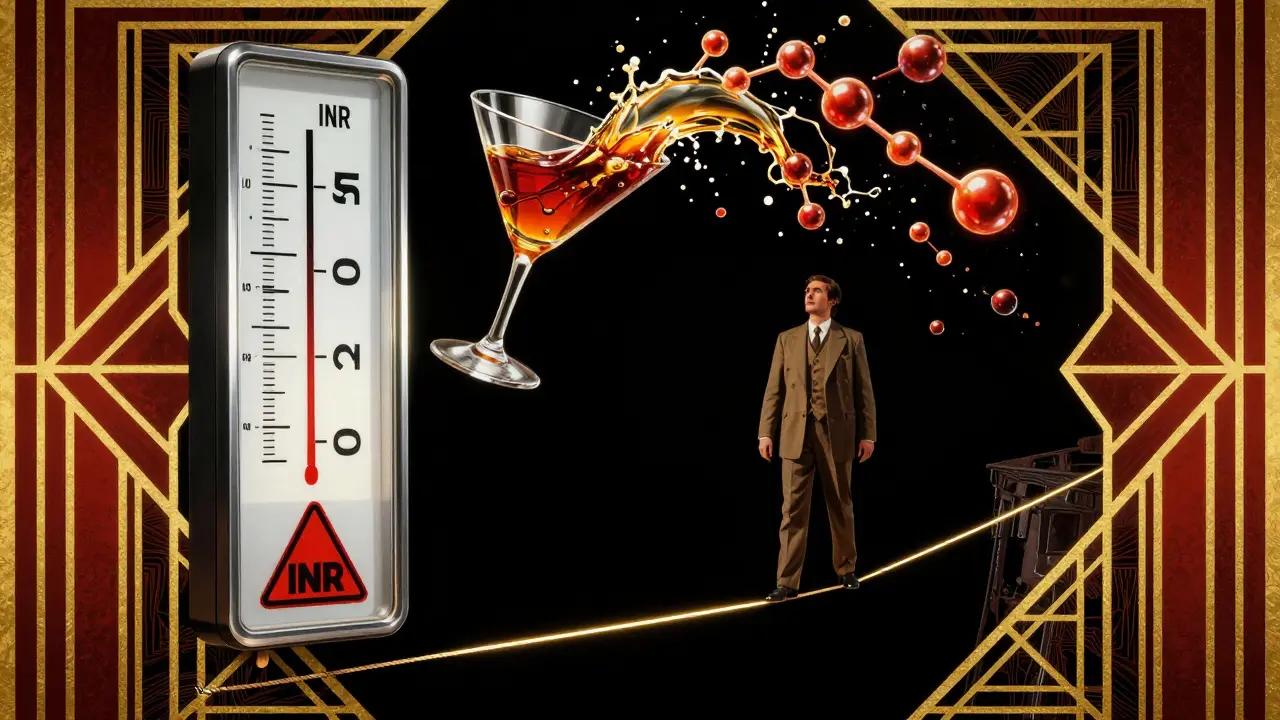
Warfarin Binge Drinking Risk Calculator
When you drink heavily while on warfarin, your liver struggles to process the medication. This can cause your INR to spike dangerously high, increasing bleeding risk by up to 4.2 times for those with certain genetic variants.
When you're on warfarin, your body is walking a tightrope. Too little anticoagulation, and you risk a stroke or clot. Too much, and you could bleed internally-sometimes without even knowing it. Now add binge drinking into the mix, and that tightrope turns into a live wire.
Warfarin, also known by its brand name Coumadin, has been used for over 70 years to prevent dangerous blood clots in people with atrial fibrillation, deep vein thrombosis, or after heart valve replacement. Its effectiveness depends on keeping your INR (International Normalized Ratio) between 2.0 and 3.0. That’s a narrow window. One small change in diet, medication, or lifestyle can push you out of it. And alcohol? Especially binge drinking? It doesn’t just nudge the needle-it slams it.
What Counts as Binge Drinking?
The National Institute on Alcohol Abuse and Alcoholism (NIAAA) defines binge drinking as consuming five or more drinks in about two hours for men, or four or more for women. That’s not a night out. That’s five shots of whiskey, five beers, or three large glasses of wine-all in under two hours. And if you do this even once a week while on warfarin, you’re putting yourself at serious risk.
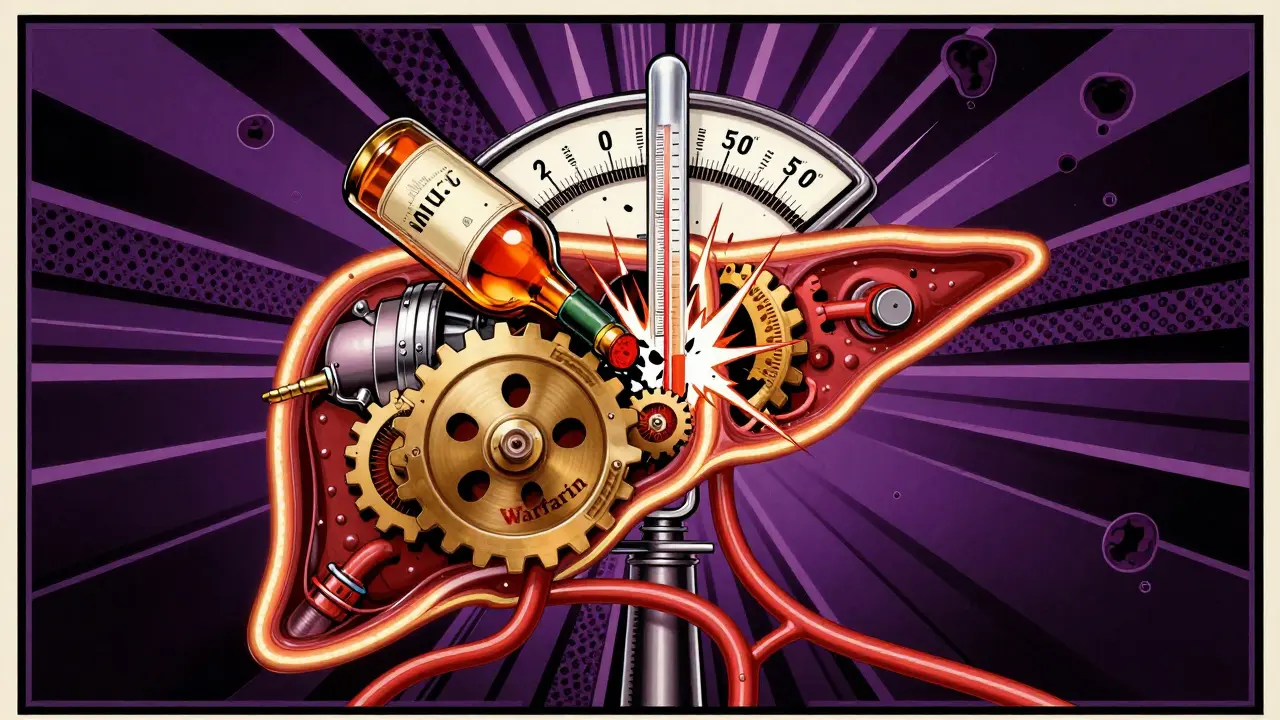
Why? Because alcohol doesn’t just make you feel dizzy. It messes with your liver-the same organ that breaks down warfarin and makes clotting proteins. When you drink heavily in a short time, your liver gets overwhelmed. It stops processing warfarin properly. That means more warfarin stays in your blood longer. Your INR spikes. Suddenly, you’re in danger zone.
The INR Rollercoaster
Here’s the scary part: alcohol doesn’t just raise your INR one time. It creates wild swings. One day, your INR might be 2.5-perfect. The next day, after a weekend binge, it could jump to 5.0. That’s not just high. That’s emergency-level high. At an INR above 4.0, your risk of serious bleeding skyrockets.
A 2015 study from the University of Michigan tracked over 1,200 warfarin patients. Those who binge drank had a 2.3-fold higher risk of major bleeding compared to those who didn’t. For people who’d been on warfarin for over a year? The risk jumped to 3.1 times higher. Why? Because long-term alcohol use damages the liver. It reduces your body’s ability to make clotting factors-and it also makes your liver less predictable in how it handles warfarin. The result? Unstable INR, no matter how carefully you dose.
Genetics Make It Worse
Not everyone reacts the same way. If you carry certain gene variants-like CYP2C9*2 or CYP2C9*3-your body breaks down warfarin much slower. These variants are common in people of European descent. If you have them and you binge drink? Your risk of bleeding isn’t just higher. It’s 4.2 times higher than someone without these genes who drinks the same amount.
This isn’t theoretical. The EU-PACT trial, which looked at over 1,500 patients across Europe, confirmed this. People with these gene variants who drank heavily had dangerous INR spikes even after just one night of drinking. And because most doctors don’t routinely test for these genes, many patients have no idea they’re sitting on a ticking time bomb.
What Does the Bleeding Look Like?
Bleeding from warfarin + alcohol doesn’t always come with a scream. Sometimes, it’s silent. You might notice:
- Unusual bruising-purple patches where you didn’t bump into anything
- Gums that bleed when you brush your teeth
- Nosebleeds that won’t stop
- Dark, tarry stools or bright red blood in your poop
- Red or brown urine
- Vomiting blood or material that looks like coffee grounds
- Severe headaches, dizziness, or abdominal pain
- Excessively heavy menstrual bleeding
These aren’t side effects. These are warning signs your body is bleeding internally. And if you ignore them? You could end up in the ER with a brain hemorrhage or a ruptured ulcer.
What Do the Experts Say?
The British Heart Foundation says it plainly: "It is OK to consume alcohol if you are taking warfarin, so long as you stick to recommended guidelines." That means no more than 14 units a week-and never all in one day. One unit is about half a pint of beer or a small glass of wine.
The University of Iowa Health Care recommends: "No more than 2 drinks a day for men, 1 for women." And they add: "It is not safe to binge drink by having many drinks in one day."
But here’s the problem: most people don’t know what a "drink" really is. A "drink" isn’t a tall pint of beer. It’s 12 oz of beer, 5 oz of wine, or 1.5 oz of hard liquor. If you’re drinking cocktails, you might be getting 2 or 3 drinks in one glass.
Why the FDA Removed the Warning (and Why It Should Be Put Back)
In 2010, the FDA removed the black box warning about alcohol and warfarin. Why? Because at the time, the evidence wasn’t "strong enough." But since then, multiple studies-including the 2015 Sung et al. study and follow-ups in Blood and the Journal of Thrombosis and Haemostasis-have proven otherwise.
In 2022, the American College of Physicians formally petitioned the FDA to reinstate the warning. Their argument? The data is now overwhelming. Patients with alcohol use disorder are 2.5 times more likely to have a major bleed while on warfarin. And the risk doesn’t go away with occasional drinking-it’s cumulative.

What About Other Blood Thinners?
You might think: "I’ll just switch to a DOAC-like rivaroxaban or apixaban." But that’s not a magic fix. Alcohol also increases bleeding risk with these drugs. The FDA’s own adverse event database shows a 1.8-fold increase in stomach bleeding with rivaroxaban in heavy drinkers.
DOACs don’t need INR checks, but they’re not safer with alcohol. In fact, because they’re less predictable in people with liver damage, binge drinking might be even more dangerous with them.
What Should You Do?
If you’re on warfarin and you drink:
- Never binge. Even one binge a month can trigger a dangerous INR spike.
- Stick to the limits: 1 drink per day for women, 2 for men-and spread them out.
- Get your INR checked within 72 hours after any drinking episode. Don’t wait for your next scheduled test.
- Tell your doctor if you’ve been drinking more than usual. They may need to adjust your dose or consider switching you.
- If you struggle to cut back, ask for help. Integrated care programs that combine addiction counseling with anticoagulation management have been shown to reduce bleeding by over 50%.
A 2022 study called the WAVE trial found that patients who got regular, structured education about alcohol and warfarin had 37% fewer bleeding events. That’s not luck. That’s knowledge saving lives.
Bottom Line
Warfarin isn’t just a pill. It’s a balancing act. Alcohol, especially binge drinking, throws that balance into chaos. It doesn’t matter if you’re a "light" drinker. One night of heavy drinking can send your INR into the danger zone. And if you’ve been on warfarin for years? Your liver is already tired. Adding alcohol? It’s like pouring gasoline on a slow-burning fire.
The choice isn’t "do I have to quit alcohol?" It’s "do I want to risk bleeding out while I sleep?"
For most people on warfarin, the answer is simple: skip the binge. Stick to the limit. And if you can’t? Talk to your doctor. There are better options-and better support-than risking your life over one night out.
Can I have one glass of wine while on warfarin?
Yes, one standard glass of wine (5 oz) is generally safe if you don’t drink regularly and your INR is stable. But never make it a daily habit, and never pair it with other alcohol. Even one drink can affect your INR if you’re genetically sensitive or have liver issues. Always check with your anticoagulation clinic before making any changes.
How long after drinking should I wait before taking my warfarin?
You shouldn’t time your warfarin dose around alcohol. The interaction isn’t about when you take the pill-it’s about how alcohol changes your liver’s ability to process it over hours and days. If you drank heavily the night before, your INR could spike 24 to 72 hours later. The best approach is to avoid binge drinking entirely and stick to your regular dosing schedule. If you did drink, get your INR checked before your next dose.
Does beer affect warfarin differently than liquor?
No. The type of alcohol doesn’t matter-only the amount. One beer, one shot, one glass of wine-all contain roughly the same amount of ethanol. What matters is how much you drink in a short time. A six-pack of beer is still binge drinking. A single shot of whiskey is fine. But if you drink five shots, you’re at risk-no matter what kind of alcohol it is.
I’ve been drinking for years on warfarin and never had a problem. Should I still worry?
Maybe not now-but you could be at risk tomorrow. Warfarin’s interaction with alcohol is cumulative. Liver damage builds over time. Your INR might be stable today, but if your liver function declines, even your usual drinking could cause a dangerous spike. Many patients don’t realize they’re at risk until they have a major bleed. Don’t wait for symptoms. Talk to your doctor about your drinking habits, even if you think it’s "not that bad."
Can I switch to a different blood thinner to avoid this risk?
Switching to a DOAC (like apixaban or rivaroxaban) may reduce some risks, but it doesn’t eliminate alcohol-related bleeding. Heavy drinking still increases bleeding risk with these drugs. If you struggle with alcohol use, the best solution isn’t just changing pills-it’s addressing the drinking. Some patients benefit from integrated care programs that combine addiction support with anticoagulation management. Ask your doctor if this is an option for you.