When you fill a prescription, you might assume all generic versions of a drug cost the same. But that’s not true. Some generics are priced like brand-name drugs-sometimes even higher. And here’s the kicker: you could be paying way more than you need to, simply because no one checked if a cheaper, equally effective option existed.
Why Some Generics Cost More Than Others
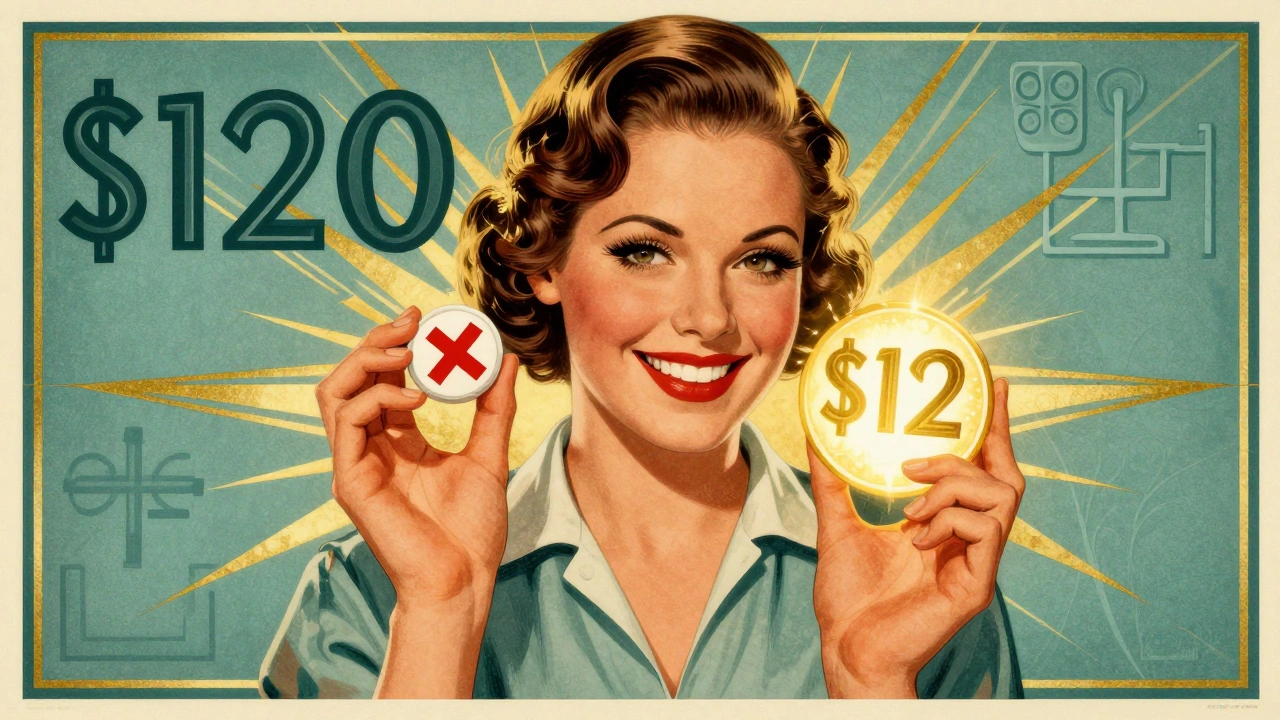
Not all generics are created equal. A 2022 study from JAMA Network Open analyzed over 1,000 generic drugs in Colorado and found 45 high-cost generics that had cheaper alternatives with the exact same clinical effect. These high-cost generics weren’t new or improved-they were just priced higher. On average, they cost 15.6 times more than their lower-cost alternatives. Take a common example: a generic version of a blood pressure pill priced at $120 per month. But there’s another generic version of the same active ingredient, just in a different strength or pill form, that costs $12. That’s a 90% drop in price. No change in how it works. No change in safety. Just a different manufacturer, a different packaging, and a much lower price tag. This isn’t rare. The study found that 62% of these high-cost generics could be swapped out for a different dosage form or strength of the same drug-and those swaps saved patients an average of 95% per prescription. In one case, switching from a branded inhaler to a generic version cut the monthly cost from $334 to $115. That’s $2,628 saved per year, just by switching to a different generic.Combination Drugs: The Hidden Savings Opportunity
Combination drugs-medications that mix two or more active ingredients into one pill-are often marketed as convenient. But convenience doesn’t always mean cheaper. In fact, buying two separate generics can cost far less than the branded combo. Take Advair Diskus, a popular asthma inhaler that combines an inhaled corticosteroid and a long-acting beta agonist. Before generics hit the market, it cost around $334 per inhaler. When Wixela Inhub, the first generic version, arrived, the price dropped to $115. That’s a 66% savings. But here’s the real win: if you bought the two separate generic ingredients (the corticosteroid and the beta agonist) as individual pills, you could have saved even more-sometimes under $50 for a month’s supply. The same pattern shows up in diabetes, heart disease, and arthritis treatments. A combination pill for high blood pressure might cost $150. But buying the two separate generic components (say, lisinopril and hydrochlorothiazide) together costs less than $10. The math is simple: more competition = lower prices. When multiple companies make the same single ingredient, they fight for your business. When only one company makes the combo, they set the price.How Much Are You Really Saving?
The numbers don’t lie. In 2023 alone, the top 10 generic drugs saved the U.S. healthcare system $89.5 billion. That’s not a guess-it’s from the Association for Accessible Medicines. Crestor (rosuvastatin) generics dropped from $5.78 per pill to $0.08. Prilosec (omeprazole) went from $3.31 to $0.05. That’s 98% to 99% savings. But savings aren’t just for big insurers. The Mark Cuban Cost Plus Drug Company analyzed over 843 million prescriptions and found that 11.8% of them had out-of-pocket savings. Uninsured patients saved the most-on average $6.08 per prescription. Even people with Medicare saved $4.64 per fill. That adds up. If you take five prescriptions a month and save $5 on each, that’s $300 a year. Over five years? $1,500. That’s a vacation. Or a new pair of glasses. Or a month’s worth of groceries.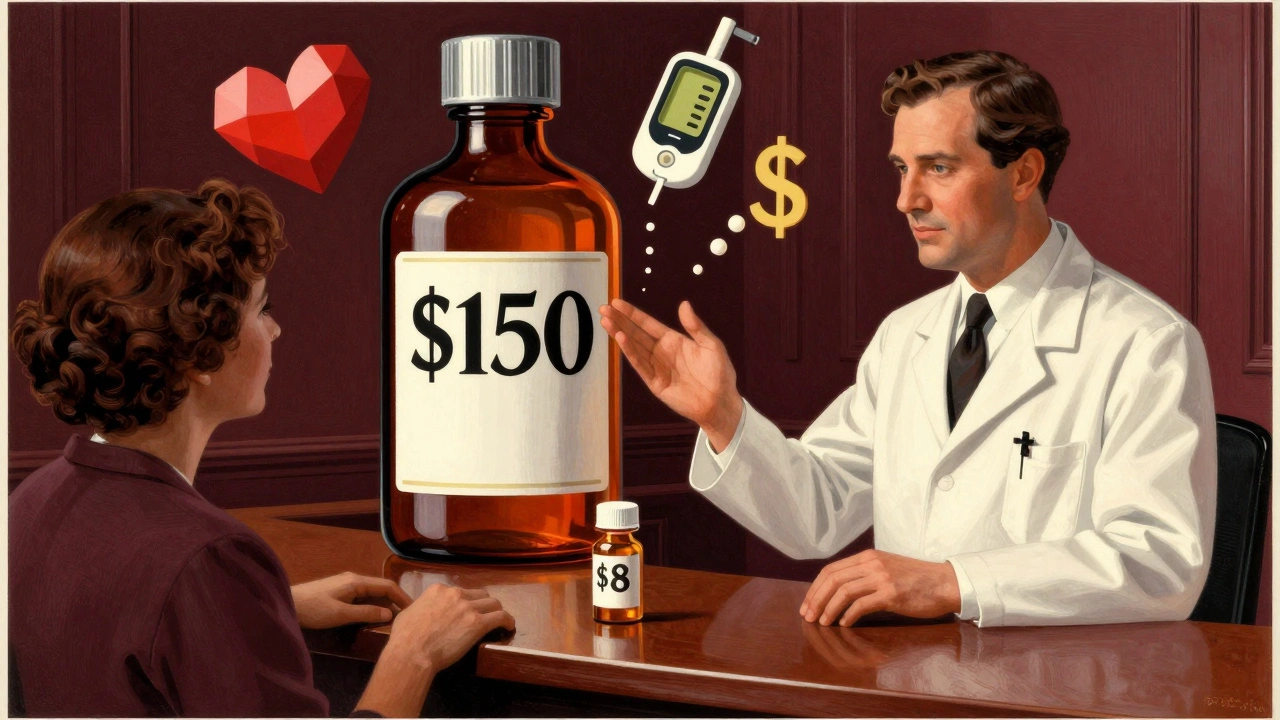
Why Don’t More People Switch?
If the savings are this big, why aren’t we all doing it? One reason: confusion. Pharmacists aren’t always told to suggest alternatives. Doctors don’t always know which generics are overpriced. And patients? Most assume “generic” means “cheap,” so they don’t question the price. Another reason: formulary rules. Insurance plans sometimes lock you into one brand or generic version-even if a cheaper one exists. Pharmacy benefit managers (PBMs) may favor certain manufacturers due to rebates, not savings. That’s why some high-cost generics stay on the market: they’re profitable for the middlemen, not the patient. The FDA’s Orange Book lists which generics are therapeutically equivalent. Look for an “A” rating-that means it’s approved as interchangeable. But you won’t see that on your receipt. You have to ask.What You Can Do Right Now
You don’t need to be a health expert to save money. Here’s how to start today:- Check your last prescription receipt. If you’re paying more than $20 for a common generic (like metformin, levothyroxine, or amlodipine), ask your pharmacist: “Is there a cheaper version of this?”
- For combination drugs, ask: “Can I get the two ingredients separately?” Often, the answer is yes-and it’s cheaper.
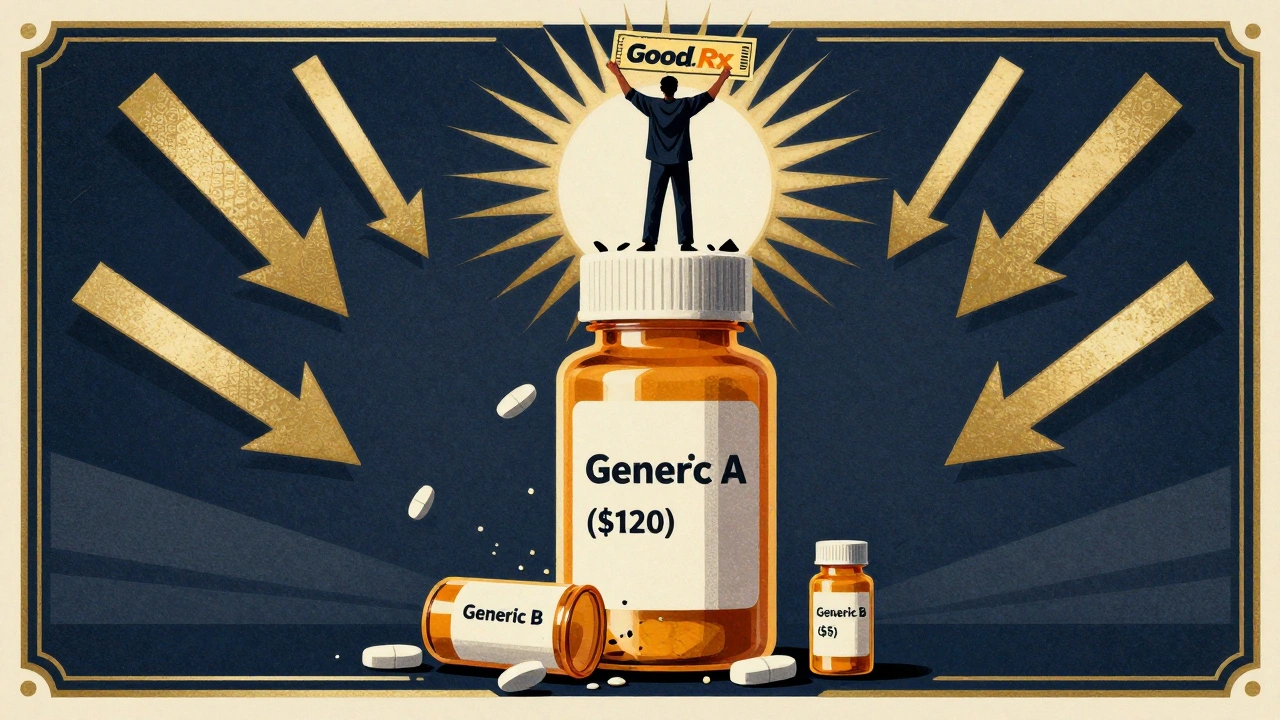
- Use free tools like GoodRx or SingleCare to compare prices across pharmacies. Prices vary wildly-even within the same city.
- Ask your doctor to write “dispense as written” only if you’re sure you want the specific version. Otherwise, leave it open so the pharmacist can choose the lowest-cost equivalent.
- Review your prescriptions every 3-6 months. New generics arrive all the time. What cost $50 last year might now cost $8.
What’s Holding Back Bigger Savings?
The system isn’t broken-it’s just not optimized for patients. Generic drug manufacturing is concentrated in the hands of a few big companies. The top 10 manufacturers control about 40% of the U.S. market. That limits competition. When only one company makes a certain generic, prices stay high. There are also patent tricks. Some brand-name companies pay generic makers to delay launching cheaper versions. That’s called “pay-for-delay,” and it’s legal-until courts step in. And while the FDA approved over 700 generic applications in 2023, that’s down from a peak of 843 in 2017. Fewer approvals mean fewer price drops. Drug shortages are another problem. In 2012, there were 166 generic shortages. By 2022, that number jumped to 258. When supply drops, prices spike-even for generics.What’s Next?
The potential for savings is still huge. Experts estimate that if we fully tapped into therapeutic substitution-swapping high-cost generics for cheaper, equally effective ones-we could save another $1.2 trillion over the next decade. But that won’t happen unless patients, doctors, and insurers work together. You don’t need to fight the system. You just need to ask the right questions. The next time you pick up a prescription, don’t just pay. Ask: Is this the cheapest version? Is there a better way to get the same medicine? That one question could save you hundreds-or even thousands-each year.Are all generic drugs the same price?
No. Two generics with the same active ingredient can cost wildly different amounts. One might be $5, another $100. The price depends on the manufacturer, the pharmacy, and whether the drug is in high demand or low supply. Always compare prices using tools like GoodRx before paying.
Can I ask my pharmacist to switch me to a cheaper generic?
Yes, absolutely. Pharmacists are trained to suggest therapeutically equivalent alternatives. Just say, “Is there a lower-cost version of this medication?” or “Can I get the individual ingredients instead of the combo pill?” Most will help if the switch is safe and approved by your doctor.
Why do some generics cost more than brand-name drugs?
Sometimes, a generic version is priced higher because the manufacturer has little competition, or the drug is in short supply. Other times, insurance formularies or pharmacy benefit managers steer patients toward pricier versions due to rebates-not savings. It’s not common, but it happens. Always check.
What’s the difference between a combination drug and taking two separate generics?
A combination drug puts two medicines in one pill for convenience. But buying the two generics separately often costs less because multiple companies make each individual ingredient, driving prices down. For example, a combo pill for high blood pressure might cost $150, while the two separate generics cost under $10. Always ask your pharmacist if splitting the prescription is an option.
How do I know if a generic is safe and effective?
All FDA-approved generics must meet the same safety and effectiveness standards as brand-name drugs. Look for the “A” rating in the FDA’s Orange Book, which means the generic is therapeutically equivalent. Your pharmacist can tell you if the generic you’re getting has that rating.
Do insurance plans encourage switching to cheaper generics?
Some do, but many don’t. Insurance companies often use formularies that favor certain generics-even if they’re more expensive-because of rebates from manufacturers. If your plan doesn’t cover the cheaper version, ask your doctor to file an exception or appeal. You might be surprised how often it works.
Let me guess - the pharma giants paid off the FDA, the pharmacists, and your damn insurance rep. You think this is about savings? Nah. It’s about control. One company makes the combo pill, another makes the generic, but they’re both owned by the same parent company that also owns your health plan. They want you to think you’re saving money while they just move the money from one pocket to another. I’ve seen it. I’ve documented it. You’re being played.
And don’t even get me started on GoodRx - that’s not a tool, it’s a data farm. They track your searches, sell your prescriptions to the highest bidder, and then the pharmacy charges you more because they know you’re desperate. You think you’re saving? You’re being monetized.
Anyone who believes generics are inherently cheaper hasn’t studied supply chain economics. The cost differential isn’t about manufacturing - it’s about market fragmentation. When multiple manufacturers enter a space, prices collapse. But when a single entity controls distribution via PBMs and formularies, the illusion of competition persists while real savings vanish. This isn’t consumer advocacy - it’s systemic manipulation disguised as empowerment.
And yes, the FDA Orange Book is a joke. Its ‘A’ ratings are based on bioequivalence thresholds so broad they’d allow a sugar pill if it dissolved in 12 minutes instead of 10. You’re not getting cheaper medicine. You’re getting statistically equivalent placebo with a different label.
Hey, I’ve been helping folks in Dublin navigate this for years. It’s not about being a drug expert - it’s about being a smart shopper. I showed my neighbor how to switch from a $90 combo pill to two $4 generics. He cried. Not from sadness - from relief. He’d been paying that for five years.
Pharmacists are usually happy to help if you ask. And yes, GoodRx works. I’ve saved over $2000 in two years just by asking two questions: ‘Is there a cheaper version?’ and ‘Can I split this?’ No magic. Just curiosity.
Don’t let the noise drown out the simple stuff. You’re not fighting the system. You’re just outsmarting it.
Oh wow. A 98% price drop on Crestor? That’s like buying a Ferrari for the price of a bicycle tire. And we’re supposed to be impressed?
Let me tell you what’s really happening. The brand-name company sold the patent rights to a shell corporation in the Caymans, which then licensed it to a generic maker who pays them 40% of every dollar saved. So when you save $50 on your prescription, they pocket $20. The FDA doesn’t regulate greed - they just stamp it with an ‘A’ and call it progress.
Meanwhile, your pharmacist gets a $3 bonus for pushing the pricier version. You think they’re rooting for you? Nah. They’re just doing their KPIs. You’re not a patient. You’re a revenue stream with a pulse.
I came to the US last year and I was shocked - I paid $120 for a month’s supply of levothyroxine. In India, same medicine, same factory, same pill - $2. I cried. Not because I was sad - because I realized how much we’ve been lied to. We think we live in the best country in the world, but our medicine is a luxury. I told my cousin back home and she said, ‘Why do you think they call it ‘generic’? Because it’s not meant for you. It’s meant for the poor. And we’re poor now.’
I don’t hate America. I just hate that we let this happen. And now I check every pill. Every time. I won’t be silent again.
While the empirical data presented in this piece is both compelling and rigorously substantiated by peer-reviewed research from JAMA Network Open and the Association for Accessible Medicines, it is imperative to contextualize these findings within the broader socio-economic architecture of pharmaceutical pricing in the United States. The dissonance between therapeutic equivalence and market pricing reveals a profound misalignment between public health imperatives and profit-driven incentive structures.
Furthermore, the agency of the patient - while nominally empowered through tools like GoodRx - remains structurally constrained by formulary gatekeeping, opaque rebate systems, and the absence of mandatory price transparency protocols. One might argue that the onus of cost mitigation has been unfairly externalized onto the individual consumer, who is expected to become a de facto pharmacoeconomic analyst in lieu of systemic reform.
Thus, while individual behavioral interventions yield measurable, albeit modest, savings, they are ultimately palliative measures in the face of a predatory, oligopolistic market. The real solution lies not in asking pharmacists for alternatives, but in demanding legislative intervention to dismantle rebate secrecy and enforce true price competition.
OMG I just did this yesterday!! 😭 I was paying $110 for my blood pressure combo pill and I asked my pharmacist if I could get the two separate ones and she said YES!! I got lisinopril and HCTZ for $8 total!! I almost screamed in the pharmacy!! 🤯 I told my mom and she’s like ‘Why didn’t you do this years ago?!’ and I was like ‘I thought generics meant same price’ 😅
Now I check every prescription on GoodRx before I pay. Last week I saved $47 on my diabetes med. I’m basically a drug detective now 🕵️♀️✨ I even made a spreadsheet. My friends are like ‘You’re weird’ but I’m like ‘I’m saving $500 a year, what’s your excuse?’ 😎
Also, if you’re on Medicare, ask for a formulary exception - it’s easier than you think. My aunt did it and now pays $5 instead of $80. Life changing. Don’t be shy. Ask. Ask. Ask. 💬💊
This is why America is collapsing. You think you’re saving money by switching generics? You’re just enabling the system. The real problem is that we let corporations own our healthcare. The FDA approves generics but doesn’t regulate pricing. The pharmacy benefit managers are the real villains. They don’t care if you live or die - they care about their quarterly dividends.
And now you’re proud of saving $5 per prescription? Pathetic. That’s a coffee. Not a solution. You’re not a consumer. You’re a victim with a spreadsheet. Meanwhile, the same 10 companies control 40% of the market and they’re laughing at you. You think your GoodRx app is helping? It’s just a distraction. The real fix is nationalizing drug manufacturing. But you? You’re too busy checking prices to see the bigger picture.
Generic prices vary. Sometimes. Ask your pharmacist. GoodRx works. Done.
Just switched my dad’s meds last week. He was paying $130 for a combo pill. Got the two generics for $12. He said, ‘I feel like I just won the lottery.’ 😄
Pharmacist didn’t even blink. Just said, ‘Yeah, that’s a no-brainer.’
Don’t overthink it. Ask. Save. Repeat.
Also - you can get the same pills at Walmart for $4. Seriously. $4. 🤯
Why are Americans so naive? You think this is about savings? It’s about cultural decay. In India, we’ve known for decades that generics are the only way to survive. We don’t need GoodRx. We don’t need PhDs to understand that if two pills have the same chemical name, they’re the same. You people pay $100 for aspirin because you trust brands, not science. This isn’t innovation - it’s ignorance dressed up as consumerism.
And now you’re proud of saving $5? You’re not saving. You’re just catching up to the rest of the world. We’ve been doing this since the 1980s. You’re late. And you’re still surprised.