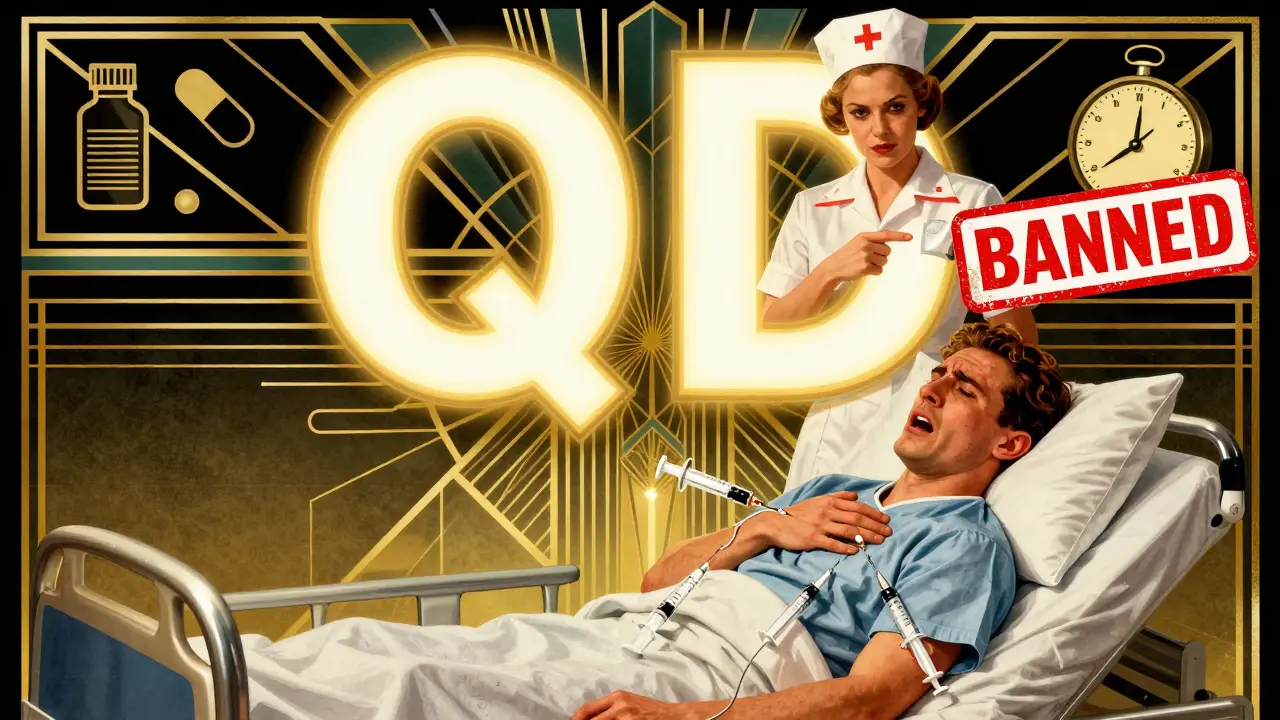
Every year, thousands of patients are harmed because a doctor wrote a shortcut on a prescription - and someone misread it. It’s not a rare mistake. It’s a preventable one. The problem isn’t bad handwriting alone. It’s the use of abbreviations that sound harmless but can kill. Dangerous medical abbreviations are still showing up in prescriptions today - even in digital systems - and the consequences are terrifyingly real.
What’s on the ‘Do Not Use’ List?
In 2001, The Joint Commission and the Institute for Safe Medication Practices (ISMP) created a simple but powerful rule: stop using certain abbreviations. These weren’t chosen randomly. They came from analyzing thousands of medication errors. The list was updated in 2015 and is still active today. Hospitals and clinics must follow it to keep their accreditation. And it’s not optional. If your facility doesn’t enforce it, you risk being cited during inspections.
The most dangerous one? QD. It stands for “once daily,” but it looks too much like “QID” (four times a day). A 2018 study of nearly 5,000 error reports found that QD was involved in over 43% of all abbreviation-related mistakes. Imagine giving a patient a daily dose of blood thinner - and they get it four times a day. That’s not a typo. That’s a life-threatening overdose.
Then there’s QOD - meant to mean “every other day.” But pharmacists often read it as “QD” or “qid.” A patient on a chemotherapy schedule could end up getting treated every day instead of every other day. The side effects? Nausea, bone marrow failure, even death.
And don’t forget BIW. It means “twice a week.” But one pharmacist in 2019 misread it as “twice daily” for a patient on chlorambucil, a cancer drug. The patient received double the intended dose. That’s not speculation. That’s a documented case.
Route of Administration: When ‘SC’ Becomes ‘SL’
Abbreviations for how a drug is given are just as risky. SC (subcutaneous) and SQ (also subcutaneous) are often confused with SL (sublingual). One mistake can mean a drug meant to be injected under the skin ends up dissolving under the tongue - changing how fast it enters the bloodstream.
Even worse: U for “unit.” It looks like a zero, a four, or even the letter “V.” A diabetic patient was once given 100 units of insulin instead of 10 because the “U” was misread as “100.” The patient went into a coma. Another case: IU (international unit) mistaken for IV (intravenous). That’s not just a mix-up. It’s a route error that can cause immediate, severe reactions.
And then there’s cc - cubic centimeters. Sounds harmless, right? But it’s often confused with “U” (units). In 2022, a pharmacist caught a prescription for 5 cc of a medication - but the doctor meant 5 units. The patient could’ve received 100 times the dose. That’s why mL (milliliters) is now the only acceptable term.
Drug Names That Can Kill
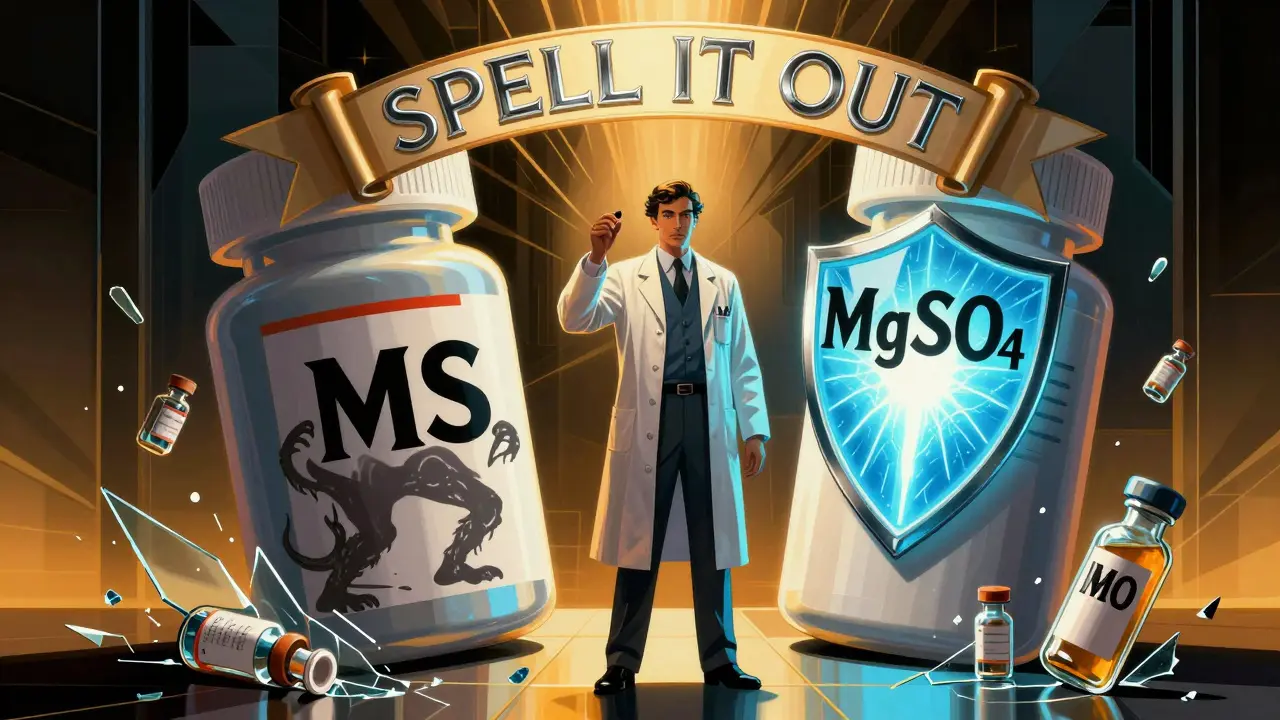
Some drug abbreviations are deadly because they sound alike. MS or MSO4 means morphine sulfate. But it’s easily confused with MgSO4 - magnesium sulfate. One is a powerful painkiller. The other is used for seizures and preeclampsia. Mix them up? You’re giving a patient a drug that stops breathing - instead of one that relieves pain.
Then there’s AZT. It stands for zidovudine, an HIV drug. But some prescribers write it without context. Pharmacists have mistaken it for azathioprine (an immune suppressant) or aztreonam (an antibiotic). Each drug has wildly different uses. Giving the wrong one could mean a patient’s HIV isn’t treated - or they get an immune reaction they didn’t need.
TAC is another trap. It means triamcinolone, a steroid cream. But when handwritten poorly, it looks like Tazorac, a different acne treatment. A patient with eczema got Tazorac instead - and suffered severe skin irritation. No one meant to harm them. But the abbreviation did.
And DTO - diluted tincture of opium - was confused with morphine sulfate in a 2019 report. Both are opioids. But dosing is different. The patient got too much. That’s how a simple scribble turns into a tragedy.
Why Do These Still Happen?
You’d think EHRs (electronic health records) would have fixed this. They’ve cut abbreviation errors by nearly 70%. But 12.7% of errors still happen - because doctors still type free-text notes. A nurse once entered “MS 10 mg SC” into the system. The computer didn’t flag it. The pharmacist caught it - just in time. But not everyone is that lucky.
Old habits die hard. A 2022 survey found that 43.7% of physicians over age 50 still use banned abbreviations. They learned them in medical school decades ago. “It’s faster,” they say. But speed doesn’t matter if the patient dies.
And it’s not just doctors. Nurses, pharmacists, and even patients have been caught in these traps. A Reddit thread from 2022 titled “Caught a potentially fatal abbreviation error today” had 87% of comments sharing similar stories. One pharmacist wrote: “I once stopped an order for ‘QD’ on a high-risk drug. The prescriber didn’t even know it was banned.”
How Facilities Are Fighting Back
Successful hospitals don’t just post a policy. They build systems. Mayo Clinic cut abbreviation errors by 92% using three things: hard stops in the EHR (the system won’t let you submit if you type “QD”), mandatory training for every clinician, and real-time feedback when someone tries to use a banned term.
It costs money - $12,500 to $28,000 for a mid-sized facility - but it saves far more. The Agency for Healthcare Research and Quality estimates that fixing this one issue prevents $1.27 billion in annual costs from hospital stays, lawsuits, and lost productivity.
Some places use AI now. Epic Systems rolled out a tool in 2023 that auto-detects dangerous abbreviations during voice dictation. If you say “MS,” it pops up: “Did you mean morphine sulfate or magnesium sulfate?” That’s not science fiction. It’s happening now.

What You Need to Do
If you’re a prescriber: Stop using these. Period. Replace “QD” with “daily.” Replace “QOD” with “every other day.” Use “mL,” not “cc.” Spell out “units.” Write out “morphine sulfate,” not “MS.”
If you’re a pharmacist: Don’t guess. If you see an abbreviation you’re unsure of - call the prescriber. Don’t assume. Don’t interpret. Ask.
If you’re a patient: Ask. If your prescription says “QD,” ask what it means. If it says “U,” ask if it’s units. Knowledge is your safety net.
The truth? We’ve known the solutions for over 20 years. The problem isn’t technology. It’s culture. Changing how we write is harder than writing the rules. But every time you skip the shortcut, you’re saving a life.
What are the most dangerous medical abbreviations?
The most dangerous include QD (mistaken for QID), U (confused with zero or IV), MS (confused with MgSO4), and cc (mistaken for units). These abbreviations have caused fatal overdoses, incorrect drug administration, and treatment delays. The Joint Commission and ISMP list these as prohibited because they’re the most commonly misread.
Why is QD so dangerous on prescriptions?
QD stands for “once daily,” but it looks too similar to QID (four times daily). In handwritten orders, the “D” can be misread as an “I,” turning a safe daily dose into a dangerous four-times-daily dose. A 2018 analysis of nearly 5,000 medication errors found QD was involved in over 43% of abbreviation-related mistakes - making it the single most dangerous abbreviation.
Is it still okay to use ‘cc’ for cubic centimeters?
No. ‘cc’ is banned because it’s easily confused with ‘U’ (units). A prescription for 5 cc of insulin could be read as 5 units - or 500 units. That’s a 100-fold error. The only acceptable term is ‘mL’ (milliliters). All accredited healthcare facilities now require mL for liquid dosing.
How do electronic health records help prevent these errors?
EHRs reduce abbreviation errors by about 68% by eliminating handwriting and adding alerts. Many systems now have hard stops - if you type ‘QD’ or ‘U,’ the system blocks the order and forces you to spell it out. Some even auto-correct during voice dictation. But they’re not foolproof. Free-text fields and old habits still cause mistakes.
Are these rules enforced everywhere?
Yes, in accredited hospitals and clinics in the U.S. The Joint Commission requires facilities to follow the ‘Do Not Use’ list as a condition of accreditation. Non-compliance can lead to citations or loss of accreditation. However, enforcement is weaker in outpatient clinics and long-term care settings, where 63.8% of outpatient medication errors still involve banned abbreviations as of 2023.
What’s Changing in 2026?
The ISMP updated its list in January 2024, adding 17 new abbreviations related to HIV drugs - like DOR, TAF, and TDF. Why? Because errors involving these rose 227% between 2019 and 2023. These drugs are complex. Their abbreviations are similar. And in outpatient settings, where prescriptions are often handled by pharmacists without direct access to the prescriber, confusion is deadly.
By 2026, most major EHR systems will auto-correct prohibited abbreviations during voice dictation. That means if a doctor says “MS,” the system will ask: “Did you mean morphine sulfate or magnesium sulfate?” This isn’t a future dream - it’s already rolling out in 72% of U.S. hospitals.
The message is clear: If you’re still using these shortcuts, you’re not just being lazy. You’re risking lives. The fix isn’t complicated. It’s simple: spell it out. Always.
I've seen this firsthand. My grandma almost died because her script said 'QD' for her blood thinner. Pharmacist caught it, but the doctor just shrugged. We need hard stops in EHRs. No exceptions. Lives aren't optional.
why do u even write 'cc' anymore?? its 2025. its mL. always. i had a coworker who wrote 'U' for units and almost killed someone. she said 'it was just a dot'. like???
Let me tell you something real - this isn’t about bureaucracy. This is about humanity. Every time someone writes 'QOD' instead of 'every other day,' they’re gambling with a stranger’s life. And you know what? That stranger could be your sister. Your dad. Your best friend. We don’t need more policies. We need more courage to say: 'I’m not cutting corners.'
I mean, honestly, if you can't spell out 'morphine sulfate' instead of 'MS', maybe you shouldn't be prescribing. I work in a hospital and I swear half the docs are still using 'BIW' like it's 1998. It's not laziness. It's arrogance.
lol. so we're blaming doctors for being human? next they'll ban 'etc.' and 'i.e.' too. i mean, come on. it's not like these are rocket science. unless you're a bot, you know what 'U' means.
this is all part of the WHO global mind control program. they want us to use full words so they can track every prescription. also, EHRs are linked to the CIA. if you type 'mL' instead of 'cc', they log your IP. 🤐
I cried when I read this. Truly. I’ve sat in a hospital room while a child’s heart stopped because a nurse thought 'MS' meant magnesium sulfate. It wasn’t a mistake. It was a systemic failure. And now? We’re still letting it happen. This isn’t healthcare. It’s a casino with white coats.
why do americans make everything so complicated? in india we just say 'daily' or 'twice'. no 'QD' no 'mL'. simple. if you can't understand 'daily' then you shouldn't be a doctor. problem solved.
As someone who works in a Canadian hospital, I can confirm that the implementation of hard stops and mandatory training has reduced our error rate by over 85%. It’s not about blame - it’s about design. Systems should protect people, not rely on their perfection.
I disagree. There’s no evidence that spelling out 'every other day' reduces errors. In fact, longer text increases cognitive load. Abbreviations are efficient. The real problem? Poor training. Not the abbreviations.
QD is dangerous. End of story.
Bro. I work in an ER. Last week, a guy came in with a prescription that said 'MS 10mg'. I called the doc. He said 'oh yeah, that's morphine'. I said 'cool, but you wrote MS'. He said 'yeah, that's what I always write'. I had to write 'morphine sulfate' on his face. Literally. I printed a sticky note and stuck it on his scrubs. He laughed. We almost lost a patient because of a two-letter shortcut. We need to stop being cool about this.
this is why america is failing. too much paperwork. too many rules. in india we trust doctors. if they write 'QD' they know what they mean. stop overthinking. doctors are not idiots. you are making them look bad.
i work at a hospital and we still use 'cc' because its easier. also 'U' is fine. if your pharmacist cant read it, they need better glasses. i had a patient die last year. it wasnt the abbreviation. it was the meds. the system is broken. not the shorthand.
i used to be a nurse. we had this one doc who wrote 'QOD' every time. never got caught. never got in trouble. never made a mistake. so why change? sometimes old ways work better. no need to overcomplicate.