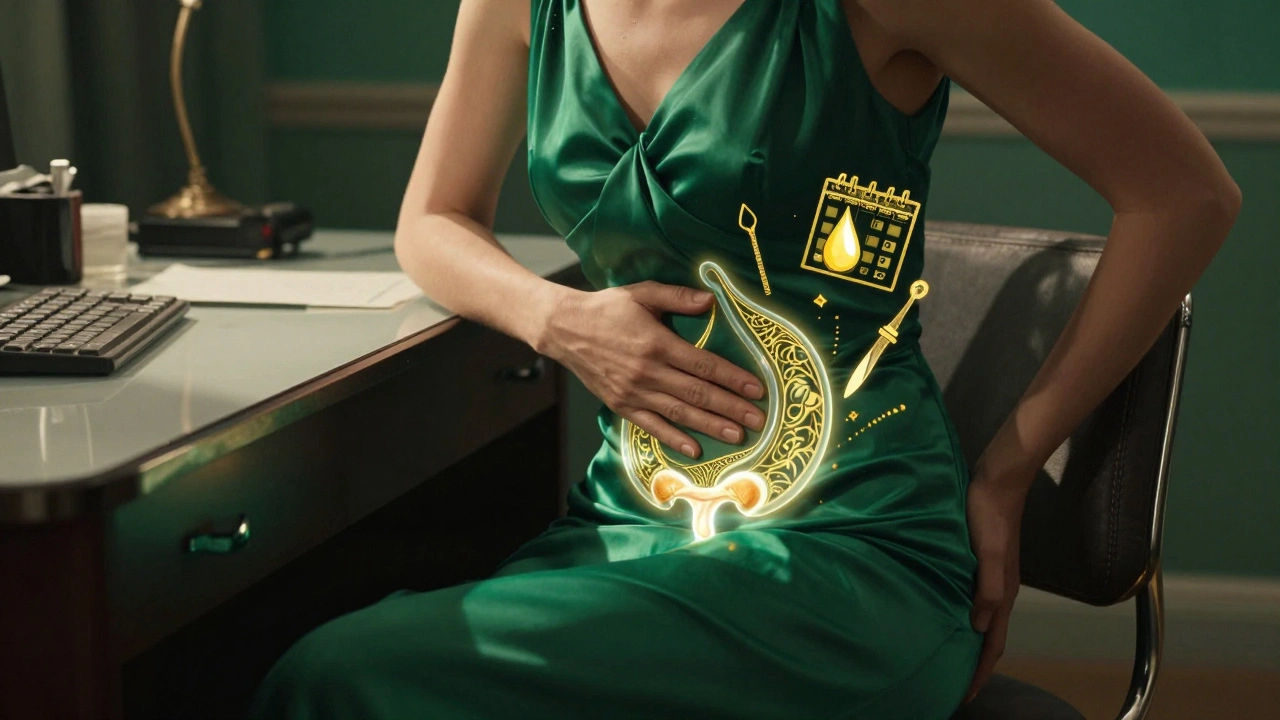
For many women, pelvic pain isn’t just a bad day-it’s a daily battle. It shows up when you’re trying to sleep, during sex, while peeing, or even sitting at your desk. Two conditions, endometriosis and interstitial cystitis, are often behind this suffering-and they’re frequently mistaken for each other. Worse, many women wait years before getting the right diagnosis. If you’ve been told it’s ‘just stress’ or ‘a UTI that won’t go away,’ you’re not alone. This isn’t normal. And it doesn’t have to be this hard.
What Endometriosis Really Feels Like
Endometriosis happens when tissue similar to the lining of your uterus grows outside it-on your ovaries, fallopian tubes, bowel, or even your bladder. It doesn’t just cause cramps. It causes deep, burning, stabbing pain that often gets worse around your period. About 92% of women with endometriosis report cyclical pain tied to their menstrual cycle. Some describe it as feeling like their insides are being torn apart. Others say it feels like a constant pressure, especially during bowel movements or sex. The pain doesn’t always match the severity of the disease. A woman with stage I endometriosis can have worse pain than someone with stage IV. That’s why relying on pain levels alone to judge the condition doesn’t work. The only way to confirm endometriosis is through laparoscopic surgery, where a surgeon removes tissue samples for testing. This isn’t a simple procedure-it costs between $5,000 and $15,000 in the U.S., requires general anesthesia, and takes 2 to 4 weeks to recover from. But without it, you’re flying blind. Bladder endometriosis affects 1 to 12% of people with the condition. When it happens, you might notice blood in your urine during your period, pain when your bladder fills, or sudden urges to pee. These symptoms look exactly like interstitial cystitis-which is why so many women get misdiagnosed.What Interstitial Cystitis Actually Is
Interstitial cystitis (IC), also called painful bladder syndrome, is a chronic condition where the bladder wall becomes inflamed, leading to pain, pressure, and urinary urgency. Unlike a urinary tract infection, there’s no bacteria to kill. No antibiotics will help. The bladder becomes hypersensitive, and even small amounts of urine trigger sharp pain. Most women with IC feel the need to pee more than 7 times a day-and sometimes up to 60 times. The pain doesn’t follow your cycle like endometriosis. It’s usually constant, though it can flare up around your period. About 45% of IC patients say their symptoms get worse during menstruation, but they don’t disappear afterward. A key sign is pain when your bladder fills, and relief after you empty it. Many women describe it as a burning, aching, or pressure sensation deep in the pelvis. Diagnosing IC is tricky. There’s no blood test, no scan, no single marker. Doctors have to rule out everything else first-UTIs, bladder cancer, sexually transmitted infections, kidney stones. The process can take months. A cystoscopy (a scope inserted into the bladder) is often used, and sometimes a potassium sensitivity test (PST), which checks how your bladder reacts to a potassium solution. If it hurts badly, it’s a sign of IC. But even the PST has a 20% false negative rate. That means one in five people with IC are told they’re fine.Why These Two Conditions Are So Often Confused
Endometriosis and IC share nearly every symptom: pelvic pain, painful urination, frequent urination, pain during sex, and discomfort during bowel movements. In fact, a landmark 2011 study of 178 women with chronic pelvic pain found that 65% had both conditions at the same time. That’s not coincidence. It’s a pattern. Many doctors still treat them as separate problems. They diagnose one, treat it, and if the pain comes back, they assume the first diagnosis was wrong. But what if both are present? That’s what’s happening to so many women. Dr. Tamer Seckin, a leading endometriosis specialist, says: ‘It is not possible to confirm interstitial cystitis without first excluding endometriosis.’ One major clue? Blood in the urine. If you see red or pink in your urine during your period, it’s far more likely to be bladder endometriosis than IC. Pure IC rarely causes bleeding. Another clue? Pain that worsens predictably with your cycle. If your pain spikes right before your period and fades after, endometriosis is likely playing a role. And here’s the hard truth: up to 80% of women diagnosed with IC actually have undiagnosed endometriosis, according to Dr. Robert Moldwin, a urology professor. That means thousands of women are being treated for the wrong thing-while the real cause keeps growing.
What Happens When You’re Misdiagnosed
Getting the wrong diagnosis doesn’t just waste time-it causes real harm. Women with IC are often prescribed antibiotics for supposed ‘recurrent UTIs.’ One survey found that 41% of women with endometriosis were given antibiotics an average of 5.3 times before their real diagnosis. Antibiotics don’t fix endometriosis. They just delay the truth. And then there’s the emotional toll. A 2023 survey of 850 IC patients found that 76% were told their pain was ‘all in their head.’ One Reddit user, u/PelvicPainWarrior, waited nine years for a correct diagnosis. She was told she had IC, took medications that made her sick, and only found relief after a laparoscopy revealed stage IV endometriosis on her bladder wall. After surgery, her urinary symptoms improved by 80%. Pelvic floor dysfunction is another hidden player. Research shows that 92% of women with either condition have tight, painful pelvic floor muscles. This isn’t just a side effect-it’s part of the problem. Tight muscles can mimic bladder pain, worsen urinary urgency, and make sex unbearable. Physical therapy focused on pelvic floor relaxation can help-but only if the root cause is identified first.How to Get the Right Diagnosis
If you’ve had pelvic pain for more than six months, it’s time to push for a full evaluation. Here’s what to ask for:- A detailed medical history and voiding diary (track how often you pee, how much, and when it hurts)
- A pelvic exam by a specialist trained in endometriosis
- Urine tests to rule out infection
- A cystoscopy with biopsy if bladder symptoms are present
- Laparoscopic surgery with deep excision if endometriosis is suspected-even if imaging looks normal
- A referral to a urogynecologist or endometriosis specialist
This is the kind of post that makes me want to hug every woman who’s been told it’s ‘just stress.’ You’re not broken. You’re not crazy. You’re just not being heard. Keep fighting. You deserve better.
I spent 7 years getting told I had anxiety. Then I got diagnosed with endometriosis AND IC. The moment my surgeon cut out the lesions on my bladder? I cried for 20 minutes. I could finally sit down without pain. This isn’t normal. It’s not in your head. I’m so glad this exists.
So… we’re supposed to just get surgery on a $15k gamble because doctors can’t be bothered to learn? And then pay for PT? And then hope the meds don’t blind you? Wow. Just… wow.
This is why America sucks. You need to be rich to not be in pain? I mean, come on. I got my wife to a doc who said ‘drink more water’ and sent her home. Now she’s on disability. This system is broken.
I’m from Australia and we’ve got a decent public system, but even here, endometriosis diagnosis takes an average of 8 years. It’s not just an American problem-it’s a global failure of medical education. We need mandatory training in pelvic pain syndromes for all med students.
Did you know the FDA knew Elmiron caused retinal damage since 2018? They didn’t warn patients. Big Pharma doesn’t want you to know the truth. They profit off chronic pain. This isn’t medicine-it’s a money scheme. #CoverUp
The assertion that endometriosis is frequently misdiagnosed as interstitial cystitis is not substantiated by longitudinal cohort studies. While symptom overlap exists, the pathophysiological mechanisms are distinct. To conflate the two is to undermine evidence-based diagnostics. One must exercise epistemological caution before advocating for invasive surgical intervention as a first-line approach.
Life is suffering. Pain is just the universe reminding us we’re alive. Maybe the answer isn’t surgery… maybe it’s meditation. Or acceptance. Or karma. 🤔🙏
LMAO they say ‘laparoscopy’ like it’s magic. I got mine done and they just cut stuff out and said ‘all good.’ I still hurt. Turns out they missed half the lesions. These docs are just fancy butchers. 😒💀
It is imperative to recognize that the diagnostic pathway for chronic pelvic pain must be multidisciplinary and patient-centered. The conflation of endometriosis and interstitial cystitis, while clinically common, necessitates a structured algorithm that includes imaging, biomarker screening, and surgical confirmation-preferably within a specialized pelvic pain center. Delayed diagnosis correlates strongly with increased psychological morbidity and diminished quality of life.
I had a cystoscopy and the doc was like, ‘Your bladder’s screaming.’ I was like, ‘Yeah, it’s been screaming for 5 years.’ Then he gave me a pamphlet on ‘bladder retraining.’ I almost threw the chair at him. 🤬🪑
I’m not even gonna lie. I thought I was the only one. I’ve had to cancel 3 weddings, 2 vacations, and my sister’s baby shower because I couldn’t sit through it. I had to wear adult diapers to work. And now I’m being told to ‘just drink more water’? I’m not just in pain-I’m being erased.
I’ve been doing pelvic floor PT for 11 months. It’s not glamorous. It’s not quick. But I can finally sit on the toilet without crying. If you’re reading this and you’re struggling-please, don’t give up. Find a good PT. Even if it costs everything. You’re worth it.
I just got my laparoscopy results. Stage IV. On my bladder. My doc said ‘we got it all.’ But I still have to pee every 20 mins. I’m so mad. Why didn’t they check for both? Why didn’t anyone listen? 😭
You’re not alone. 🫂 I’m here. I’ve been there. Surgery saved me. PT saved me. You’re not broken. You’re just waiting for the right person to see you. Keep going. You got this. 💪❤️