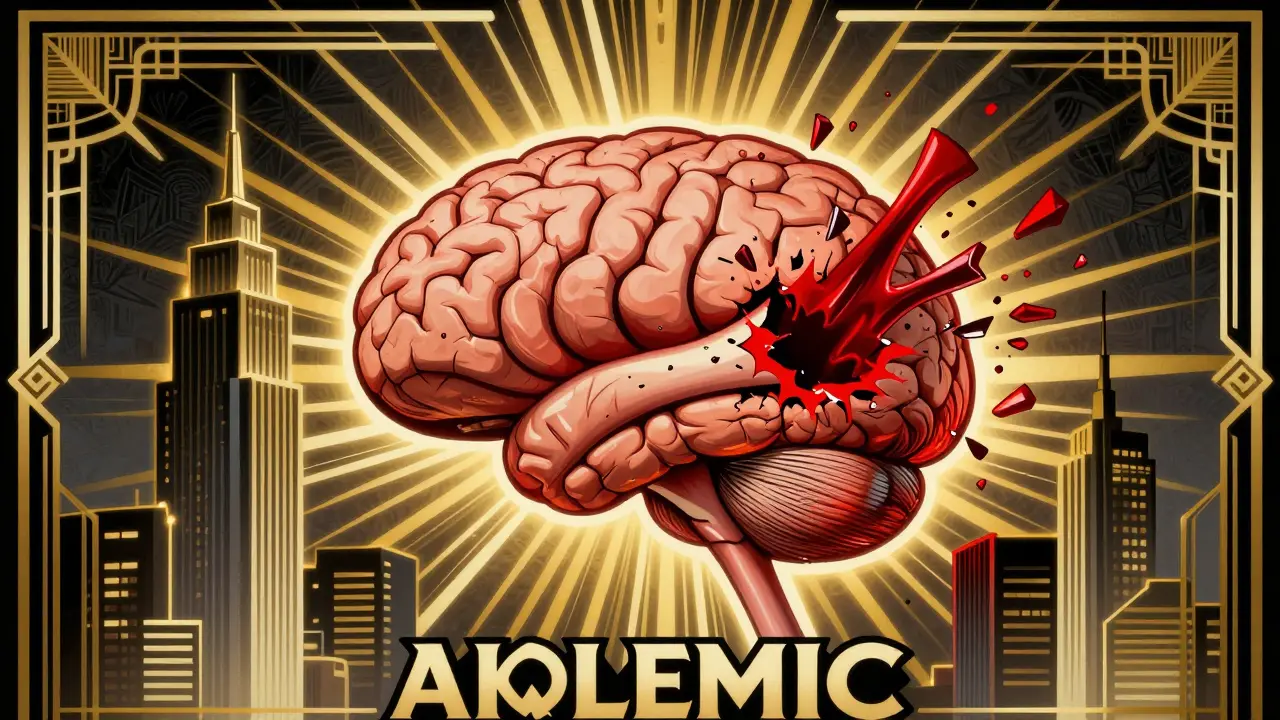
When someone has a stroke, every second counts. But not all strokes are the same. Two main types - ischemic and hemorrhagic - behave differently, need different treatments, and come from different causes. Knowing the difference isn’t just medical jargon. It’s the key to surviving one.
What Happens During an Ischemic Stroke?
Imagine your brain as a city. Every part needs constant power. When a blood vessel gets blocked, that power cuts off. That’s an ischemic stroke - and it’s the most common kind, making up about 87% of all strokes.
This blockage usually comes from a clot. Sometimes, the clot forms right in a brain artery, often because of fatty buildup (atherosclerosis). This is called a thrombotic stroke and accounts for half of all ischemic cases. Other times, the clot forms in the heart or neck, breaks loose, and travels to the brain. That’s an embolic stroke, responsible for about 20% of ischemic strokes.
Then there’s the mystery kind - cryptogenic stroke. About 30% of ischemic strokes have no clear cause, even after full testing. These are especially tricky because prevention becomes harder without knowing why it happened.
Symptoms don’t always hit like a siren. They often creep in. Numbness on one side of the face or arm. Trouble finding words. Vision blurring. These can start slowly, over minutes or even hours. Many people ignore them, thinking it’s just fatigue or a migraine. But that delay can cost brain cells.
What Happens During a Hemorrhagic Stroke?
While ischemic strokes are about blockage, hemorrhagic strokes are about rupture. A blood vessel in or around the brain bursts, and blood floods into brain tissue. This is far less common - only 13-15% of strokes - but often more deadly.
Two main types exist. Intracerebral hemorrhage (ICH) happens when a vessel inside the brain bursts. About 8-10% of all strokes are this kind. Subarachnoid hemorrhage (SAH) is when bleeding happens on the brain’s surface, usually from a ruptured aneurysm. That’s about 5% of strokes.
The warning signs are harder to ignore. A hemorrhagic stroke often hits like a thunderclap. People describe it as the worst headache of their life - sudden, explosive, unlike anything before. It’s common to lose consciousness right away. Other signs include a stiff neck, vomiting, seizures, or one pupil becoming larger than the other. A 2017 study of over 500 stroke patients showed 92% of hemorrhagic cases had severe headaches, compared to just 19% in ischemic strokes.
Why does this happen? High blood pressure is the biggest culprit. In fact, 78-88% of intracerebral hemorrhages are caused by long-term, uncontrolled hypertension. It weakens vessel walls over time until they burst. Other causes include aneurysms, trauma, or rare blood disorders.
How Are They Treated Differently?
You can’t treat both the same way. Giving a clot-busting drug to someone with bleeding in the brain would be dangerous - even deadly.
For ischemic strokes, time is brain. If you get to the hospital within 3 to 4.5 hours of symptom start, doctors can give a drug called tPA (alteplase) or tenecteplase. These dissolve the clot. For larger clots in major brain arteries, a mechanical thrombectomy can remove the blockage - even up to 24 hours after symptoms begin. Studies show this can save lives and reduce long-term disability.
Hemorrhagic strokes don’t respond to clot-busters. Instead, doctors focus on stopping the bleeding and reducing pressure in the skull. This might mean surgery - like placing clips on an aneurysm or using coils to seal it off from inside the artery. In some cases, minimally invasive techniques, like draining blood with a small tube and clot-dissolving agents, have lowered death rates by 10% over standard care.
CT scans are the first step in every stroke case. They show quickly whether there’s bleeding or not. That’s why every hospital with stroke care must have a CT scanner ready 24/7. Newer tools like MRI and AI systems are helping too. One AI tool used in over 1,200 hospitals cuts the time to give tPA by more than 50 minutes.
What Are the Real Warning Signs?
You’ve probably heard FAST: Face drooping, Arm weakness, Speech difficulty, Time to call emergency services. That’s still the best rule. But hemorrhagic strokes can have extra signs:
- Sudden, severe headache - unlike anything you’ve ever felt
- Loss of consciousness
- Nausea or vomiting
- Seizures
- Dilated or unequal pupils
- Stiff neck
Ischemic strokes are more subtle. People often say, “I just felt off.” Or, “My hand went numb, but I thought I slept on it wrong.” That’s dangerous. If you notice any of these - even if they go away - call emergency services. Transient ischemic attacks (TIAs), or mini-strokes, are major red flags. Up to 1 in 3 people who have a TIA will have a full stroke within a year if not treated.
How to Prevent Stroke - Type by Type
Prevention isn’t one-size-fits-all. What stops one kind of stroke might not help the other.
For ischemic stroke:
- If you have atrial fibrillation (AFib), take blood thinners. Warfarin or newer drugs like apixaban reduce stroke risk by 60-70%. Not taking them is one of the biggest preventable causes of stroke.
- Take daily aspirin or clopidogrel if you’ve had a prior stroke or TIA. This cuts your risk of another by 25%.
- Control cholesterol. High LDL feeds plaque buildup in arteries.
- Manage diabetes. High blood sugar damages blood vessels over time.
For hemorrhagic stroke:
- Lower your blood pressure. The SPRINT trial proved that keeping systolic pressure below 120 mmHg - not just under 140 - cuts hemorrhagic stroke risk by 38% in high-risk people.
- Don’t smoke. Smoking doubles stroke risk. Quitting cuts it in half within a year.
- Avoid excessive alcohol. Heavy drinking raises blood pressure and weakens vessel walls.
- Treat aneurysms. If you know you have one, talk to a neurosurgeon. Not all need surgery, but some can be safely clipped or coiled before they burst.
Both types benefit from:
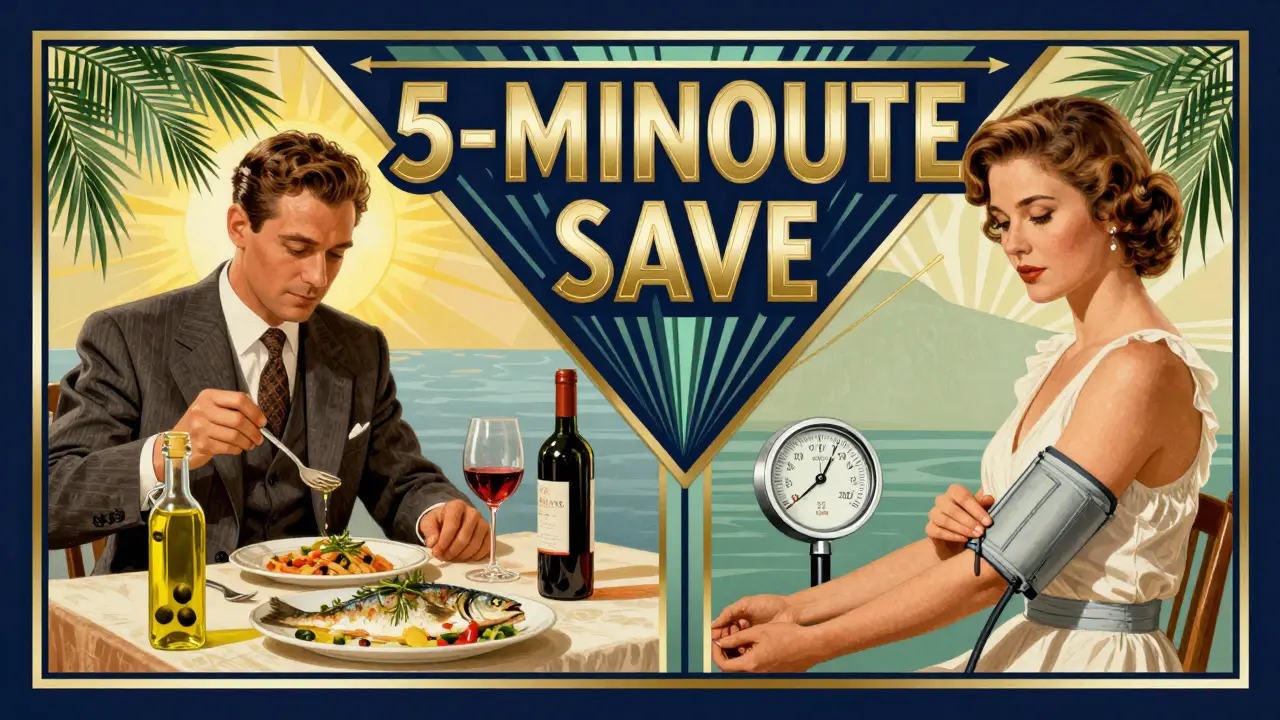
- The Mediterranean diet - rich in olive oil, fish, nuts, vegetables. The PREDIMED study showed a 30% drop in stroke risk.
- Regular exercise - 150 minutes a week of brisk walking or cycling reduces overall stroke risk by 27%.
- Maintaining a healthy weight. Obesity increases stroke risk by 40%.
Why Early Action Saves Lives
Patients who recognize symptoms and call for help within 5 minutes have 73% better outcomes. That’s not a guess - it’s from real data from stroke survivors.
Too many people wait. They think, “I’ll rest it off.” Or, “It’s probably just stress.” But stroke doesn’t wait. Brain cells die at 1.9 million per minute. By the time you reach the hospital, you may have already lost millions.
Younger people are especially at risk of misdiagnosis. A 32-year-old with dizziness and slurred speech might be sent home with a diagnosis of anxiety. But strokes are rising in people under 50. Don’t let age fool you.
Telestroke networks are changing this. In rural areas, a doctor can review brain scans remotely within minutes. Since 2018, access to stroke specialists in remote regions has jumped 300%. That means faster treatment - even far from big hospitals.
What’s Next in Stroke Care?
Science is moving fast. A blood test that can tell if a stroke is ischemic or hemorrhagic in 15 minutes is already in trials. It looks for a protein called GFAP - and it’s 92% accurate. Imagine an ambulance driver using this before even reaching the hospital.
MRI-guided treatment is expanding. The WAKE-UP trial showed that some ischemic stroke patients can be treated up to 9 hours after symptoms start - if imaging shows brain tissue is still salvageable. This could help 1 in 5 more people.
For hemorrhagic strokes, new surgical tools are making procedures safer. Instead of opening the skull, doctors can now insert tiny devices to drain blood and stop bleeding with less damage.
But the biggest change isn’t high-tech. It’s awareness. More people know the signs. More EMS teams are trained. More hospitals are certified as stroke centers. And that’s saving lives.
Can you have a stroke and not know it?
Yes. Silent strokes - often small ischemic events - happen without obvious symptoms. They’re usually found on brain scans done for other reasons. But they still damage brain tissue and increase the risk of future, more serious strokes. If you have high blood pressure, diabetes, or AFib, regular check-ups are key.
Is stroke only a problem for older people?
No. While stroke risk increases with age, about 1 in 4 strokes now happen in people under 55. Rising rates of obesity, diabetes, and high blood pressure in younger populations are driving this trend. Younger stroke survivors often face longer recovery times and major life disruptions - like losing a job or ability to care for children.
Can lifestyle changes reverse stroke risk?
Absolutely. Quitting smoking cuts stroke risk in half within a year. Lowering blood pressure to under 120 systolic reduces hemorrhagic stroke risk by nearly 40%. Eating well and moving more can cut overall stroke risk by a third. You don’t need perfection - just consistent, smart choices.
What should I do if I suspect someone is having a stroke?
Call emergency services immediately. Don’t wait. Don’t drive them yourself. Don’t give them aspirin or food. Just call. While waiting, note the time symptoms started. This helps doctors decide on treatment. If you’re unsure, use the FAST test: ask them to smile (face drooping?), raise both arms (one arm drops?), say a simple sentence (slurred or strange?), and act fast.
Do all stroke patients recover fully?
No. Recovery depends on how much brain tissue was damaged, how fast treatment started, and the person’s overall health. About 1 in 3 stroke survivors need long-term care. But with rehab - physical therapy, speech therapy, occupational therapy - many regain independence. Early action gives the best chance for recovery.
Look, I don't care what some fancy study says - if you're having a stroke and you're not calling 911 right away, you're just being dumb. I've seen people sit there for an hour thinking it's 'just a headache.' Bro, your brain is dying. 1.9 million neurons per minute? That's like losing a whole city block of neurons every time you check your phone. Stop waiting for it to 'go away.' Just call. It's not that hard.
bro i had a tia last year and i thought it was just my coffee being too strong 😅
then i woke up with my left arm numb and my speech all slurry
called 911 bc my roommate screamed at me
turns out i had a tiny clot in my carotid
now i take that baby aspirin like it's my job
ps: if you're young and think 'it won't happen to me' - i was 28 🫠
From India, I want to say - we’re waking up to this. In my village, people used to say stroke was 'God's will.' Now? My cousin’s uncle had a hemorrhagic stroke last year. He survived because his daughter recognized the headache and rushed him. We’ve started community awareness drives - yoga, blood pressure checks, even street plays about FAST. Change starts small. You don’t need a hospital to save a life - just someone who cares enough to act.
And yes, the Mediterranean diet? We’ve had it for centuries - olive oil, lentils, greens, no processed junk. It’s not 'trendy,' it’s just smart living.
Really solid breakdown. I appreciate how you separated prevention by type - most people just say 'eat healthy' and call it a day. But the difference between managing AFib with anticoagulants vs. dropping BP to 120? That’s life-or-death nuance. Also, love the mention of telestroke. Rural access is still a massive gap in the US. If we can get AI-assisted triage into ambulances, we’re talking about cutting delays from 90 minutes to 20. That’s huge.
Clarity is overrated. The real issue? Healthcare systems prioritize profit over prevention. Why are we waiting for strokes to happen before we act? Because fixing hypertension is cheaper than treating stroke. And no one gets rich off a blood pressure monitor.
Let’s deconstruct this. The 87% ischemic stat? That’s misleading without context. It’s not that ischemic is 'more common' - it’s that we’re better at detecting microinfarcts now. Silent strokes were invisible 20 years ago. Now we see them on MRI like it’s nothing. So is the incidence rising… or are we just better at seeing it? Also - tPA? It’s a gamble. 6% symptomatic hemorrhage rate. That’s not 'saving lives' - that’s trading one risk for another. We need better biomarkers. GFAP is a start, but it’s still reactive. We need predictive.
I work in a hospital ER and I see this every shift. People wait. They wait because they’re scared. They wait because they don’t want to be 'that person' who overreacted. But here’s the thing - you can’t overreact to a stroke. Even if it goes away. Even if you feel fine five minutes later. I had a 34-year-old come in last month with dizziness and a weird tingling. She thought she was 'just tired.' Turned out it was a TIA. She’s back at work now. But if she’d waited another hour? She might not have been. Don’t be the person who regrets waiting.
OMG this post saved me 😭
i thought my mom’s 'bad headache' was just migraines
she’s 62, had high bp but didn’t take meds
we took her to the ER bc i remembered the 'worst headache of my life' line
turns out it was SAH from an aneurysm
they coiled it in time and she’s home now
she’s on meds, drinking water, and walking every day
thank you for writing this - i’m telling everyone i know
One thing I wish more people understood: stroke isn’t just a 'brain thing.' It’s a whole life thing. My uncle had a stroke at 48. Lost his job. Couldn’t drive. Couldn’t play with his kids like before. Rehab took two years. He’s doing better now - but he’s not 'fixed.' The system doesn’t prepare you for the emotional toll. The guilt. The fear. The loneliness. Prevention is key - but so is support. We need more resources for families, not just hospitals.
Oh honey. Let me guess - you’re one of those people who thinks 'lifestyle changes' are enough to fix a lifetime of bad decisions? 😏
Let’s be real - if you’re 55, sedentary, eating pizza every night, and have BP of 160, no amount of kale will save you. Prevention? It’s not 'eat better.' It’s 'stop being a walking time bomb.'
And don’t even get me started on 'young people don’t get strokes.' I’ve seen 21-year-olds with strokes from vaping and energy drinks. The future is a mess. And you? You’re just scrolling while your arteries turn to cement. 💅