
Have you ever tried to place your palm flat on a table and found it impossible? If so, you might be dealing with Dupuytren's contracture, a progressive condition where the tissue beneath your palm thickens and pulls your fingers into a bent position. It’s not just a cosmetic issue; for many, it turns simple tasks like shaking hands or gripping a coffee cup into daily struggles.
This isn't a rare anomaly. In Western countries, roughly 3% to 6% of the population lives with this condition, with rates climbing to 30% among older adults of Northern European descent. While there is no known cure that reverses the process entirely, modern medicine offers several effective ways to manage the deformity and restore function. The key lies in understanding when to act and which treatment fits your specific stage of progression.
What Is Happening Inside Your Palm?
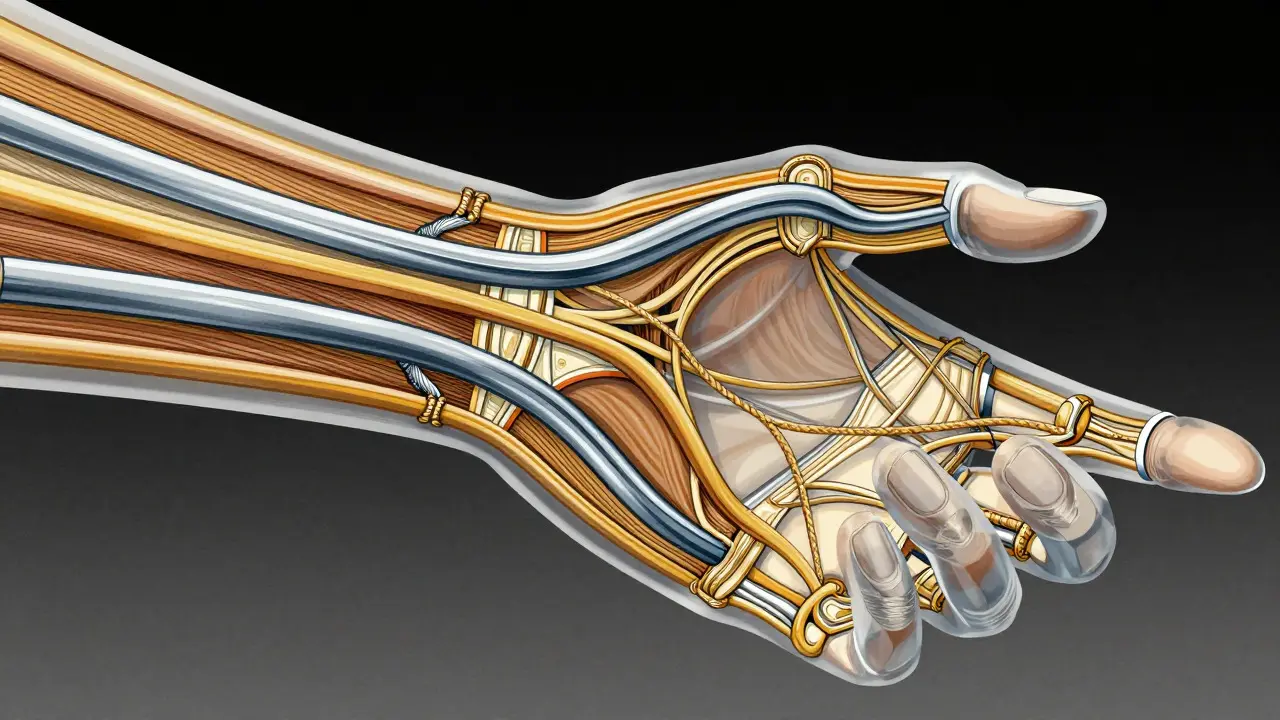
To understand why your fingers are bending, you have to look at the palmar fascia. This is a thin layer of fibrous connective tissue located just under the skin of your palm. In a healthy hand, this fascia is flexible. But in Dupuytren's contracture, it undergoes pathological changes. Specifically, cells called myofibroblasts proliferate excessively, depositing large amounts of collagen types I and III. This creates rope-like cords that can measure 2 to 8mm in thickness.
These cords don't just sit there; they exert contractile forces exceeding 10 Newtons, effectively pulling the finger toward the palm. The ring finger is the most common victim, affected in 61.2% of cases, followed by the little finger in 53.8%. Interestingly, about 50% to 60% of patients experience bilateral involvement, meaning both hands are affected, though rarely symmetrically. One hand is usually more severely impacted than the other by 15 to 25 degrees of contracture difference.
Recognizing the Stages of Progression
Dupuytren's contracture typically follows a predictable timeline, often spanning 5 to 15 years from the first sign to significant impairment. However, some people see rapid progression within just 12 to 24 months. Recognizing where you stand in this timeline helps determine the right next step.
- Stage 1 (Nodules): You feel small, painless lumps (0.5 to 2cm) forming near the base of your fingers, usually on the pinky side of the palm. Many patients notice dimpling of the skin here first.
- Stage 2 (Cords): The nodules develop into visible cords extending from the palm into the fingers. At this stage, the "table top test" often becomes positive-you can no longer lay your palm completely flat on a surface.
- Stage 3 (Visible Contracture): The finger begins to bend permanently. Clinically, this is measured between 10 and 30 degrees of flexion at the metacarpophalangeal joint.
- Stage 4 (Severe Contracture): The bend exceeds 45 degrees. Functional impairment is severe, making it difficult to grip objects or perform hygiene tasks.
Doctors generally recommend intervention once the contracture reaches 30 degrees at the knuckle or 20 degrees at the middle joint of the finger. Waiting too long can make recovery harder, but treating too early may expose you to unnecessary procedures if the condition stabilizes.
Why Does It Happen? Genetics and Risk Factors
You likely didn't choose to get this condition; genetics played a massive role. Genome-wide association studies have identified 11 susceptibility loci, with significant markers on chromosomes 16q and 20q. These genetic factors explain about 25% to 30% of the disease heritability. If you have a first-degree relative with Dupuytren's, your lifetime risk jumps to 68%, compared to just 8% in the general population.
Beyond genetics, certain lifestyle and demographic factors increase your risk:
- Age and Gender: Men over 50 are significantly more susceptible than women.
- Ancestry: Individuals of Northern European descent have higher prevalence rates.
- Comorbidities: There is a strong correlation with diabetes, epilepsy, and smoking.
- Hand Trauma: Previous injuries to the hand can sometimes trigger the onset of symptoms.
Treatment Options Compared
When it comes time to treat, you have three main paths: enzyme injections, needle aponeurotomy, and surgical fasciectomy. Each has distinct pros and cons regarding cost, recovery time, and recurrence rates.
| Treatment Method | Success Rate (Immediate) | Recurrence Rate (3-5 Years) | Average Cost (USD) | Recovery Time |
|---|---|---|---|---|
| Collagenase Injection (Xiaflex) | 65-78% | ~30-40% | $3,500 - $5,000 | 1-2 weeks |
| Needle Aponeurotomy | 80-90% | 30-50% | $1,500 - $3,000 | Days to 1 week |
| Open Fasciectomy | 90-95% | 20-30% | $8,000 - $15,000 | 6-12 weeks |
Collagenase Clostridium Histolyticum (Xiaflex) was FDA-approved in 2013 and works by enzymatically breaking down the collagen cords. It requires one to three injections per cord. The advantage is minimal downtime, but adherence to post-injection stretching exercises is critical. Studies show that 92% adherence to extension maneuvers correlates with an 85% success rate, whereas poor adherence drops this to 65%.
Needle Aponeurotomy involves using a needle to puncture the tight cords under local anesthesia. It’s quick and less invasive than surgery, offering immediate correction in most early-stage cases. However, because the underlying disease process isn't removed, recurrence rates are higher, ranging from 30% to 50% within three years.
Open Fasciectomy remains the gold standard for severe cases. A surgeon removes the diseased tissue entirely. While it offers the lowest recurrence rate (20-30% at five years), it is the most invasive option. Complication rates range from 15% to 25%, including potential nerve injury in 3-5% of cases. Recovery is lengthy, requiring 6 to 12 weeks of rehabilitation to regain full range of motion.
Managing Life with Dupuytren's
Living with this condition means adapting to physical limitations. A 2023 survey of over 1,200 patients found that 89% reported difficulty gripping objects, with an average grip strength reduction of 35%. Personal hygiene tasks became challenging for 76% of respondents. For working-age patients, the impact is even more pronounced; manual laborers experience work limitations 3.2 times more frequently than office workers.
Home management plays a crucial role, especially between treatments or during watchful waiting periods. Physical therapy regimens typically involve 2 to 3 sessions weekly for 6 to 8 weeks post-intervention. Patients who complete more than 80% of their prescribed therapy regain 95% of their pre-contracture range of motion, compared to only 75% for those with partial compliance. At home, simple stretching protocols-holding finger extensions for 5 to 10 minutes, four to six times daily-can help maintain flexibility. Apps like 'Hand Meter' allow you to track your progress at home, demonstrating a 95% correlation with clinical goniometer measurements.
Emerging Treatments and Future Outlook
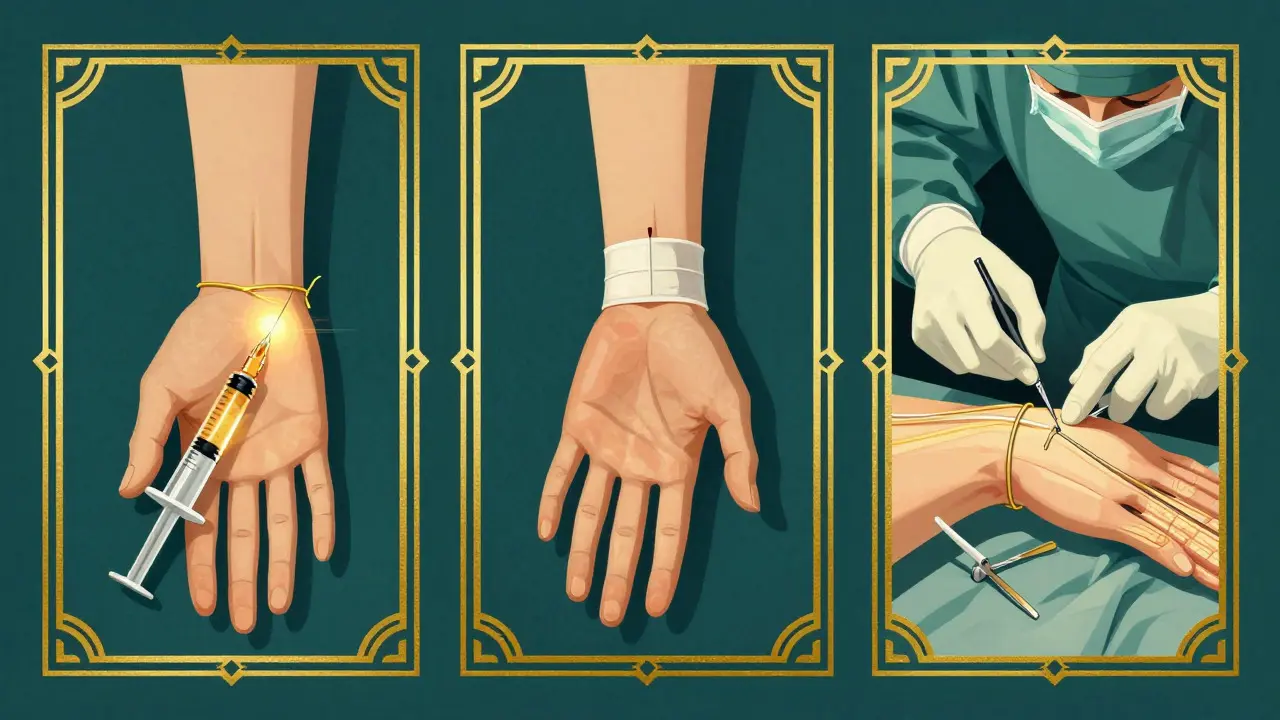
The field of hand surgery is evolving rapidly. Current research is focused on biologic therapies and minimally invasive techniques. One promising area is AAV gene therapy targeting TGF-β1, a protein involved in fibrosis. Phase I trials have shown a 40% reduction in cord thickness at six months. Additionally, ultrasound-guided percutaneous needle devices, such as the 'Fasciotome,' received FDA clearance in March 2023, reducing procedure time from 30 minutes to just 12.
Cellular therapy approaches, including adipose-derived stem cells, are also showing promise. A pilot study from the University of Pittsburgh Medical Center in 2023 reported a 55% reduction in recurrence at two years. As the global population ages, the market for these treatments is projected to grow at 6.8% annually through 2028, driven by the need for more durable, less invasive solutions.
Frequently Asked Questions
Is Dupuytren's contracture painful?
Most of the time, it is painless. The nodules and cords themselves do not hurt. However, some patients experience tenderness in the early stages or pain during the stretching exercises required after treatment. Corticosteroid injections are sometimes used specifically for painful nodules, though they are not a primary treatment for the contracture itself.
Can I prevent Dupuytren's contracture?
Since genetics play a major role, prevention is difficult. However, managing risk factors like smoking and maintaining good blood sugar control if you have diabetes may help. Regular hand exercises can keep tissues flexible, but they cannot stop the disease process if you are genetically predisposed. Early detection via the table top test is the best strategy for timely intervention.
Which treatment is best for me?
It depends on the severity of your contracture and your lifestyle. If you need to return to work quickly, collagenase injections or needle aponeurotomy might be preferable due to shorter recovery times. If you have severe contracture or have failed previous minimally invasive treatments, open fasciectomy offers the most durable result despite the longer recovery. Consult with a hand specialist to evaluate your specific degree of flexion and medical history.
Will it come back after surgery?
Yes, recurrence is possible with any treatment. Open fasciectomy has the lowest recurrence rate (20-30% at 5 years), while needle aponeurotomy has the highest (30-50%). Even after successful treatment, the underlying tendency for fibrosis remains, so regular monitoring is essential. Newer biologic therapies aim to reduce this recurrence rate further.
Does Dupuytren's affect the thumb?
Rarely. The condition primarily affects the ring and little fingers. The index and middle fingers are affected less frequently. Thumb involvement is uncommon and usually indicates a different pathology or a very advanced, atypical presentation.