
When you're pregnant, even a simple headache or stuffy nose can turn into a big decision. You want to feel better, but you also don’t want to risk your baby’s health. That’s why so many women reach for over-the-counter (OTC) meds without thinking twice - until they hear a warning. The truth? OTC medications aren’t always safe during pregnancy, even if they’re sold on pharmacy shelves next to cough drops and antacids.
More than half of pregnant women take at least one OTC drug during pregnancy. Acetaminophen (Tylenol) is the most common - used by 65% of expectant mothers. Ibuprofen? Around 18%. Pseudoephedrine? About 15%. But here’s the catch: just because it’s available without a prescription doesn’t mean it’s harmless. Some of these meds can affect fetal development, especially in the first trimester. Others become dangerous later on, even if they were fine earlier.
What’s Actually Safe? The Real List
Not all OTC meds are created equal. Some have decades of safety data behind them. Others? Not so much.
Acetaminophen (Tylenol) is still the go-to for pain and fever. It’s considered the safest option across all three trimesters. But even this isn’t risk-free. Stick to 650-1,000 mg every 4-6 hours, and never exceed 4,000 mg in 24 hours. Long-term use at high doses is still being studied - some early research suggests possible links to neurodevelopmental changes, but nothing’s confirmed yet. Until more data comes in, stick to the lowest dose for the shortest time.
For heartburn, calcium carbonate (Tums) is fine as long as you don’t take more than 2,000 mg per day. Mylanta or Maalox (aluminum hydroxide/magnesium hydroxide/simethicone) are also safe. Famotidine (Pepcid AC) works too - it’s an H2 blocker, not an antacid, but it’s been used safely for years.
Cough? Go for dextromethorphan only. That means plain Robitussin or Delsym. Avoid anything labeled "Multi-Symptom," "Cold & Flu," or "Maximum Strength" - those often include pseudoephedrine, phenylephrine, or extra acetaminophen. And yes, even "alcohol-free" versions can still contain up to 10% ethanol. Read the label.
Allergies? Loratadine (Claritin) and cetirizine (Zyrtec) are both considered safe. So is fexofenadine (Allegra), based on a 2022 study of over 12,000 pregnancies. Skip diphenhydramine (Benadryl) unless your provider says it’s okay - it can make you drowsy and may affect fetal movement.
Diarrhea? Loperamide (Imodium) is okay if you don’t have a fever and you follow the package instructions. No more than two doses in 24 hours.
What to Avoid - And Why
Some OTC meds are outright dangerous during pregnancy. These aren’t "maybe" risks - they’re clear warnings.
Ibuprofen (Advil, Motrin) and naproxen (Aleve) are NSAIDs. They’re fine in the first trimester - but after 20 weeks, they can cause serious problems: low amniotic fluid, kidney damage in the baby, and even premature closure of a vital blood vessel (the ductus arteriosus). That can lead to heart failure or stillbirth. The FDA issued a formal warning in 2020. Many drug labels now say "Do not use after 20 weeks."
Pseudoephedrine (Sudafed) is a decongestant. It’s linked to a 2.2 times higher risk of gastroschisis - a rare birth defect where the baby’s intestines stick outside the abdomen. This risk is highest in the first trimester. Many doctors say: avoid it completely.
Aspirin is a no-go unless prescribed for a specific condition like preeclampsia. It can increase bleeding risks and affect fetal growth.
Herbal supplements? Skip them. "Natural" doesn’t mean safe. Many herbal products haven’t been tested in pregnancy. Some can trigger contractions, affect hormone levels, or interfere with fetal development. Ginger tea? Fine. Peppermint capsules? Probably okay. But anything labeled "detox," "immune boost," or "pregnancy support"? Don’t touch it.
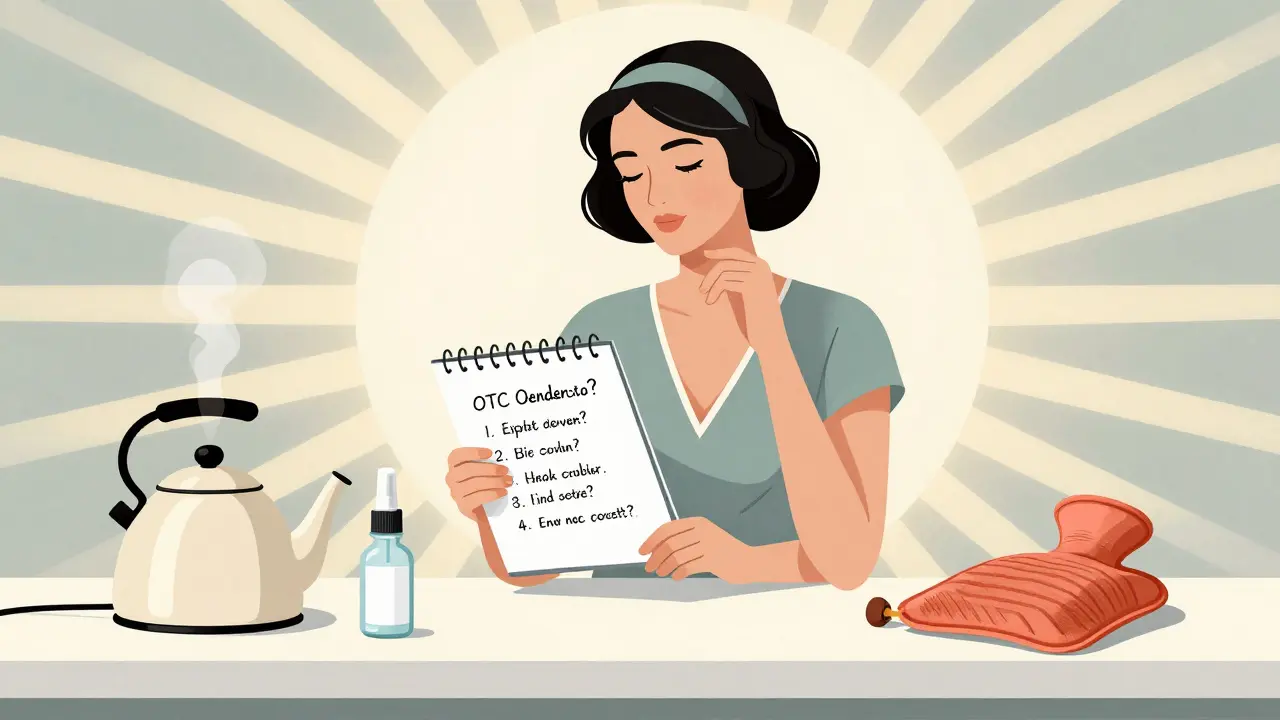
The 5 Questions You Must Ask Before Taking Anything
There’s no magic pill that’s 100% safe. Every decision needs context: your health, your trimester, your history. That’s why you need to ask these five questions before reaching for any OTC med:
- Is this medication absolutely necessary? Can you manage your symptoms with rest, hydration, steam, saltwater rinses, or a heating pad? Sometimes, the best treatment is no treatment at all.
- What’s the lowest effective dose? If you need Tylenol, start with 500 mg instead of 1,000. Don’t double up just because you think "more will work faster."
- How short can the duration be? One day of a cold? One dose of antacid? Don’t keep taking it "just in case."
- Are there non-drug options? For heartburn: eat smaller meals, don’t lie down after eating. For congestion: use a humidifier, saline nasal spray. For constipation: fiber, water, movement.
- Has my provider approved this exact product? Brand matters. "Robitussin" alone is fine. "Robitussin Multi-Symptom"? Not okay. Check the active ingredients - not just the brand name.
Why You Can’t Trust the Label
Drug labels are confusing. Some say "consult your doctor." Others say "safe in pregnancy." But here’s the truth: only 89% of antacid labels give clear pregnancy info. For multi-symptom cold meds? Just 37% do.
And here’s the kicker: 32% of pregnant women start taking OTC meds without talking to a provider. Most do it for headaches, colds, or heartburn. They think, "It’s just Tylenol," or "I’ve taken this before." But pregnancy changes how your body handles drugs. What was safe last year might not be safe now.
Even pharmacists can miss details. One study found that 41% of calls to pregnancy hotlines were from women confused about which product was safe. They didn’t know that "Delsym" (dextromethorphan only) was okay, but "Delsym Cold & Flu" wasn’t.
What to Do Before Your First Prenatal Visit
Don’t wait until you’re 12 weeks along to think about meds. If you’re trying to conceive or just found out you’re pregnant, make a list of everything you take - even supplements, vitamins, and herbal teas. Write down:
- Brand name
- Active ingredient
- Dose
- How often you take it
Bring that list to your first OB appointment. If you’ve been taking something regularly - like a daily antacid or allergy pill - ask: "Is this still okay?"
Some women with chronic conditions - like asthma, migraines, or depression - need to adjust their meds before pregnancy. That’s why preconception counseling matters. If you’re planning a pregnancy, talk to your provider about your meds now. Don’t wait.

The Bigger Picture: Why This Is So Hard
Here’s the uncomfortable truth: almost no OTC drug has been tested in pregnant women. Why? Because it’s unethical to give experimental drugs to pregnant people. So we rely on old studies, accidental exposures, and animal data. That’s why advice changes - new studies come out, and we learn more.
Right now, researchers are tracking 50,000 pregnancies to see if long-term acetaminophen use affects brain development. Results aren’t out yet. But that uncertainty is why you can’t just guess. You need to talk to someone who knows the latest data.
And it’s not just about pills. It’s about what’s in them. Some OTC products have hidden ingredients - caffeine, alcohol, or even stimulants. That’s why reading the full ingredient list matters more than the brand name.
Bottom Line: Don’t Guess. Ask.
OTC meds aren’t the enemy. But they’re not harmless either. The safest approach isn’t to avoid all meds - it’s to use them wisely, with clear information.
When in doubt: pause. Ask yourself the five questions. Check the label. Call your provider. Keep a list. Avoid anything with "cold & flu" in the name unless you’ve confirmed the ingredients.
There’s no perfect answer. But there is a better way: informed choices, not guesses.
Let’s be real-OTC meds are the wild west of prenatal care. We’ve got acetaminophen as the ‘safe’ baseline, but even that’s under scrutiny now with emerging neurodevelopmental data. The real issue isn’t the drugs themselves; it’s the lack of longitudinal, controlled studies in pregnant populations. Ethical constraints mean we’re flying blind using animal models and retrospective cohorts. We need better frameworks for risk stratification-not just blanket ‘avoid everything’ or ‘take Tylenol like water.’
Yessss this is so needed 😊 I took Tylenol for 3 weeks straight during my first trimester and panicked when I read this. But knowing the 650-1000mg window and max 4g/day? HUGE relief. Also-Delsym over Delsym Cold & Flu? Mind blown. I didn’t even know they were different. Thanks for the clarity! 🙌
I appreciate the structured approach here. The five questions are gold. Especially #1: Is this necessary? I used to pop Zyrtec like candy during allergy season-now I use saline rinses, a humidifier, and just breathe through it. It’s not glamorous, but it’s sustainable. Also-please stop calling herbal supplements ‘natural.’ That word is a trap. Just because it comes from a plant doesn’t mean it won’t cross the placenta like a freight train.
It’s fascinating how the regulatory landscape lags behind clinical reality. The FDA’s 2020 warning on NSAIDs was overdue, yet labels still say ‘consult your physician’-as if that’s a meaningful directive when most OBs don’t have time to review pharmacokinetics. We need standardized, machine-readable pregnancy risk tags on packaging. Something like: ‘Risk: Moderate (2nd/3rd trimester) | Evidence: Strong (2018 cohort)’.
So… we’re supposed to trust the label? The same label that says ‘safe for pregnancy’ on the front and then hides ‘pseudoephedrine’ in the tiny print under ‘other ingredients’? Lol. I once took a ‘natural’ prenatal vitamin that had 200mg caffeine. No one told me. I thought ‘natural’ meant ‘no stimulants.’ Turns out, ‘natural’ just means ‘not synthetic’… and caffeine is totally natural. Thanks, capitalism.
While I appreciate the thoroughness, I must challenge the premise. You imply that OTC = dangerous, but what about the dangers of *not* treating symptoms? Severe nausea leading to dehydration? Unmanaged fever? Chronic congestion impairing sleep? You’re pathologizing normal physiological responses. The real risk is fear-driven avoidance. Sometimes, a little Tylenol is the difference between a healthy pregnancy and a hospital visit.
Bro. I took Robitussin like it was Gatorade. Didn’t even check the label. Just grabbed the red bottle. Then I saw ‘Dextromethorphan’ on the back and was like ‘wait… is that the stuff that gets you high?’ Turns out yeah. But apparently it’s fine in pregnancy? Wild. I’m gonna start reading labels like I’m decoding a crypto whitepaper. No more blind grabs.
Let me tell you about my cousin. She took ibuprofen at 24 weeks. Baby was born with oligohydramnios. Had to be induced. NICU for 3 weeks. All because she thought ‘it’s just Advil.’ This isn’t theory. This is real life. And if you’re still using NSAIDs after 20 weeks? You’re gambling with a life. No ‘maybe.’ No ‘it’s fine sometimes.’ The science is clear. Stop.
From an OB-GYN perspective in India, the challenge is even greater. Many patients self-medicate due to cost, access, or cultural norms. We don’t have pharmacists on standby. We need community-based education-posters in clinics, WhatsApp info sheets, audio briefings in local languages. The data is here. The tools are here. What’s missing is delivery. Knowledge without access is just noise.
OMG YES. I’m 14 weeks and I literally just googled ‘safe cold meds pregnancy’ and came here. I was about to grab DayQuil because ‘it’s just a cold.’ Now I’m deleting my cart. Also-saline spray for congestion? Why didn’t I think of that? I’ve been using a humidifier for weeks but didn’t connect it to symptom relief. This is the kind of info that saves lives. Thank you. 💕
They’re all lying. The FDA, the drug companies, your OB. They want you scared so you’ll take their patented, overpriced, FDA-approved ‘safe’ meds. But what if the real danger is the pharmaceutical industry? What if acetaminophen is just the next thalidomide? I’ve been taking ginger and acupuncture since conception. Zero meds. Zero problems. The system wants you dependent. Don’t be fooled.
I just took Tylenol. Whatever.