When you pick up a generic pill from the pharmacy, you expect it to work just like the brand-name version. But what happens when that pill is unsafe? In 2024, the FDA issued 347 drug recalls, and nearly nine out of ten involved serious or potentially life-threatening issues. Most of these weren’t caused by rogue pharmacies or bad luck-they came from manufacturing flaws in facilities halfway across the world. The system meant to protect you isn’t broken, but it’s stretched thin, and the triggers that start a recall are more technical-and more dangerous-than most people realize.
What Actually Causes a Generic Drug to Be Recalled?
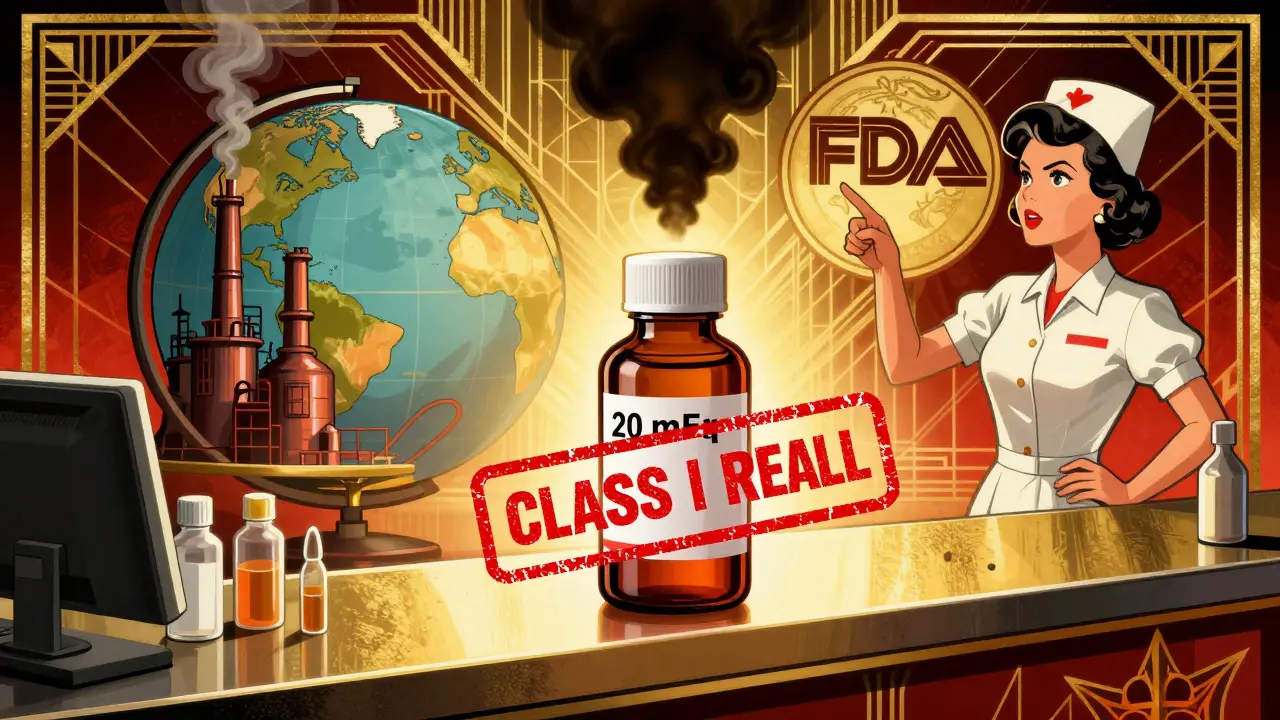
A drug doesn’t get pulled just because someone complained. The FDA has clear, measurable criteria for when a recall is needed. The most serious are Class I recalls: these happen when there’s a reasonable chance the drug could cause serious harm or death. Think of the July 2024 case where a potassium chloride injection was mislabeled-20 mEq labeled as 10 mEq. That’s not a typo. That’s a patient getting double the dose of a drug that can stop the heart. One mistake like that can kill. Class II recalls are more common. These involve problems that might cause temporary or reversible health issues. In April 2025, Glenmark Pharmaceuticals recalled nearly 40 generic drugs because of violations in their Indian manufacturing plant. The issue? Contaminated equipment, poor air quality, and unsterile conditions. The drugs weren’t toxic, but they weren’t clean either. For someone with a weakened immune system, that’s enough to trigger an infection. Class III recalls? Those are the least urgent. Maybe the label says “take with food” when it should say “take on an empty stomach.” Harm is unlikely, but the product still breaks the rules. These make up only about 13% of all recalls. The real triggers? They’re hidden in the numbers. Sterility failures cause 37% of all recalls. That means bacteria, mold, or other microbes got into a medicine meant to be sterile-like an IV bag or an injectable. Particulate matter-tiny bits of glass, metal, or plastic-shows up in 12% of cases. Labeling errors? That’s 9%. And active ingredient potency? That’s 7%. If a pill says it contains 10 mg of a drug but only has 5 mg, it won’t work. If it has 15 mg, it might overdose you.Why Do These Problems Keep Happening?
Most generic drugs in the U.S. come from factories in India and China. Together, they make about 80% of the active ingredients in American medicines. But here’s the problem: the FDA inspects U.S. plants every 1.8 years on average. Foreign plants? Once every 4.6 years. That’s not a glitch. That’s policy. The Glenmark case wasn’t an accident. The FDA hadn’t inspected their Indian facility in over four years. Journalists found the issues-not regulators. And when the FDA finally did show up, they found multiple violations: dirty floors, uncalibrated equipment, and workers not following basic hygiene rules. These aren’t one-off mistakes. They’re signs of a broken quality culture. The U.S. system relies on manufacturers to report problems voluntarily. About 98% of recalls are self-initiated. That sounds cooperative, but it also means companies can delay action. In the EU, regulators can force a recall within days. In the U.S., it takes an average of 42 days from detection to public notice. That’s more than a month of people taking potentially unsafe pills.Who Notices the Problems First?
You might think the FDA catches everything. But in reality, the first alarm often comes from someone else. Pharmacists and nurses are on the front lines. In one case, a nurse noticed that a batch of hydroxyzine pills looked different-slightly darker, slightly softer. She checked the lot number, found it on the FDA’s recall list, and flagged it. That single action prevented dozens of adverse reactions. Patients, too, are noticing things. On Reddit’s r/Pharmacy, users reported pills that didn’t dissolve properly, tasted bitter, or caused unusual side effects. One user said they’d been taking a generic blood pressure pill for years, then suddenly started getting dizzy. After switching brands, the dizziness vanished. They reported it to the FDA’s MedWatch system. That report joined 142,857 others in 2024-but only 3.2% of people who could have reported issues actually did. Healthcare providers are overwhelmed. One pharmacist said they had to contact 127 patients after a recall. Only 38 had side effects. But 100% were terrified. That’s the emotional toll no one talks about.
What Happens When a Recall Is Issued?
Once a recall is announced, it’s not just about pulling pills off shelves. It’s a chain reaction. Hospitals and pharmacies must immediately stop using the product. They need to check every lot number-sometimes across dozens of shipments. Eighty-two percent of hospitals say tracking those lot numbers is one of their biggest headaches. Then comes patient communication. The FDA recommends notifying patients within 72 hours. But only 12% of patients actually get a direct notice. Most find out by accident-like when their pharmacist says, “Sorry, we can’t refill that.” Healthcare facilities must also update their systems. They add the recalled drug to a “do not purchase” list so it doesn’t get reordered. Seventy-six percent of large hospitals now use automated systems to block these drugs. But smaller clinics? They’re still using spreadsheets. Documentation is strict. The Joint Commission requires recall records to be kept for six years. Most now use digital systems to track every step-from the moment the recall was issued to when the last patient was contacted.Why Are Generic Drugs More Likely to Be Recalled?
It’s not because generics are inferior. It’s because of how they’re made. The global generic drug market is worth over $220 billion. To compete, manufacturers cut costs. They use cheaper raw materials. They outsource production to low-cost countries. They run multiple lines on the same equipment without proper cleaning. And because they’re making the same drug as a brand-name product, they don’t have to repeat expensive clinical trials. The FDA accepts bioequivalence data-meaning the drug works the same way-but not necessarily that it’s made the same way. Indian manufacturers alone account for 34% of all generic drug recalls in the U.S., even though they only make 20% of the supply. Why? Because they’re under pressure to produce more, faster, cheaper. And oversight doesn’t keep up.
What’s Changing? What’s Next?
The system is starting to shift. In April 2025, the FDA announced the Enhanced Oversight Initiative. High-risk foreign factories-those tied to 67% of all recalls-will now be inspected every year instead of every 4.6 years. That’s a big change. New laws are coming, too. The Pharmaceutical Supply Chain Security Act, introduced in May 2025, would require foreign manufacturers to share real-time quality data with the FDA. That means sensors on equipment, automated alerts for contamination, and digital logs of every batch. Technology is helping. Blockchain, once rare in pharma, is now used by 18% of major manufacturers. It tracks a drug from raw ingredient to pharmacy shelf. If something goes wrong, they can trace it back in hours, not weeks. The FDA is also testing AI tools to predict failures before they happen. By analyzing past inspection data, production patterns, and supplier history, the system can flag a factory that’s likely to fail. A $47 million investment is backing this effort. But here’s the hard truth: the Government Accountability Office estimates the FDA needs $780 million more each year just to inspect foreign facilities properly. Without that, recalls will keep happening-because the system is still built on trust, not proof.What Should You Do?
If you take generic medication, here’s what you can do:- Check the lot number on your bottle. If you hear about a recall, compare it to the FDA’s searchable Enforcement Reports.
- Don’t panic. Most recalls aren’t emergencies. But don’t ignore them either. Call your pharmacist or doctor before stopping a medication.
- Report side effects. Even if you’re not sure it’s the drug, use the FDA’s MedWatch system. Your report could help prevent someone else’s hospitalization.
- Ask your pharmacist: “Is this batch from a facility with recent violations?” They have access to the same data as the FDA.
Generic drugs save billions of dollars every year. But safety isn’t optional. The system works-when it’s funded, when it’s monitored, when it’s trusted. Right now, it’s a patchwork. And patches can fail.
Are generic drugs less safe than brand-name drugs?
No, generic drugs are not inherently less safe. They must meet the same FDA standards for strength, quality, and performance as brand-name drugs. But because generics are often made in facilities with less frequent inspections-especially overseas-the risk of manufacturing errors is higher. The drug itself is safe; the way it’s made may not be.
How do I know if my medication has been recalled?
The FDA posts all recalls on its website in the Enforcement Reports section. You can search by drug name, manufacturer, or lot number. Your pharmacy should also notify you, but many don’t. If you’re unsure, call them. Don’t wait for a letter-check online yourself.
Why don’t I get a direct notice when my drug is recalled?
The FDA doesn’t require manufacturers to notify individual patients. Instead, they notify pharmacies and hospitals. It’s up to those providers to reach out. In 2024, only 12% of patients received direct notice. Most find out from their pharmacist or by accident. Always check the FDA’s recall list if you’re on a long-term medication.
Can I return a recalled drug for a refund?
Yes. Most manufacturers will provide a return label or refund if you contact them directly. Your pharmacy can help you with this. Don’t throw the pills away-return them. That helps the manufacturer track the recall and prevents someone else from accidentally using them.
What should I do if I think I took a recalled drug?
Don’t stop taking the medication without talking to your doctor. Some recalls are serious, but others are minor. If you’re concerned, call your pharmacist or prescriber. If you have symptoms like dizziness, nausea, or irregular heartbeat, seek medical advice. Report your experience to the FDA’s MedWatch program-it helps track patterns and prevent future recalls.
So let me get this straight-we’re trusting our lives to pills made in factories inspected less often than my car gets an oil change? 😑
Bro, this isn't just about drugs-it's about how we outsource safety for profit. We don't inspect foreign plants because it's cheaper to let people get sick than to pay for oversight. And then we act shocked when someone dies from a mislabeled vial. This system is designed to fail. We need to stop pretending this is a 'market efficiency' issue. It's a moral failure. And yeah, I'm angry. You should be too.
One is compelled to reflect upon the epistemological paradox inherent in pharmaceutical regulation: the state delegates authority to private entities to self-report infractions, thereby constructing a governance architecture predicated upon voluntary compliance, despite the systemic incentives for obfuscation. The FDA’s reliance upon industry self-policing constitutes a form of regulatory capture, wherein the surveillant becomes subservient to the surveilled. One must ask: is safety a public good, or merely a cost center to be minimized?
Look, I get it. Generic drugs are cheaper. But cheaper doesn't mean bad-unless you're cutting corners on sterility, which is exactly what's happening. I spent two years working in a compounding pharmacy before I got burned out. We had to check every lot, every batch, every vial. You'd be shocked how many times the label didn't match what was inside. And no one told us why. We just got told to 'move on.' The FDA doesn't have the manpower. The manufacturers don't have the incentive. And patients? We're just numbers on a spreadsheet. That nurse who noticed the darker pills? She's a hero. Most of us just shrug and take the next one. But we shouldn't. We need to demand better. Not because we're paranoid. Because we're alive.
I'm from a rural town in Ohio. My mom takes five generics. Last year, one of them got recalled. She didn't know until I called her. She just thought she 'felt funny'-dizzy, nauseous, like she was floating. We switched brands and she felt normal again. No one called her. No one emailed. We found out because I was scrolling through the FDA site out of boredom. This isn't just a policy issue. It's a human one. People are scared. And they shouldn't have to Google their own safety.
So the FDA inspects U.S. plants every 1.8 years and foreign ones every 4.6? That’s not oversight-it’s a waiting game. And we wonder why recalls keep happening? Companies know the lag. They know they can run dirty lines for years before anyone shows up. And when they do? They get a slap on the wrist and a ‘we expect better next time.’ Meanwhile, someone’s heart stopped because a pill had 20 mEq instead of 10. This isn’t negligence. It’s policy. And we’re the ones paying for it-with our health.
I work in a small clinic. We don’t have automated systems. We use a whiteboard. When a recall hits, we scramble. One time, we had to call 87 patients. Only 12 had side effects. But 85 of them cried. Not because they were sick. Because they felt abandoned. Like the system forgot them. I’ve had patients ask me, ‘Is this pill going to kill me?’ I don’t have a good answer. All I can say is, ‘I’ll check the lot number.’ That’s not enough. We need better tools. And we need to stop pretending this is someone else’s problem.
Check your lot number. Always. And report anything weird-even if you think it’s nothing. FDA needs every data point.