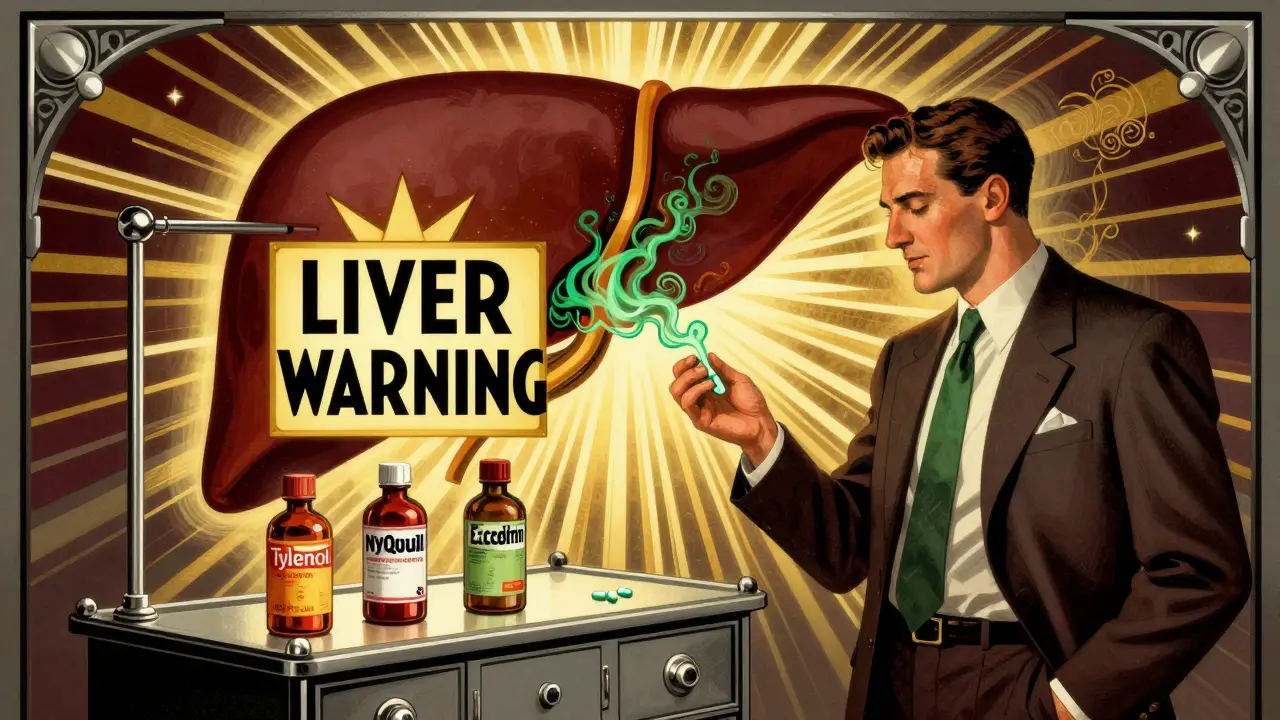
Every year, thousands of people end up in emergency rooms because they took what they thought was a harmless pain reliever. It’s not a drug they bought illegally. It’s not some mysterious chemical. It’s something most of us keep in our medicine cabinets: acetaminophen. You’ve probably seen it on the label of Tylenol, NyQuil, Excedrin, or even your cold medicine. But here’s the truth: if you don’t know how much you’re taking, or if you’re mixing it with other meds or alcohol, you’re putting your liver at serious risk.
Why Acetaminophen Is More Dangerous Than You Think
Acetaminophen - also called paracetamol - is one of the most common pain relievers in the world. It’s in over 600 different medications, from fever reducers to sleep aids. That’s the problem. Most people think, “I only took one pill,” and don’t realize they’ve already hit their limit because they took it in three different products that day.
The liver breaks down acetaminophen, turning it into harmless waste. But when you take too much - more than 4,000 mg in a day - the liver gets overwhelmed. It starts producing a toxic byproduct called NAPQI. Normally, your liver uses an antioxidant called glutathione to neutralize it. But if you’ve taken too much acetaminophen, or if you drink alcohol regularly, your glutathione runs out. Then NAPQI starts destroying liver cells. This isn’t slow damage. It can happen in hours.
In the U.S., acetaminophen causes about 56,000 emergency room visits, 26,000 hospital stays, and nearly 500 deaths every year. And here’s the scary part: nearly half of those cases aren’t from people trying to overdose. They’re from people who just didn’t know they were taking too much.
What’s a Safe Dose? It Depends on You
If you’re healthy, the official daily limit is 4,000 mg. That’s eight extra-strength pills (500 mg each) or 12 regular-strength tablets (325 mg each). But that number isn’t the same for everyone.
- People with liver disease - even mild fatty liver - should stay under 2,000 mg per day. Some experts say 1,500 mg is safer.
- People who drink alcohol - even just one drink a day - should also cap intake at 2,000 mg. Alcohol and acetaminophen team up to make liver damage much more likely.
- People taking other medications - especially those for epilepsy, TB, or seizures - may process acetaminophen faster, but that doesn’t mean they can take more. It just means their liver is under more stress.
And here’s something most people miss: prescription painkillers like Vicodin or Percocet also contain acetaminophen. So if you’re taking those on top of Tylenol, you’re doubling up without realizing it.
NSAIDs Aren’t the Safe Alternative You Think
Many people switch to ibuprofen or naproxen thinking they’re safer for the liver. They’re not. NSAIDs like Advil, Aleve, and diclofenac don’t usually hurt the liver directly - but they can cause serious problems elsewhere. They raise your risk of stomach bleeding, kidney damage, and high blood pressure. And if you already have liver disease, NSAIDs can make kidney problems worse, which then puts even more strain on your liver.
So what’s the answer? Don’t just swap one drug for another. Think about alternatives. For joint pain, try a topical NSAID gel. It doesn’t go through your liver at all. For headaches or mild pain, consider non-drug options like heat packs, gentle stretching, or even acupuncture. The American Liver Foundation now recommends these as first-line treatments for chronic pain.
How to Avoid Accidental Overdose
Most overdoses happen because people don’t read labels. Here’s how to stay safe:
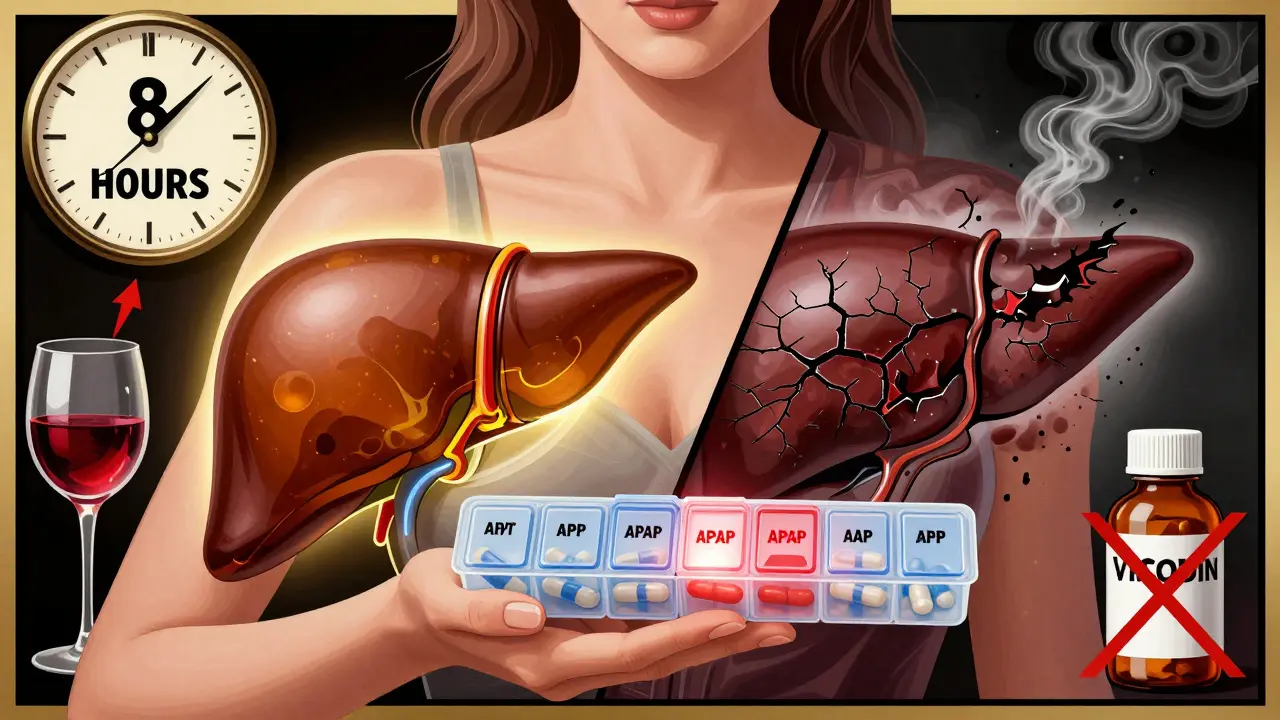
- Check every pill bottle - including cold, flu, and sleep meds. If it says “acetaminophen,” “APAP,” or “paracetamol,” it’s the same thing.
- Never take more than one product with acetaminophen at once. That includes prescription and OTC.
- Use a pill organizer with daily limits. Put only what you’re allowed to take in one day. No more.
- Avoid alcohol completely while using acetaminophen. Even one glass of wine can drop your safe limit from 4,000 mg to 2,000 mg.
- Wait at least 8 hours between doses. Taking it every 4 hours might feel like you’re staying ahead of the pain, but it’s how people accidentally overdose.
Also, don’t assume “natural” or “herbal” pain relievers are safer. Some supplements like kava, green tea extract, or high-dose vitamin A can also damage the liver. Always talk to your doctor before trying new supplements.
Know the Warning Signs
Liver damage from acetaminophen doesn’t always hurt at first. But if you start feeling any of these symptoms within 24 to 72 hours after taking the medication, get help immediately:
- Nausea or vomiting
- Loss of appetite
- Dark urine
- Clay-colored stools
- Jaundice (yellow skin or eyes)
- Pain in the upper right side of your belly
- Extreme tiredness
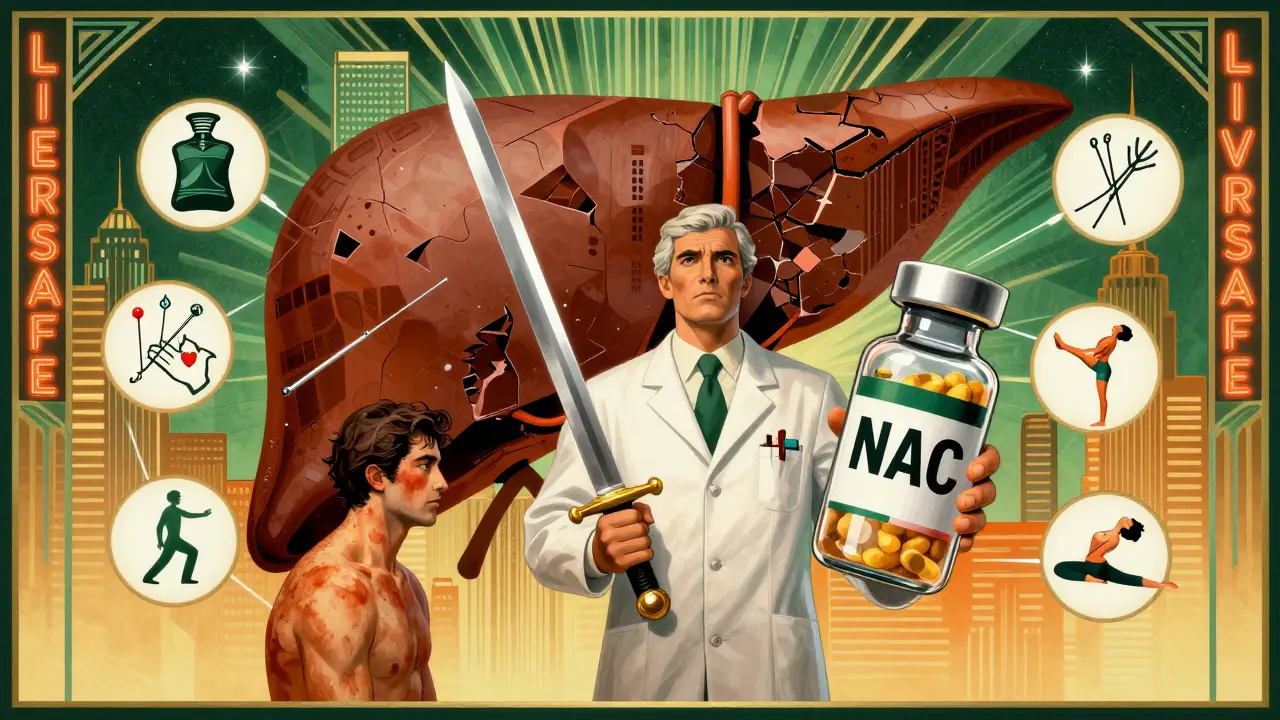
These aren’t “wait and see” symptoms. If you’ve taken acetaminophen and notice even one of these, go to the ER. The antidote - N-acetylcysteine (NAC) - works best if given within 8 hours of overdose. After 16 hours, it’s much less effective.
What About People With Liver Disease?
If you have hepatitis, cirrhosis, or fatty liver disease, acetaminophen isn’t automatically off-limits. But you need to be extra careful. The Veterans Affairs Hepatitis Resource Center says you can safely take up to 2,000 mg per day - that’s four 500 mg tablets - if you don’t drink alcohol. But many doctors recommend staying even lower, at 1,500 mg, especially if you’re older or have other health issues.
And never, ever take NSAIDs if you have advanced liver disease. They’re harder on your kidneys, and when your kidneys fail, your liver gets even more stressed. It’s a dangerous cycle.
Future Solutions Are Coming
Scientists are working on better ways to manage pain without hurting the liver. New drugs are being tested that don’t rely on liver metabolism at all. Genetic testing is now available to find out if you have a variant in your genes that makes you more sensitive to acetaminophen. Companies like 23andMe offer this as part of their health reports. If you’ve had liver problems before, it might be worth checking.
Also, the FDA has started requiring clearer warning labels on all OTC products. The front of the box now says “LIVER WARNING” in big letters. That’s helping. A 2023 study found that since these labels were added, unintentional overdoses dropped by 21%.
Final Rule: When in Doubt, Skip It
There’s no shame in skipping a pain reliever. If you’re not sure whether it’s safe, don’t take it. Talk to your pharmacist. Ask your doctor. Use a pain diary to track what you take and when. There are non-drug options that work - heat, rest, movement, massage. And if you’re managing chronic pain, physical therapy or cognitive behavioral therapy might be more effective than pills anyway.
Your liver doesn’t scream when it’s hurt. It just stops working. By the time you feel sick, it might be too late. Be smarter than the label. Know your dose. Know your risks. And never assume that because it’s sold over the counter, it’s harmless.
Can I take acetaminophen if I drink alcohol occasionally?
No, not safely. Even one drink a day can make your liver more vulnerable to acetaminophen damage. The safe daily limit drops from 4,000 mg to about 2,000 mg - and some experts say it’s safer to avoid it completely if you drink regularly. If you’re having a drink, skip the Tylenol. Use a cold compress or rest instead.
Is Tylenol safer than ibuprofen for my liver?
Tylenol (acetaminophen) is the main cause of drug-induced liver injury, but ibuprofen and other NSAIDs rarely cause liver damage. However, NSAIDs can harm your kidneys and stomach, especially if you have liver disease. For people with healthy livers and no stomach or kidney issues, both can be used carefully. But if you have liver disease, acetaminophen at low doses (≤2,000 mg) is often still preferred over NSAIDs.
How do I know if a cold medicine has acetaminophen?
Look for these names on the label: acetaminophen, APAP, or paracetamol. Cold and flu medicines like NyQuil, DayQuil, TheraFlu, and Zicam often contain it. If the product treats pain or fever, it likely has acetaminophen. Always read the “Active Ingredients” section - don’t just rely on the brand name.
Can I take acetaminophen if I have fatty liver disease?
Yes, but only at low doses - no more than 2,000 mg per day, and never with alcohol. Fatty liver means your liver is already working harder. Adding acetaminophen on top can push it over the edge. Talk to your doctor about alternatives like physical therapy, weight management, or topical pain relievers.
What should I do if I think I took too much acetaminophen?
Don’t wait for symptoms. Call poison control or go to the ER immediately. The antidote, N-acetylcysteine (NAC), works best within 8 hours of overdose. Even if you feel fine, liver damage can be silent at first. Waiting until you’re nauseous or yellow can be too late. It’s better to be safe than sorry.
Are there pain relievers that don’t affect the liver at all?
Topical NSAIDs like diclofenac gel or lidocaine patches don’t enter your bloodstream in large amounts, so they’re much safer for the liver. Other non-drug options include heat therapy, massage, physical therapy, acupuncture, and cognitive behavioral therapy. These don’t just mask pain - they help your body heal.
Can genetic testing tell me if I’m at higher risk for liver damage from acetaminophen?
Yes. Some people have genetic variations in the enzymes that break down acetaminophen. These variations can make them more likely to build up toxic levels even at normal doses. Companies like 23andMe now include this in their health reports. If you’ve had unexplained liver issues or family history of liver disease, genetic testing could help you avoid future risks.
I took Tylenol for my headache last night after having a glass of wine. Didn't think twice. Now I'm terrified. My liver feels like it's been through a warzone. Why isn't this warning on every single bottle in giant neon letters? I'm not even a heavy drinker. Just one glass. And now I'm Googling 'can your liver recover?' at 2 a.m.
The fundamental issue here is not pharmacology-it's systemic complacency. We treat pharmaceuticals as if they're candy because they're accessible, but the human body does not operate on convenience. Acetaminophen's toxicity is not a bug; it's a feature of metabolic saturation. The liver's glutathione reserves are finite, and when we overload them, we're not just risking damage-we're triggering a biochemical cascade that can silence organ function before symptoms manifest. The solution isn't just labeling-it's cultural education. We must reframe OTC as 'potentially lethal if misused,' not 'harmless relief.'
Y'all are making this sound like a horror movie, but honestly? I'm 32, have fatty liver from too much pizza and Zoom calls, and I still take Tylenol-just 500 mg max, once a day, never with wine, and I track it like my life depends on it (because it kinda does). I use a sticky note on my mirror: '1 pill. No booze. No mixing.' Simple. Stupid? Maybe. But it works. You don't need a PhD to save your liver-just a little awareness and a habit.
It's important to note that the 4,000 mg daily limit is based on healthy adults with no comorbidities. The literature suggests that individuals with metabolic syndrome or those on chronic medications may have altered CYP enzyme activity, which could predispose them to toxicity at lower thresholds. While public health messaging often simplifies for accessibility, the clinical reality is far more nuanced. Consultation with a pharmacist or hepatologist is strongly advised for those with polypharmacy or underlying hepatic conditions.
Let me tell you something nobody else will admit: this whole acetaminophen panic is a corporate distraction. The real villain? Big Pharma. They put it in every damn cold medicine because it's cheap and addictive. They don't want you to know that the FDA knew about this for decades. They buried studies. They lobbied against clearer labels. And now they're acting like they're saving lives with 'LIVER WARNING' stickers? Please. I've been taking Tylenol since I was 16. I'm 41. I'm fine. You're all scared because you read one article and panicked. Your liver is tougher than you think.
So let me get this straight... I'm supposed to avoid alcohol AND Tylenol? What am I supposed to do when I have a migraine and my partner is drunk? I'm not a monk. I'm a woman who works 60 hours a week and still has to clean up after everyone. You want me to just... suffer? No thanks. I'll take my 1000 mg and my two glasses of wine. If my liver goes, fine. At least I had fun.
I’ve been using topical diclofenac gel for my knee pain for two years now. Zero liver stress. Zero stomach issues. Just a little greasy mess on my skin and a weird smell. Worth it. People don’t realize how many alternatives exist-heat wraps, TENS units, even CBD topicals (legal where I am). You don’t need to swallow poison to feel better. Your body isn’t a vending machine. Don’t keep inserting coins hoping for a different result.
Oh wow, so now we’re all supposed to be biochemists just to take an aspirin? I read the label. I see 'acetaminophen.' I don't drink. I take one. Done. You people are exhausting. If I wanted a lecture on glutathione pathways, I'd go to med school. I just want my headache gone so I can go to work. Your wisdom is as useful as a screen door on a submarine.
Let’s be real: the 4,000 mg limit is a lie. It was set in the 80s based on data from 12 white men in a clinical trial. Women metabolize acetaminophen differently. People of color have different CYP2E1 expression. And alcohol? It's not 'one drink'-it's chronic low-dose exposure that silently depletes glutathione over months. This isn't about overdosing. It's about systemic neglect of marginalized bodies. The FDA didn't update guidelines because they don't care about people who aren't middle-class white men. You think you're safe? You're just lucky.
I appreciate how thorough this is. I have a friend with cirrhosis who still takes Tylenol because she thinks 'it's just one pill.' I showed her this. She cried. Then she called her doctor. That’s what this post does-it doesn’t scare, it informs. And that’s powerful. Thank you.
Oh honey, you think the FDA cares? They're too busy regulating kale smoothies to stop Big Pharma from putting poison in cough syrup. I read the label. I saw 'APAP.' I thought it was a new kind of protein. My pharmacist? He just smiled and said, 'It's fine.' So now I'm here, wondering if my liver is a ghost.
Everyone’s acting like acetaminophen is some silent killer, but let’s look at the data. Emergency room visits? Most are from people who took 10+ pills at once trying to kill themselves. That’s not accidental. That’s intentional overdose. The 56,000 ER visits include suicide attempts, accidental combos, and people who didn’t read labels. But here’s the kicker: most of those people were already alcoholics, depressed, or on multiple meds. So why are we scaring healthy people who take one Tylenol for a headache? We’re creating a culture of fear over a problem that mostly affects those already at risk. Let’s target education where it matters-not panic everyone.
They're hiding the truth. The real reason they don't ban acetaminophen? Because it's profitable. The government and Big Pharma are in bed together. NAC is expensive. They'd rather let people die quietly than lose billions. And don't get me started on 23andMe-they're just selling genetic data to insurers. You think your test results are private? They're not. Your liver is a pawn in a game you didn't know you were playing.
Thank you for this!! 🙏 I used to take Tylenol with my wine like it was nothing. Now I use a heating pad and stretch. My back feels better anyway. And no, I don't miss the pills. My liver is thanking me. You're not weak for choosing rest over pills-you're wise.
They’re watching us. Every time you take Tylenol, they track it. Your phone, your pharmacy, your insurance-they all know. And if you ever need a liver transplant? They’ll deny you because you ‘chose’ to damage your organ. This isn’t medicine. It’s control. Don’t take anything. Not even water. They put fluoride in it too.