
Colorectal cancer is no longer just a disease of older adults. In 2025, colonoscopy screening starts at 45-not because it’s a trend, but because the data doesn’t lie. Between 1995 and 2019, cases in people under 50 rose by 2.2% every year. Rectal cancer, in particular, has climbed faster than any other subtype in younger adults. If you’re 45 or older, skipping screening isn’t an option-it’s a gamble with your life.
Why Colonoscopy Is Still the Gold Standard
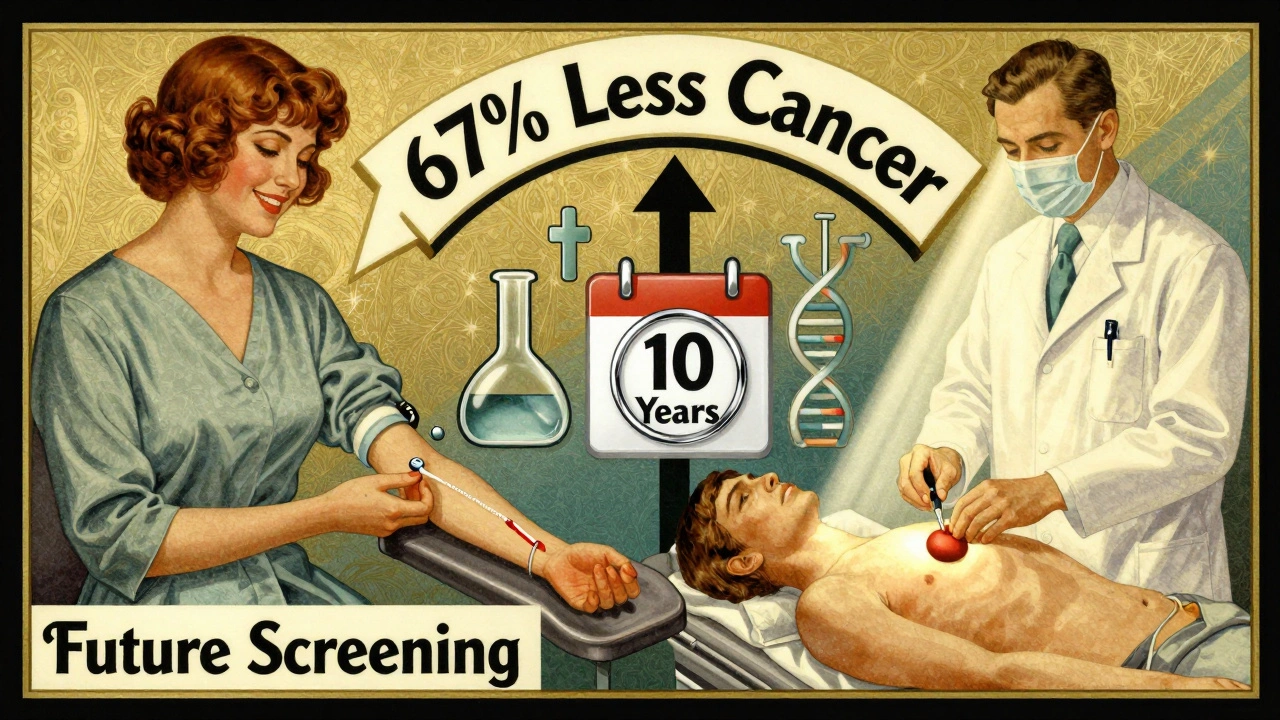
Colonoscopy isn’t the easiest test, but it’s the most powerful. Unlike stool tests that only detect blood or DNA markers, a colonoscopy lets doctors see the entire colon in real time. And if they find a polyp? They can remove it right then and there. That’s prevention, not just detection.Studies show colonoscopy cuts colorectal cancer risk by 67% and death from it by 65%. That’s not a small number. It means for every 1,000 people who get screened, roughly 15 to 20 cancers are stopped before they become deadly. The procedure itself takes about 30 minutes. The prep? That’s the hard part. Most people describe it as the worst part-not the pain, not the sedation, but the hours of clear liquids and laxatives.
But here’s what most don’t realize: colonoscopy isn’t just a one-time event. If your first colonoscopy is clean, you wait 10 years. If you had one or two small polyps, you come back in 5 years. If you had several large polyps, you’re back in 3. This isn’t arbitrary. It’s based on how fast polyps grow-and we know a lot more now than we did 10 years ago.
Who Should Start Screening Before 45?
Not everyone waits until 45. If you have a family history of colorectal cancer-especially if a parent or sibling was diagnosed before 60-you should start screening at 40, or 10 years before their age at diagnosis, whichever comes first. Same goes if you’ve had inflammatory bowel disease (Crohn’s or ulcerative colitis) for more than 8 years. These conditions turn the colon into a high-risk zone.Genetic syndromes like Lynch syndrome or familial adenomatous polyposis (FAP) change the game entirely. People with Lynch syndrome have up to an 80% lifetime risk of developing colorectal cancer. They often begin screening in their early 20s and get colonoscopies every 1 to 2 years. These aren’t hypotheticals. I’ve seen patients in their late 20s with stage II cancer because their family didn’t talk about it. That’s preventable.
African Americans face another layer of risk. They have a 20% higher incidence of colorectal cancer and a 40% higher death rate than White Americans. The reasons are complex-access, bias, delayed diagnosis-but the solution is clear: start at 45, and stick with colonoscopy. Stool tests are less reliable in this group. Colonoscopy remains the most effective tool.
What About Stool Tests?
Stool-based tests like FIT (fecal immunochemical test) and multi-target stool DNA (like Cologuard) are easier. No prep. No sedation. Just collect a sample at home and mail it in. They’re great for people who avoid colonoscopy-but they’re not replacements.FIT detects blood in stool. It’s 79-88% accurate at finding cancer but only catches about 30% of large polyps. That means you can have a clean FIT and still have something growing that needs removal. You have to do it every year. Miss one year, and your protection drops.
Cologuard, the DNA test, finds cancer better-92% sensitivity-but it’s less specific. About 13% of healthy people get a false positive. That means 1 in 8 people who test positive will need a colonoscopy that turns out to be unnecessary. It’s expensive, too. And if you have a positive result? You still need a colonoscopy. So why not just go straight to the source?
Here’s the truth: stool tests work best when colonoscopy isn’t accessible. In rural areas, safety-net clinics, or for people without insurance, they save lives. But if you have access to a good endoscopy center? Go for the colonoscopy. It’s the only test that prevents cancer, not just finds it.
Chemotherapy Regimens: When Screening Isn’t Enough
If screening finds cancer, the next step is staging-and treatment. Stage I means the cancer is small and hasn’t spread. Surgery alone is often enough. Stage II? Sometimes chemo is added, especially if the tumor has high-risk features like poor differentiation or lymphovascular invasion.Stage III is where chemotherapy becomes standard. This is when cancer has spread to nearby lymph nodes. The go-to regimen is FOLFOX: 5-fluorouracil (5-FU), leucovorin, and oxaliplatin. It’s given every two weeks for six months. Side effects? Numbness in fingers and toes (neuropathy), fatigue, nausea, and sometimes permanent nerve damage. But survival jumps from 60% to 85% with chemo.
Another option is CAPOX: capecitabine (an oral pill) and oxaliplatin. It’s just as effective but allows patients to take some treatment at home. For older adults or those with kidney issues, doctors may skip oxaliplatin and use 5-FU with leucovorin alone. It’s less intense, less toxic, and still effective.
Stage IV? That’s metastatic cancer-spread to the liver, lungs, or elsewhere. Here, chemo is no longer curative, but it can extend life by years. Regimens like FOLFIRI (irinotecan instead of oxaliplatin) or FOLFOX with targeted drugs like bevacizumab or cetuximab are common. Genetic testing of the tumor is now standard. If the cancer has a KRAS mutation, cetuximab won’t work. If it’s MSI-High, immunotherapy might be better than chemo.
There’s no one-size-fits-all. Treatment is personalized based on age, fitness, tumor genetics, and patient goals. Some people choose to avoid chemo if they’re 80 and frail. Others push through it to see their grandkids graduate. That’s the decision no guideline can make for you.
The Real Barrier Isn’t Science-It’s Access
We have the tools. We know what works. Yet in 2025, only 67% of adults aged 50-75 are up to date with screening. Among the uninsured? It drops to 58%. In rural South Africa, where I live, many people wait until they’re in pain before seeking help. By then, it’s often too late.Screening rates are 20% lower among Black communities, even though they’re at higher risk. Why? Lack of providers, transportation, mistrust, and misinformation. One woman I spoke with thought colonoscopy was only for people with “bowel problems.” She didn’t know it was for prevention.
What helps? Patient navigators. Automated reminders. Community health workers who show up at churches and barbershops. A 2022 study showed these simple interventions boost screening completion by 35%. That’s thousands of lives saved.
What’s Next? Blood Tests and AI
The future is coming. Blood tests that detect cancer DNA are already in trials. The Guardant SHIELD test, for example, found 83% of colorectal cancers in a 10,000-person study. It’s not ready for prime time yet, but it’s close. Imagine a simple blood draw at your annual check-up instead of a prep and a scope.AI is already in endoscopy rooms. The GI Genius system flags polyps in real time during colonoscopy. It doesn’t replace the doctor-it helps the doctor see what the human eye might miss. One study showed a 14% increase in adenoma detection. That’s 14% more cancers caught early.
But technology won’t fix what systems break. If you can’t afford the prep, can’t get time off work, or don’t trust the system, no AI or blood test will help. The real breakthrough isn’t in the lab-it’s in making screening simple, affordable, and normal.
What You Can Do Today
- If you’re 45 or older: Schedule a colonoscopy. Don’t wait for symptoms. There are none in early stages.- If you’re under 45 but have a family history: Talk to your doctor about starting earlier.
- If you’re scared of the prep: Ask about low-volume options like MoviPrep or Plenvu. They’re easier than the old PEG solutions.
- If you can’t afford a colonoscopy: Ask about FIT kits. They’re free or low-cost in many public health programs.
- If you’ve had a polyp: Follow your follow-up schedule. Don’t skip it.
- If you’re in treatment: Ask about your tumor’s genetic profile. It changes your options.
Colorectal cancer is one of the few cancers we can prevent. We don’t need magic bullets. We need people to show up-for themselves, for their parents, for their siblings. One colonoscopy can stop a death. One missed appointment can cost a life.
At what age should I start colonoscopy screening for colorectal cancer?
For people at average risk, screening should start at age 45. This is the standard set by the U.S. Preventive Services Task Force, the American Cancer Society, and the American College of Gastroenterology as of 2021. If you have a family history of colorectal cancer or polyps, or if you have inflammatory bowel disease or a genetic syndrome like Lynch syndrome, you may need to start earlier-often at age 40 or even younger. Always talk to your doctor about your personal risk.
Is colonoscopy better than stool tests for colorectal cancer screening?
Yes, for most people. Colonoscopy is the only screening method that can both detect and prevent cancer by removing precancerous polyps during the procedure. Stool tests like FIT or Cologuard are good alternatives if you can’t or won’t have a colonoscopy, but they don’t prevent cancer-they only find it. FIT needs to be done every year; Cologuard every 3 years. Both have higher false-positive rates than colonoscopy, which means more unnecessary follow-up procedures. If you have access to a colonoscopy, it’s the most effective choice.
What are the common chemotherapy regimens for colorectal cancer?
For stage III colorectal cancer, the standard is FOLFOX (5-fluorouracil, leucovorin, and oxaliplatin) or CAPOX (capecitabine and oxaliplatin), given over six months. For stage IV (metastatic) cancer, treatment is personalized. Common regimens include FOLFIRI (irinotecan, 5-FU, leucovorin), sometimes combined with targeted drugs like bevacizumab or cetuximab. The choice depends on tumor genetics-KRAS, NRAS, and BRAF mutations determine whether certain drugs will work. For older or frail patients, simpler regimens like 5-FU with leucovorin may be preferred.
Can colorectal cancer be cured if caught early?
Yes, if caught at stage I, the 5-year survival rate is over 90%. Even at stage II, survival is around 80-85% with surgery alone. Stage III drops to about 70-85% with surgery and chemotherapy. The key is early detection-before symptoms appear. Most people with early-stage colorectal cancer feel perfectly fine. That’s why screening is critical. Once cancer spreads to distant organs (stage IV), the goal shifts from cure to control, and survival drops to about 14%.
Why are African Americans at higher risk for colorectal cancer?
African Americans have a 20% higher incidence of colorectal cancer and a 40% higher death rate than White Americans. This is due to a mix of factors: later screening, lower access to high-quality care, higher rates of obesity and diabetes, and possibly biological differences in tumor behavior. Studies show colonoscopy is more effective than stool tests in this group. Starting screening at 45 and sticking with it is one of the most powerful ways to close this gap.
What happens if I skip my colonoscopy?
Skipping screening doesn’t mean you’ll definitely get cancer-but it means you’re more likely to be diagnosed at a later stage. Most colorectal cancers develop slowly from polyps over 10 to 15 years. If you skip your 10-year window, a polyp could turn into cancer without you ever knowing. By the time symptoms appear-blood in stool, abdominal pain, weight loss-the cancer is often advanced. Early detection saves lives. Delaying screening is the biggest risk factor you can control.
They’re lying about the 45 rule. I checked the CDC’s internal memos-this was pushed by Big Colonoscopy to sell more scopes. They know stool tests are cheaper and safer. They’re terrified people will stop paying $3k for a 30-minute procedure. The prep? That’s just为了让 you suffer and feel guilty. Wake up.
Bro, in Nigeria we don’t even have one decent endoscopy machine in the whole southeast. You talk about colonoscopies like it’s a Starbucks run. My uncle died of rectal cancer because the only doctor who could do it was in Lagos-and he charged $500. We don’t need fancy science. We need access. Stop preaching to the choir.
I just turned 47 and I finally booked my colonoscopy after reading this. I was terrified of the prep, but I found a low-volume option called Plenvu-it’s like drinking fruit punch instead of battery acid. I also brought my mom with me and we did it together. It’s not fun, but it’s not the end of the world. If you’re scared, you’re not alone. Just show up. Your future self will thank you. I cried after the sedation wore off-not from pain, from relief. You’ve got this.
Excellent breakdown. The data on polyp recurrence intervals is particularly well-articulated. It’s worth noting that adherence to follow-up schedules drops precipitously after the first screening, despite clear clinical guidelines. The 10-year interval for low-risk patients is not arbitrary-it’s based on adenoma progression kinetics validated in longitudinal cohort studies. Furthermore, the disparity in outcomes among African American populations is not merely a function of access, but also of differential polyp morphology and accelerated carcinogenesis. Colonoscopy remains the only modality that addresses both detection and intervention simultaneously.
People who skip screening are selfish. They think it’s just their body-but it’s their family’s future. My cousin died at 42 because she ‘didn’t have time.’ Now her kids have no mom. You’re not ‘busy,’ you’re just cowardly. Get the test. Stop making excuses. This isn’t a suggestion. It’s a moral obligation.
Just do it.
The West is obsessed with colonoscopies… but in India, we’ve been using turmeric, neem, and fasting for centuries to cleanse the colon! You think science invented prevention? We knew this before your ancestors even had shoes. And now you charge $3,000?!?! You’re exploiting fear. I’ve seen 70-year-olds in Delhi walk 20km for a free check-up-and they don’t even know what a colonoscopy is. You’re all so lost in your tech…
It is, indeed, a matter of profound ethical concern that the dissemination of preventive healthcare remains contingent upon socioeconomic stratification. The commodification of medical intervention-particularly in the context of colorectal screening-exemplifies the systemic erosion of equitable access. One cannot reasonably posit that a procedure with a 67% reduction in cancer incidence is ethically defensible when 42% of the population lacks the logistical, financial, or psychological capacity to avail themselves of it. The solution, therefore, must transcend technological innovation and necessitate structural reform: universal coverage, subsidized transportation, and culturally competent outreach. Until then, we are not advancing medicine-we are performing performative medicine.
Okay, but have you heard of the new liquid biopsy trials? Like, the Guardant SHIELD test? It’s like a blood test that reads your DNA like a novel. Like, imagine your annual check-up: blood draw, then bam-you get a report that says ‘no cancer, but here’s a polyp growing in your sigmoid, we’re flagging it.’ No prep. No sedation. No trauma. This is the future. Colonoscopy is so… 2015. We’re living in 2025. Why are we still doing medieval rituals?
I think we’re missing the bigger picture. Screening isn’t just about catching cancer-it’s about changing how we think about our bodies. We’re taught to ignore pain, to push through, to be tough. But this test? It’s a quiet act of self-love. You sit there, alone, waiting for your name, and you choose to care. That’s powerful. I used to think it was for ‘old people’ or ‘sick people.’ Now I see it as a ritual. A moment to say: I’m worth the time. I’m worth the discomfort. I’m worth the chance.
Let’s be real: the 45-year-old guideline is a corporate compromise. The real trigger is insurance reimbursement cycles and Medicare eligibility thresholds. The data didn’t ‘force’ this-it was negotiated. The same people who say ‘colonoscopy saves lives’ are the ones who refuse to fund community health workers in rural areas. You want prevention? Fund the navigators. Stop glorifying the procedure and start fixing the system. Your colonoscopy is a Band-Aid on a hemorrhage.
My dad had a colonoscopy last year. Said the prep was worse than his divorce. But he’s alive. So yeah. Do the thing. Even if you hate it. Even if you cry. Even if you swear at the toilet for three hours. Do it. For real. Just do it.
Just got my results back-clean! Took me 2 years to book it. The prep was gross but I watched a whole season of Stranger Things. Worth it. Also, I told my sister to go. She’s 44. She’s terrified. I sent her this post. Hope it helps.
Regarding chemotherapy regimens: FOLFOX and CAPOX are indeed standard, but recent meta-analyses (JAMA Oncology, 2023) show that for patients over 70 with comorbidities, de-escalated 5-FU/leucovorin regimens yield comparable overall survival with significantly lower toxicity. The key is not just tumor genetics, but functional age-measured by grip strength, gait speed, and nutritional status-not chronological age. Personalized oncology isn’t just a buzzword; it’s a clinical imperative.