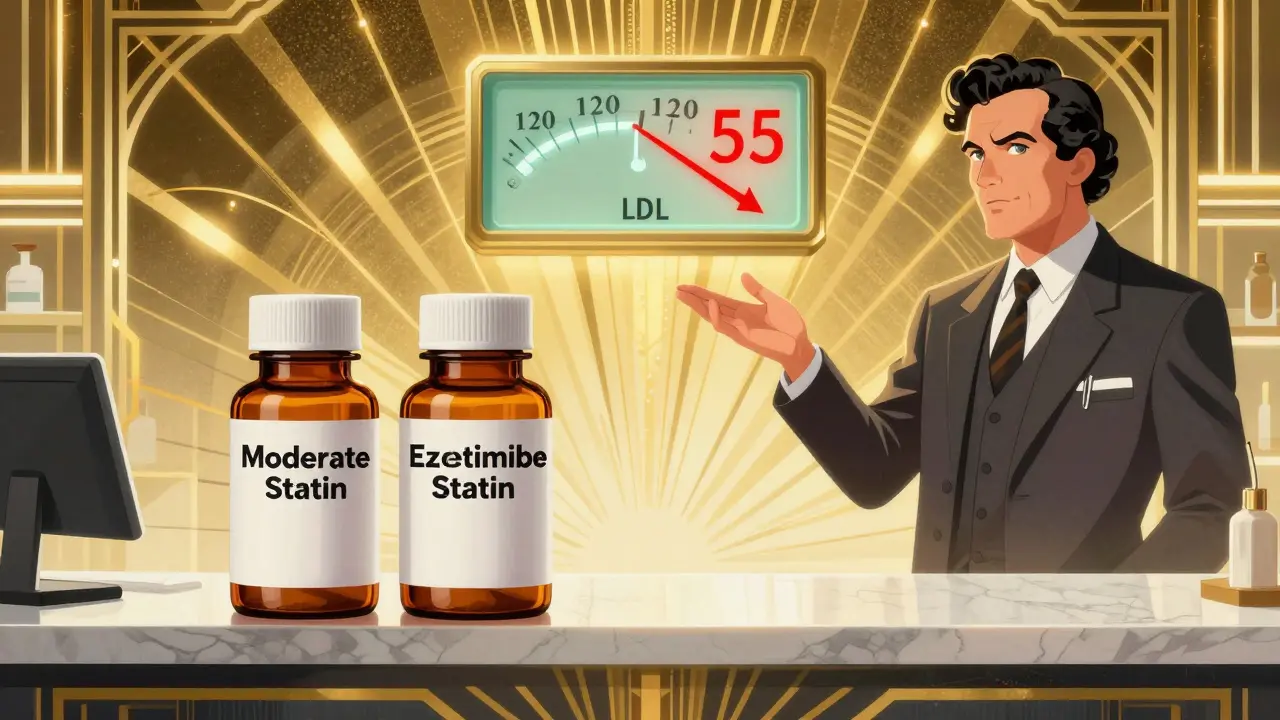
LDL Reduction Calculator
How LDL Reduction Works
Understanding cholesterol reduction is key to better treatment. When you increase statin doses, LDL reduction follows the "Rule of Six": each doubling of the statin dose gives only about 6% additional LDL reduction.
The chart below shows how LDL reduction increases with higher statin doses. Notice how the curve flattens at higher doses—meaning more side effects for less benefit.
Note: The maximum LDL reduction from statins alone is approximately 50%. Beyond this point, the benefits plateau while side effects increase.
Your LDL Reduction Calculator
Most people assume that if a statin isn’t lowering their cholesterol enough, the answer is simple: take more. But what if taking more isn’t just less effective-it’s riskier? That’s the reality behind combination cholesterol therapy with reduced statin doses. Instead of cranking up the statin to high doses, doctors are now starting with lower doses and adding another drug to get the job done. And it’s not just theory-it’s working in real patients, every day.
Why Doubling Your Statin Doesn’t Double Your Results
The old thinking was straightforward: more statin = better cholesterol control. But science doesn’t work that way. In fact, there’s a hard limit called the rule of six. Every time you double a statin dose, you only get about 6% more LDL reduction. So going from 10 mg to 20 mg of atorvastatin might drop your LDL from 120 to 95. Go from 20 mg to 40 mg? It drops to maybe 88. That’s not a big win for doubling the dose-and you’re doubling your risk of side effects.High-dose statins like atorvastatin 80 mg or rosuvastatin 40 mg can lower LDL by about 50%. But that’s the ceiling. You can’t get much more out of the drug itself. And for many people, the side effects-muscle pain, fatigue, liver enzyme spikes-start showing up right around this dose. Studies show up to 15% of patients on high-dose statins stop taking them within a year because of how they feel. That’s not compliance. That’s failure.
What Happens When You Add a Second Drug?
Here’s where things change. Instead of pushing the statin harder, add ezetimibe. It’s a simple pill. One daily tablet. It works in the gut to block cholesterol absorption. Alone, it lowers LDL by about 18-20%. But when you pair it with a moderate statin-say, atorvastatin 20 mg or rosuvastatin 10 mg-the effect isn’t just added. It’s multiplied.Let’s say your statin cuts LDL by 40%. Ezetimibe cuts another 20%. But it doesn’t cut 20% of your original number. It cuts 20% of what’s left after the statin did its job. So 40% reduction + 20% of the remaining 60% = 52% total reduction. That’s better than high-dose statin alone. And you’re taking half the statin dose. Fewer side effects. Same or better results.
Real-world data backs this up. A 2025 analysis of nearly 19,000 patients showed that adding ezetimibe to a moderate statin lowered LDL by an extra 23.7 mg/dL compared to just doubling the statin dose. That’s not a small difference. That’s the difference between missing your target and hitting it. In one study, 78.5% of high-risk patients reached their LDL goal with statin + ezetimibe. Only 62.3% did with statin alone. That’s a 16% jump in success rate-just by adding one cheap, safe pill.
Who Benefits the Most?
This isn’t for everyone. But for certain groups, it’s game-changing.- People with statin intolerance: About 1 in 5 statin users can’t tolerate high doses. Muscle aches, weakness, cramps-they stop taking it. Switching to a lower statin dose plus ezetimibe brings back adherence. One study showed 85% of these patients stayed on the combo after a year. Only 50% stayed on repeated high-dose attempts.
- People with familial hypercholesterolemia: Their LDL starts sky-high-sometimes over 200 mg/dL. Even high-dose statins aren’t enough. Adding ezetimibe or bempedoic acid gets them closer to the goal of under 55 mg/dL.
- Post-heart attack or stroke patients: These are very high-risk. Guidelines say their LDL should be under 55 mg/dL. Getting there with one drug is nearly impossible. Combination therapy gets them there faster-on average, 4.2 months sooner than statin-only treatment.
- People with diabetes and heart disease: They’re at the highest risk. And they often can’t handle high statin doses. Combo therapy gives them control without the side effects.
It’s not about replacing statins. It’s about using them smarter. You still need the statin. But you don’t need to push it to the limit.
Bempedoic Acid: An Alternative for Statin-Intolerant Patients
If even moderate statin doses cause trouble, there’s another option: bempedoic acid. It works in the liver, like statins, but doesn’t enter muscle tissue. That’s why it’s gentler. In the CLEAR Harmony trial, patients on a moderate statin plus bempedoic acid saw the same LDL drop as those on high-dose statin alone-but with 25% fewer muscle-related side effects. For someone who had to quit statins because of pain, this is a lifeline.It’s not perfect. It’s more expensive than ezetimibe. And it can slightly raise uric acid levels, so it’s not ideal for people with gout. But for many, it’s the only way to get back on track.
The Cost Question: Is It Worth It?
Yes. Even if the pills cost more upfront.Ezetimibe is now generic. In the U.S., a month’s supply costs $10-$15. Bempedoic acid? Around $500-$600 a year. PCSK9 inhibitors like evolocumab? Still pricey-$14,000 a year. But here’s the key: every 1 mmol/L (39 mg/dL) drop in LDL-no matter how you get it-lowers your risk of heart attack, stroke, or death by 22%. That’s proven across dozens of trials.
One study found that for every 100 patients treated with statin + ezetimibe instead of high-dose statin alone, 3 major heart events were prevented over five years. That’s 3 heart attacks or strokes avoided. That’s not just saving money on pills-it’s saving money on hospital stays, stents, bypass surgery, and long-term care.
Insurance can be a hurdle. Prior authorizations for non-statin drugs often delay treatment by 7-14 days. But more insurers are starting to cover these combos for high-risk patients. And with the 2023 FDA update saying to use the lowest effective dose of statins, the tide is turning.
Why Isn’t Everyone Doing This?
Because old habits die hard. Most doctors still start with the highest statin dose they think a patient can handle. They wait until the patient fails, then add another drug. That’s backward.Studies show primary care doctors only start combination therapy in 25% of eligible patients-even when guidelines say they should. Why? Lack of training. Confusion about how to calculate LDL reduction. Fear of complexity. And inertia.
Cardiologists are ahead of the curve. In academic centers, 45% of high-risk patients get combo therapy. In community clinics? Only 32%. The gap isn’t about knowledge-it’s about systems. Most clinics don’t have tools to quickly calculate expected LDL reduction. They don’t have protocols to guide the switch.
But that’s changing. The 2024 European Heart Journal guidelines now say: for very high-risk patients, start with moderate statin + ezetimibe. Not as a backup. Not as a last resort. As the first move.
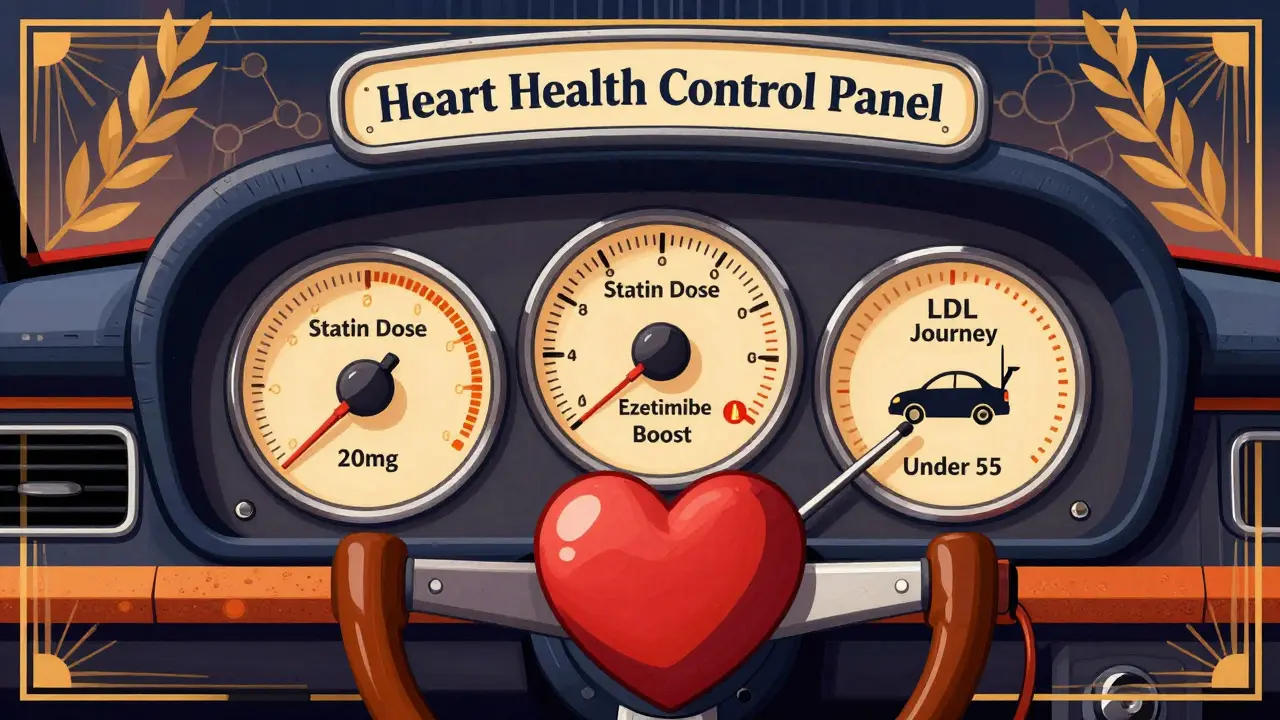
What Should You Do?
If you’re on a high-dose statin and still not hitting your LDL goal:- Ask your doctor: “Could I get the same result with a lower statin dose plus ezetimibe?”
- If you’ve had muscle pain: “Would bempedoic acid or a lower statin dose help me stay on treatment?”
- If you’ve had a heart attack or stroke: “Is my LDL under 55 mg/dL? If not, what’s the next step?”
Don’t assume you need more statin. You might need a different strategy. The goal isn’t to take the biggest pill. It’s to get your LDL low-and keep taking your meds.
What About PCSK9 Inhibitors?
They’re powerful. They can drop LDL by 60%. But they’re injectable, expensive, and usually reserved for people who still haven’t reached target after statin + ezetimibe. They’re not first-line. Not yet. But for those who need it, they’re life-changing. And the new triple combo-high-dose statin + ezetimibe + PCSK9 inhibitor-can lower LDL by 84%. That’s not just good. It’s extraordinary.But most people don’t need that. Most people just need a smarter start.
Final Thought: It’s Not About More Drugs. It’s About Better Choices.
Combination therapy with reduced statin doses isn’t a shortcut. It’s a smarter path. It respects the science. It listens to the body. It reduces side effects without sacrificing results. And it’s backed by real outcomes-not just theory.For too long, we’ve treated cholesterol like a volume knob: turn it up until it’s loud enough. But cholesterol isn’t a stereo. It’s your heart. And you don’t need to blast it to save it. You just need to tune it right.
Can I just take ezetimibe instead of a statin?
No. Ezetimibe alone lowers LDL by only 18-20%. For most people, especially those with heart disease, diabetes, or very high cholesterol, that’s not enough. Statins are still the most effective first-line treatment. Ezetimibe is meant to be added to a moderate statin-not replace it.
Is combination therapy safe for long-term use?
Yes. Ezetimibe has been used safely for over 20 years. Bempedoic acid has been studied in trials lasting up to five years with no major safety signals. The combination of statin + ezetimibe is as safe as statin monotherapy, and in many cases, safer because the statin dose is lower. The IMPROVE-IT trial followed patients for nearly seven years and found no increase in cancer, liver, or muscle problems with the combo.
Will I need to take these pills forever?
For most people with established heart disease, high cholesterol, or diabetes, yes. Cholesterol-lowering therapy is not a cure-it’s a long-term management strategy. Stopping means your LDL will rise again. But the goal isn’t to take pills forever because you have to. It’s to take them because they’re helping you live longer and avoid heart attacks and strokes.
What if I can’t afford the combo?
Ezetimibe is available as a low-cost generic-often under $10 a month. Bempedoic acid is more expensive, but many patient assistance programs exist. If cost is an issue, talk to your doctor. They can often help you find coupons, manufacturer discounts, or switch to a more affordable option. The cost of a heart attack or stroke is far higher than any pill.
How do I know if I’m a good candidate for this approach?
You’re a good candidate if: your LDL is still too high on a moderate statin; you’ve had side effects from high-dose statins; you have heart disease, diabetes, or familial hypercholesterolemia; or your doctor says you need to lower your LDL by more than 50%. If any of those apply, ask about adding ezetimibe or bempedoic acid.
So let me get this right-we’ve been giving people massive statin doses like they’re energy drinks, and nobody thought to just ADD A SIMPLE PILL??!?!!? I mean, come ON! Ezetimibe costs less than my monthly coffee habit, and it’s doing the heavy lifting while my statin takes a nap?!? This is the medical equivalent of realizing you can fix a leaky faucet with a rubber band instead of replacing the whole pipe!!!
The rule of six is one of those beautiful, underappreciated truths in lipidology-it’s not just about the statin dose, it’s about diminishing returns and pharmacokinetic ceilings. When you combine ezetimibe, which inhibits NPC1L1-mediated cholesterol absorption in the jejunum, with a moderate-intensity statin that upregulates LDL receptors via HMG-CoA reductase inhibition, you’re achieving synergistic pleiotropic effects beyond mere additive reduction. The IMPROVE-IT trial demonstrated a 6.4% relative risk reduction in major cardiovascular events over seven years, and that’s with only a 23.7 mg/dL additional LDL drop. That’s not marginal-it’s clinically transformative. And yet, primary care providers still default to high-dose statins because of inertia, lack of EHR decision support, and outdated continuing education modules. We need better systems, not just more pills.
OMG this is literally the most revolutionary thing since sliced bread?? 😭😭😭 I’ve been on 80mg atorvastatin for 3 years and my muscles feel like they’ve been through a blender. I switched to 20mg + ezetimibe and now I can actually lift my arms to brush my hair. I’m not crying, you’re crying. 💪💊 #StatinsAreOverrated #EzetimibeIsMySavior
It is imperative to underscore that the clinical efficacy of combination therapy must be contextualized within the broader framework of evidence-based guidelines, particularly those promulgated by the American College of Cardiology and the European Society of Cardiology. The assertion that reduced statin dosing with adjunctive ezetimibe constitutes a superior therapeutic strategy is empirically supported by multiple randomized controlled trials, including IMPROVE-IT and FOURIER. However, the generalizability of these findings to heterogeneous populations-particularly those with comorbid renal impairment or polypharmacy-remains an area requiring further investigation. The cost-benefit analysis must also account for adherence dynamics, which are demonstrably improved with lower-dose regimens.
I want to thank the author for writing this with such clarity and compassion. So many patients are told, ‘Just take more,’ without being told why that’s not always the answer. This isn’t just about cholesterol-it’s about dignity. It’s about giving people a treatment that works without breaking their body. The fact that ezetimibe is generic, safe, and effective should make it the default add-on, not the afterthought. I’ve seen patients cry because they finally feel like themselves again after switching. This isn’t medicine. This is justice.
Okay, but let’s be real-this is just Big Pharma’s new cash cow. First they pushed high-dose statins. Now they’re pushing combo pills like it’s the next big thing. EZETIMIBE? It’s been around since 2002. Why is this suddenly groundbreaking? And don’t get me started on bempedoic acid-$600 a year? That’s not affordable, that’s a scam. They’re just repackaging old drugs with new marketing. Wake up, people.
Have you ever wondered why the FDA keeps approving these new combos? It’s not because they’re safer-it’s because the pharmaceutical industry owns the guidelines. The rule of six? It’s real, but it’s also been quietly buried for years so they could keep selling high-dose statins. And now? They’re selling ezetimibe + statin combos like it’s a miracle. But what about the long-term effects of blocking cholesterol absorption for decades? What about bile acid disruption? What about the gut microbiome? Nobody talks about that. And don’t even get me started on how the lipid panels are manipulated to make these combos look better. This is a controlled narrative. You’re being played.
Y’all in the US are acting like this is some new discovery. We’ve been doing this in South Africa since 2015. Ezetimibe is cheap as chips, statins are generic, and doctors here don’t have the luxury of wasting money on 80mg doses. We don’t have fancy EHRs, but we do have common sense. If the patient can’t handle the high dose, you lower it and add the other pill. It’s not rocket science. It’s medicine. Why is this even a debate?
Bro, you’re telling me the ‘rule of six’ is real? I thought that was just a myth people made up to sound smart. So doubling the dose only gives you 6% more? That’s wild. So if I take 10mg and get 40% off, then 20mg gives me 46%? Then 40mg gives me 52%? So why not just start with 20mg + ezetimibe from day one? That’s like buying a $1000 TV and then buying a $50 remote to make it work better instead of buying a $2000 TV. Why are we still doing this the hard way?
What if this is all a lie? What if the statin industry is just trying to avoid lawsuits by pushing combo therapy because high-dose statins cause rhabdo and liver damage? What if the real reason they’re pushing ezetimibe is because they’ve been hiding the truth that cholesterol isn’t even the main cause of heart disease? What if it’s inflammation? What if it’s insulin resistance? What if all this is just a distraction so they can keep selling pills? I’ve read studies where statins don’t even help people without existing heart disease. This feels like a distraction. I’m not taking it.
Let’s clarify the mechanism: ezetimibe targets NPC1L1, reducing dietary and biliary cholesterol absorption, while statins inhibit HMG-CoA reductase, decreasing endogenous synthesis. The additive effect is not merely arithmetic-it’s physiological. The LDL-C reduction is multiplicative because the pathways are non-redundant. This is why the combo achieves ~55-60% reduction where monotherapy caps at ~50%. The CLEAR Harmony data on bempedoic acid confirms this with ACLY inhibition bypassing muscle toxicity. The only barrier is cognitive: clinicians still equate intensity with efficacy, when it’s really about precision.
There is a moral imperative here, and it is this: to subject a patient to muscle pain, fatigue, and potential hepatotoxicity for the sake of a 6% incremental benefit is not medicine-it is negligence. The patient’s quality of life is not a secondary outcome. It is primary. To prescribe high-dose statins as first-line without considering the patient’s lived experience is to reduce human beings to biomarkers. The shift toward combination therapy with reduced statin dosing is not merely a pharmacological advancement-it is a reclamation of ethical care.
In my village in Nigeria, we say: 'When the hammer breaks, you don’t hit harder-you find another tool.' This is what they’re doing here. The statin is the hammer. The ezetimibe? The screwdriver. You don’t need to smash the nail to get it in. You just need the right tool. And for people who’ve lost their strength from statins? Bempedoic acid is the new hand drill-quiet, gentle, and effective. This isn’t Western medicine being smart. This is ancient wisdom being rediscovered. The body knows what it can handle. We just forgot to listen.
I’m a nurse, and I’ve watched so many patients quit their meds because they felt awful. One lady told me, ‘I’d rather have high cholesterol than never be able to play with my grandkids again.’ That broke my heart. Switching her to rosuvastatin 10mg + ezetimibe? She’s back to gardening, hiking, dancing. She said, ‘I feel like I got my life back.’ That’s not just science. That’s humanity. Please, if you’re a doctor reading this-don’t be afraid to try the combo. It changes lives.
This is the most common sense thing I’ve read all year. Statins are great but they’re not magic. Sometimes you just need to add another tool. Simple. No drama. No hype. Just science. I’m telling my dad to ask his doctor about ezetimibe tomorrow