
Imagine standing in customs at an airport halfway around the world. You have your passport, your boarding pass, and your suitcase packed tight. But then, an officer asks about the small bottle of pills in your pocket. Without the right paper in hand, that life-saving medication could be confiscated-or worse, you could face detention. This isn't a movie plot; it is a reality for millions of travelers carrying controlled substances, which are medications regulated under international drug control conventions due to their potential for abuse or dependence.
If you take medications for ADHD, anxiety, pain, or sleep, you likely fall into this category. Opioids, stimulants like Adderall, and benzodiazepines are tightly monitored globally. The key to staying safe and legal? A properly formatted doctor’s letter. This guide breaks down exactly what that letter needs, why countries demand it, and how to avoid the common pitfalls that lead to travel nightmares.
Why Do Countries Require Medical Documentation?
You might wonder why carrying your own medicine requires so much red tape. It comes down to global treaties. Three major international agreements-the 1961 Single Convention on Narcotic Drugs, the 1971 Convention on Psychotropic Substances, and the 1988 UN Convention Against Illicit Traffic-govern how these drugs are handled worldwide. These treaties allow governments to restrict substances but also create exceptions for legitimate medical use.
The International Narcotics Control Board (INCB) is a body established by the United Nations to monitor the implementation of international drug control treaties. In their 2023 guidelines, they recommend standardized documentation to help travelers while preventing drug trafficking. According to the INCB’s 2022 annual report, 142 countries have submitted national regulations regarding travelers carrying controlled substances. This means almost everywhere you go has rules. The goal is simple: verify that you are a patient, not a trafficker.
Dr. Ghada Wible, Chief of the Demand Reduction and Health Branch at the UN Office on Drugs and Crime (UNODC), noted in the 2022 INCB report that the absence of appropriate medical documentation remains the single largest cause of traveler detention related to medication possession. Getting this right isn't just bureaucratic; it is essential for your freedom and health.
What Must Be in Your Doctor’s Letter?
A generic note saying "Patient needs meds" will not cut it. Authorities look for specific details to match the pills in your bag to your medical history. Based on templates from the CDC’s 2023 Yellow Book and FDA guidelines updated in May 2023, here is what your letter must include:
- Patient Details: Your full legal name and date of birth, matching your passport exactly.
- Physician Details: The doctor’s full name, title, license number, and direct contact information (phone and email).
- Medication Specifics: The generic name of the drug is critical because brand names vary by country. Include the dosage, frequency, and route of administration.
- Medical Condition: A clear statement of the condition being treated (e.g., Attention Deficit Hyperactivity Disorder, Chronic Pain).
- Quantity Justification: A statement confirming the quantity is for personal use only, typically limited to a 90-day supply as advised by the FDA and U.S. Customs and Border Protection (CBP).
- Formal Request: A sentence explicitly requesting that the patient be allowed to carry these medications without restriction.
The letter must be printed on official healthcare provider letterhead and signed by the prescribing physician. Dr. Robert L. Hillman, FDA’s Director of Drug Information, emphasized in a May 2023 interview that many physicians omit specific language required by the DEA for Schedule II substances, creating unnecessary complications. Make sure your doctor knows the stakes.
Country-Specific Rules: Where Things Get Tricky
While the INCB tries to standardize things, local laws still rule. The INCB’s 2023 database shows that 78 countries require doctor’s letters for all controlled substances, but some places go further.
| Region/Country | Key Requirement | Risk Level |
|---|---|---|
| Japan | Many ADHD meds (like Adderall) are prohibited entirely despite documentation. Requires prior approval for others. | Very High |
| United Arab Emirates | Advance approval from the Ministry of Health is required even with a doctor's letter. | High |
| Singapore/Malaysia | Criminal penalties apply if quantity exceeds 30 days' supply, even with proper docs. | High |
| European Union | Generally follows INCB procedures; recognizes EU doctor's letters. Up to 90 days allowed. | Low-Medium |
| United States | Requires both doctor's letter and valid prescription for entry. CBP enforces strictly. | Medium |
| Canada | Accepts doctor's letters alone for personal quantities under 100 dosage units. | Low |
For example, Japan maintains particularly stringent requirements. The U.S. Embassy in Tokyo’s January 2023 health advisory notes that amphetamines found in Adderall are largely prohibited. If you are heading there, you need more than a letter; you need a specialized import permit. Meanwhile, in the UAE, the Pharmaceutical Control Department requires advance clearance. Never assume a letter is enough-check the embassy website for your specific destination.
Packing and Presentation: The Physical Reality
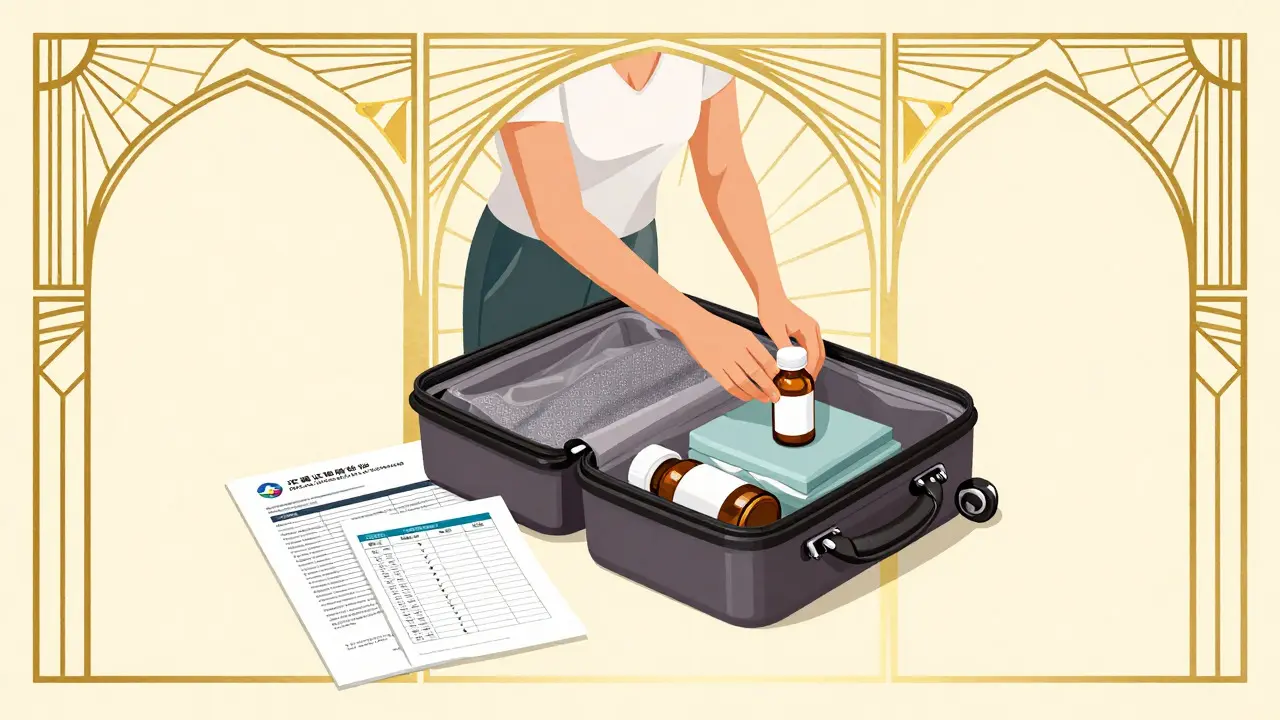
Your paperwork is only half the battle. How you pack your meds matters just as much. The FDA’s 2023 guidelines state that medications should be kept in their original labeled containers. Why? Because the label provides immediate proof of the prescription, dosage, and pharmacy source. Transferring pills to a weekly organizer is risky unless you carry the original bottle alongside it.
Keep everything accessible. Do not bury your meds in checked luggage. Carry them in your hand luggage so you can present them quickly if asked. Also, ensure the quantity matches your documentation. If your letter says 30 days, do not bring 60. The FDA and CBP consistently advise carrying no more than a 90-day supply for personal use. Exceeding this raises flags for potential resale.
Language barriers are another hidden trap. The INCB’s 2022 incident report documented language issues in 37% of cases. If your destination does not speak English, get a certified translation of your doctor’s letter. The FDA requires documentation to be in English or accompanied by a certified translation. This small step can prevent misunderstandings at customs.
Step-by-Step Preparation Guide
To avoid last-minute panic, start this process early. Brown University’s study abroad office recommends consulting your physician at least two months before departure. Here is your checklist:
- Research Destination Laws: Check the U.S. Department of State travel page or the local embassy. Note that 58% of travelers rely on inaccurate sources, so stick to official government sites.
- Visit Your Doctor: Ask for a comprehensive list of medications including generic names, chemical compositions, and dosages. A 2022 survey found that 72% of physicians fail to provide chemical names, which are often required by strict jurisdictions.
- Get the Letter: Ensure it uses the CDC template format or similar, includes all mandatory elements, and is signed on official letterhead.
- Verify Quantities: Align your pill count with the letter. Separate letters may be needed for each controlled substance per FDA guidance.
- Translate if Needed: Arrange for certified translations well in advance.
- Pack Smart: Keep meds in original containers in your carry-on. Bring copies of the letter and keep the original safe.
Emerging Trends: Digital Certificates
The landscape is changing. The INCB launched a pilot program in June 2023 for a standardized digital medical certificate across 12 European countries. The European Commission has funded a €2.4 million project to create a harmonized EU-wide system, expected by late 2024. While this promises easier travel, physical documents remain the gold standard for now. Do not rely solely on digital records until your destination country officially accepts them. The WHO’s 2023 Digital Health Global Strategy highlights this as a priority, but regulatory fragmentation remains high, with 28 countries introducing new restrictions in 2022 alone.
Do I need a doctor's letter for non-controlled medications?
Technically, no. However, it is highly recommended to carry a letter for any prescription medication, especially if you are traveling with large quantities or injectable drugs. Some countries may question any medication not clearly identified, and a letter simplifies the process significantly.
Can I use a photocopy of my doctor's letter?
It is best to carry the original signed letter. Photocopies are often accepted as backups, but authorities may request the original to verify signatures and letterhead authenticity. Always carry at least one original copy in your carry-on luggage.
What happens if I forget my doctor's letter?
You risk having your medication confiscated or facing detention for questioning. In strict countries like Singapore or the UAE, this could lead to criminal charges. If you realize you forgot it before leaving home, contact your doctor immediately to email a scanned copy, though a physical signature is preferred.
How long is a doctor's letter valid?
There is no universal expiration date, but most authorities expect the letter to be recent, ideally issued within the last 3 to 6 months. If your trip is delayed significantly, consider getting an updated letter to reflect current treatment plans.
Are electronic prescriptions accepted internationally?
Acceptance varies widely. The FDA and CBP updated guidance in May 2023 to clarify requirements for electronic prescriptions, but many countries still prefer physical documentation. Always check the specific requirements of your destination country before relying on e-prescriptions.