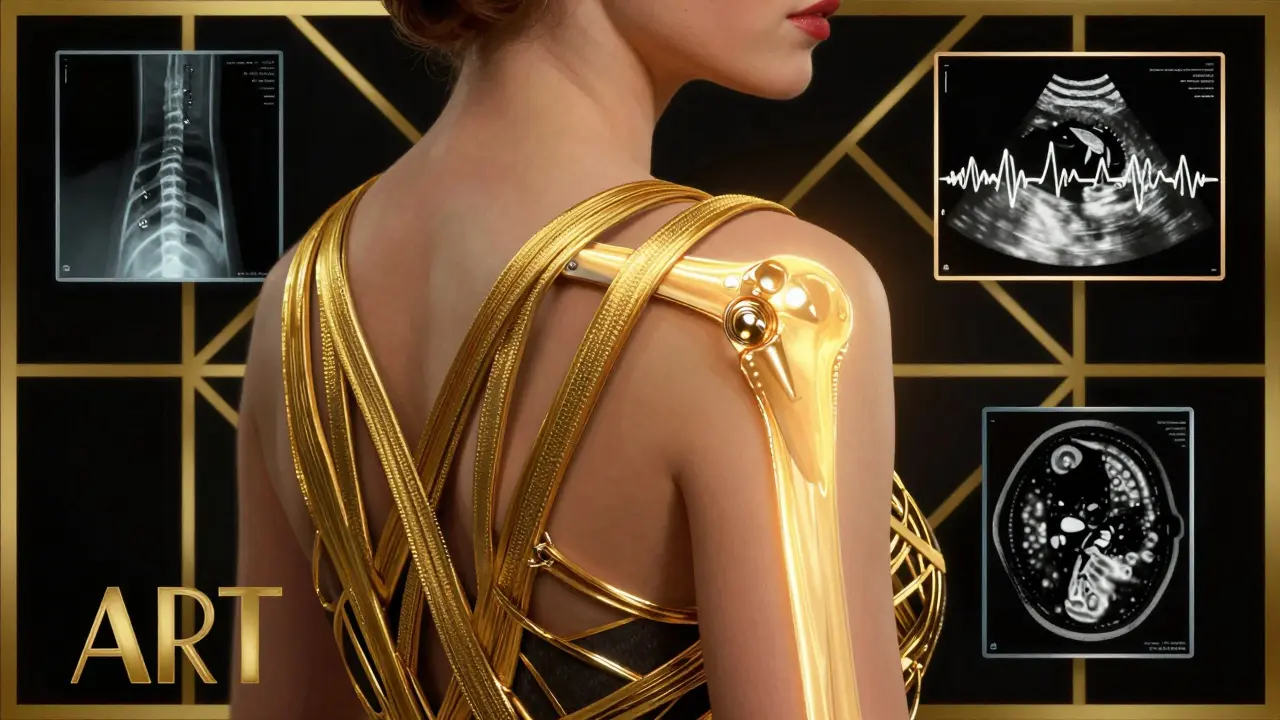
What Exactly Is a Rotator Cuff Tear?
A rotator cuff tear happens when one or more of the four tendons that hold your shoulder together get damaged. These tendons connect the muscles of your shoulder blade to the top of your arm bone. The main ones involved are the supraspinatus, infraspinatus, teres minor, and subscapularis. Think of them like the four straps holding a heavy backpack securely to your shoulders - if one snaps, the whole system starts to wobble.
These tears don’t always come from a single injury. In fact, most happen slowly over time from wear and tear, especially after age 40. You might not even notice at first. Studies show that over half of people over 60 have a rotator cuff tear but feel no pain at all. That’s why symptoms like dull aches, weakness when lifting your arm, or trouble sleeping on your side shouldn’t be ignored - they’re clues, not just aging.
How Doctors Diagnose It - Without Guessing
Before any scan, your doctor will move your arm in specific ways. Tests like the Empty Can, Neer impingement, and Hawkins-Kennedy aren’t just random motions. They’re proven tools to check if the tendons are irritated or torn. If you can’t lift your arm against resistance or feel sharp pain when your shoulder is twisted a certain way, that’s a red flag.
Then comes imaging. X-rays are always the first step - not because they show the tear, but because they rule out other things like bone spurs or arthritis that can mimic tendon pain. If the X-ray looks clean but you still hurt, the next move is soft tissue imaging.
Two options exist: ultrasound and MRI. Ultrasound is faster, cheaper, and lets the doctor watch your shoulder move in real time. It’s about 87-91% accurate for full-thickness tears and costs roughly half as much as an MRI. Many patients prefer it because it’s quiet, open, and doesn’t require lying still in a tight tube. But here’s the catch: it only works well if the technician is specially trained. Only 45% of general radiologists have that skill.
MRI gives a more detailed picture. It shows not just if the tendon is torn, but how big the tear is, whether it’s new or old, and if the muscle has started to waste away. For full-thickness tears, MRI is 92% accurate. It’s the gold standard when surgery is being considered because it gives the surgeon a clear map of what they’ll be fixing.
Contrast dye isn’t usually needed unless you’ve had surgery before and the doctor suspects a retear. Most of the time, a regular MRI is enough.
When You Don’t Need Surgery - And Why
Here’s something most people don’t expect: you don’t always need surgery. For partial-thickness tears - where the tendon is frayed but not fully cut - up to 85% of people get better with physical therapy alone. Even some small full-thickness tears can heal without an operation, especially if you’re not very active or over 65.
The standard rehab plan has three phases. First, you protect the shoulder for 6 weeks with gentle passive motion - someone else moves your arm for you, no lifting. Then, you start active-assisted exercises, using your other arm or a band to help move the injured one. After 12 weeks, you begin strengthening. Progress is slow, but skipping steps leads to re-injury.
Studies show that patients who stick with rehab for at least 3 months often regain 90% of their normal function. The key isn’t just doing the exercises - it’s doing them correctly, consistently, and under supervision. A bad rehab program can make things worse.
Surgery Options - What’s Really Best Today?
If your tear is large, you’re young and active, or rehab hasn’t helped after 3 months, surgery becomes the next step. In the U.S., about 250,000 rotator cuff repairs are done each year. And over 90% of them are done arthroscopically.
Arthroscopic surgery means the surgeon makes two or three tiny cuts, inserts a camera and small tools, and repairs the tendon using anchors. It’s less invasive than the old open method, which required a large incision. Recovery is faster, pain is lower, and complications drop by 30%. Most people go home the same day.
Mini-open surgery is a hybrid - a small cut with arthroscopic tools. It’s used less often now, mostly for massive tears or when the tendon is too damaged to be fixed with just scopes.
Open surgery is rare today. Only used in complex cases, like when the tendon has pulled away from the bone and retracted far back, or when there’s a previous failed repair.
One big change in the last decade: surgeons no longer immobilize your arm for weeks after surgery. Instead, you start moving it gently the day after. This reduces stiffness and speeds up healing. You’ll wear a sling for 4-6 weeks, but you’ll be doing passive motion exercises from day one.
What Happens After Surgery - The Real Recovery Timeline
Recovery isn’t just about healing the tendon. It’s about rebuilding strength, restoring movement, and retraining your brain to use your shoulder again. Many people think they’re “fixed” after surgery, but that’s only the start.
Weeks 1-6: Passive motion only. No lifting, no pushing, no reaching. You’ll work with a physical therapist to gently move your arm without using your own muscles. This keeps the shoulder from freezing up.
Weeks 6-12: Active-assisted motion. You start using your shoulder more, but still with help - bands, pulleys, or your good arm. Strengthening is still off-limits.
Weeks 12-24: Strengthening begins. Light resistance, then gradually heavier. This is where most people give up. It’s boring. It’s slow. But skipping this phase means you’ll never get full function back.
By 6 months, most patients can return to normal daily activities. Athletes and laborers may need up to 9 months to return to full duty. Patience isn’t optional - rushing it doubles your risk of retearing.
Why Some Tears Come Back - And How to Avoid It
Even with perfect surgery and rehab, retears happen. For small tears, the risk is only about 12%. For large tears (over 3 cm), it jumps to 27%. Why? Because the tendon tissue gets weak and thin over time. If the muscle has already shrunk or turned to fat, the tendon can’t reattach properly.
That’s why timing matters. If you wait too long - say, over a year - the chance of a successful repair drops. That’s why doctors now recommend earlier surgery for active patients under 65, even if they’re not in terrible pain.
Some new techniques are helping. Patch augmentation - sewing a biological mesh over the repair - is being used for massive tears to give the tendon extra support. Platelet-rich plasma (PRP) injections are sometimes added during surgery, hoping to boost healing. But the evidence is mixed. The Cochrane Review found only weak support for PRP. It’s not standard care.
What does work? Good technique, proper rehab, and not smoking. Smoking cuts blood flow to tendons and slows healing by up to 50%. If you smoke, quitting before surgery is one of the best things you can do.
What to Expect Long-Term - The Real Numbers
Five years after surgery, 82% of patients say they’re satisfied with the results. That’s high - but it doesn’t mean everyone feels 100% normal. Some still have occasional stiffness or weakness, especially in cold weather or after heavy lifting.
Most people can return to golf, swimming, gardening, and even tennis. But overhead sports like volleyball or weightlifting? Those require caution. Your shoulder will never be exactly like it was before the tear.
The goal isn’t perfection. It’s function. Can you reach for the top shelf? Can you carry groceries? Can you sleep through the night? If the answer is yes, you’ve done well.
When to Skip Imaging Altogether
Here’s a surprising truth: the American Academy of Orthopaedic Surgeons now says you don’t need an MRI or ultrasound right away. If your symptoms match a typical rotator cuff tear - pain with lifting, weakness, no trauma - start with 6 to 8 weeks of physical therapy first.
Why? Because many people have tears on scans but feel no pain. Imaging can lead to unnecessary worry and surgery. If therapy helps, you’ve avoided a scan, a bill, and a recovery period you didn’t need.
Only move to imaging if therapy fails, or if your symptoms are sudden, severe, or accompanied by numbness or tingling down the arm. That’s when you need to rule out something else - like a pinched nerve or a different shoulder problem.
What’s Next for Rotator Cuff Care?
The field is changing fast. Researchers are testing AI to read MRIs faster and more accurately. One 2023 study showed a deep learning algorithm could tell partial from full-thickness tears with 89% accuracy - better than some human radiologists.
Ultrasound is getting smarter too. New handheld devices let physiotherapists check your tendon during rehab sessions. That means you get real-time feedback: “Your tendon is healing,” or “You’re overdoing it today.”
But the core hasn’t changed. Good diagnosis. Tailored rehab. Smart surgery. And patience. No magic fix. Just science, time, and effort.
I hurt my shoulder lifting a fridge last year. Didn't go to the doctor for months. Just kept moving it gently and doing those band exercises. Now I can reach the top shelf again. No surgery. Just patience.
250k rotator cuff surgeries a year? Bro, we're turning shoulders into IKEA furniture that needs assembly. Just move your arm. Stop paying doctors to glue tendons back together like duct tape on a broken chair.
People don’t realize how much shame comes with saying, ‘I can’t lift my coffee cup.’ It’s not just pain-it’s losing a piece of your independence. Rehab isn’t lazy-it’s brave. And if your PT makes you cry? Good. That means you’re actually trying.
Let me just say-this is the most accurate, well-researched piece I’ve seen on this topic since the JAMA Ortho meta-analysis of 2021. The emphasis on ultrasound accuracy? Spot on. And the fact that you mentioned technician training? Most articles gloss over that. I’m a radiologist in Boston-this is exactly what I tell residents. Also, smoking kills tendons faster than caffeine kills your sleep. Quit it. Now.
Of course the AAO recommends PT first-because insurance won’t pay for an MRI unless you’ve ‘tried conservative measures.’ This isn’t medicine-it’s bureaucratic theater. And don’t get me started on AI reading MRIs. If a machine can out-diagnose a human radiologist, why do we still pay them $400k/year? The system is broken. We’re treating symptoms, not the rot.
I did the rehab for 4 months. Did everything right. Then one day I reached for my phone on the nightstand and felt that pop. Again. Now I just sleep on my back and pretend I’m a statue. My shoulder hates me. And honestly? I get it.
To anyone reading this and thinking ‘I’m too old for this’-you’re not. My mom, 71, did full rehab after a partial tear. Now she knits, gardens, and carries her own groceries. It’s slow. It’s boring. But it’s possible. You’re worth the effort. Keep going.
Smoking = 50% slower healing. That’s not a suggestion. That’s a warning label on your life. If you’re planning surgery and still puffing? You’re not just hurting your shoulder-you’re disrespecting every doctor, therapist, and family member who cares about you. Put it out. For real.
you know what i did? i just started doing yoga. not the fancy kind. the kind where you sit and breathe. and slowly, like, i started lifting my arm again. no scans. no pills. just me and my mat. weird? maybe. worked? yeah.
Wait so if you have a tear but no pain… you just… ignore it? Like a ghost shoulder? That’s wild. I thought if it’s broken, you fix it. But apparently in the US we treat body parts like exes-wait till they hurt you bad before we deal with them.
It is imperative to underscore the clinical significance of early intervention in rotator cuff pathology, particularly in individuals under the age of sixty-five. The biomechanical deterioration of tendon integrity is irreversible once significant fatty infiltration occurs. Therefore, a multidisciplinary approach, integrating imaging, physical rehabilitation, and timely surgical referral, remains the gold standard in contemporary orthopedic practice.
they don't want you to know this but the rotator cuff is a distraction. the real problem? the government is replacing tendons with microchips so they can track your movement. that's why they push surgery and scans. they don't want you moving freely. quit the system. go barefoot. lift rocks. heal naturally.