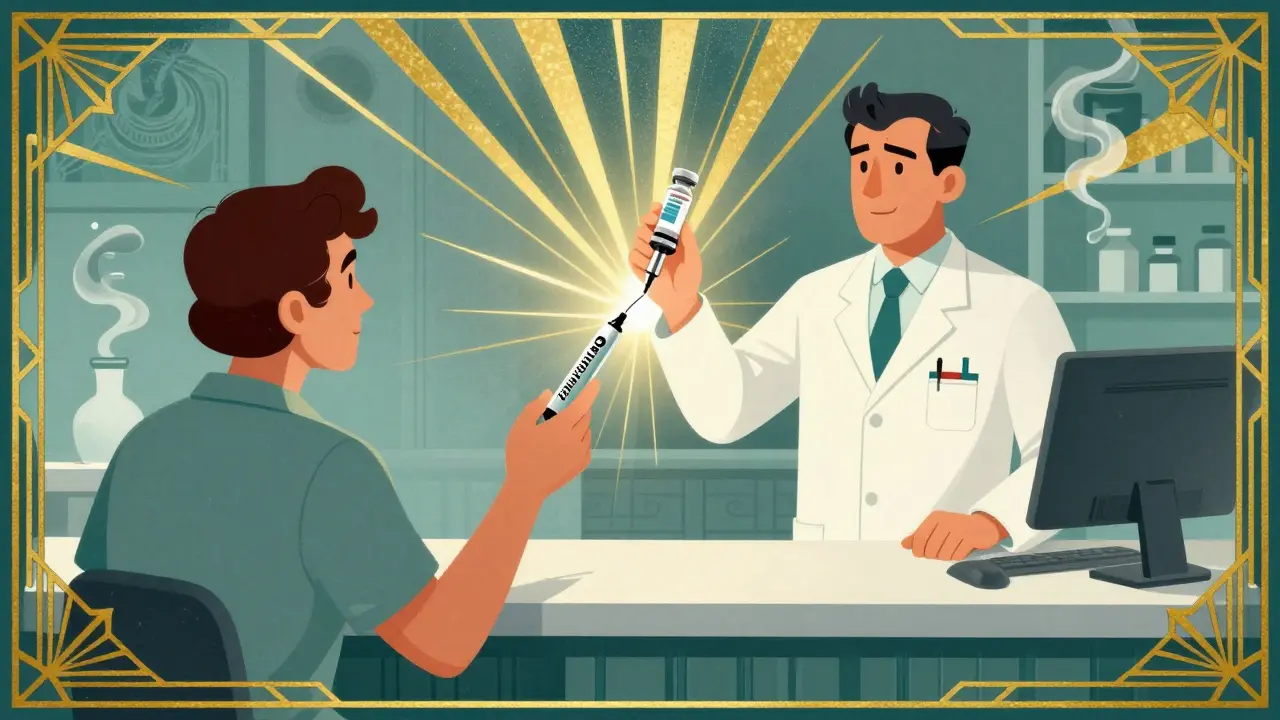
Imagine you need an EpiPen. You’ve been prescribed epinephrine because of a severe allergy. Your insurance only covers generics, so you expect to get a cheaper version. But when you pick it up, the pharmacist says, "We can’t give you a generic unless you get the exact same auto-injector device." That’s because what you’re using isn’t just a drug-it’s a combination product. And when it comes to generics, things get complicated fast.
What Exactly Is a Combination Product?
A combination product is anything that brings together two or more types of medical components-like a drug and a device-into one unit. These aren’t just packaged together for convenience. They’re designed to work as a single system. Think of an inhaler with medicine inside, a prefilled syringe, or an auto-injector like an EpiPen. The drug doesn’t work right without the device, and the device has no purpose without the drug. The U.S. Food and Drug Administration (FDA) defines these products under 21 CFR 3.2. There are three types:- Components physically or chemically combined, like a drug-coated stent
- Components packaged together, like insulin pens with pre-filled cartridges
- Components sold separately but labeled to be used together, like a generic epinephrine vial and a specific auto-injector device
Why Can’t You Just Swap Out the Drug?
In the world of regular generic drugs, substitution is simple. If your brand-name pill has a generic version, your pharmacist can switch it without asking your doctor. That’s because the active ingredient is identical, and the body absorbs it the same way. But with combination products, it’s not that easy. Take the EpiPen. The drug (epinephrine) is generic. But the auto-injector? That’s a medical device. And even if you have a generic version of the drug, you can’t use it with a different device unless that device has been approved specifically for use with that drug. Why? Because the device affects how the drug is delivered. The spring tension, needle length, injection speed, and even the button feel-all of these matter. If the generic drug is injected too slowly or too shallowly, it might not work. If it’s too fast, it could cause injury. The FDA requires manufacturers to prove that the generic version performs exactly like the brand-name product in real-world use. That’s called therapeutic equivalence. And here’s the catch: most generic manufacturers only make the drug. They don’t make the device. So even if you have a generic drug, you still need the matching generic device. And often, that device doesn’t exist yet.The Regulatory Maze
The FDA doesn’t treat combination products like regular drugs. They’re reviewed by a special office-the Office of Combination Products-created in 2002. The review team depends on the Primary Mode of Action (PMOA). If the drug does the main job, it’s reviewed by CDER (Center for Drug Evaluation and Research). If the device does the main job, it’s reviewed by CDRH (Center for Devices and Radiological Health). For a generic version of a combination product, manufacturers must submit an ANDA (Abbreviated New Drug Application). But unlike regular generics, they must also prove:- The device works the same way as the brand’s device
- The user interface is identical (button feel, safety features, visual cues)
- The drug and device work together without failure
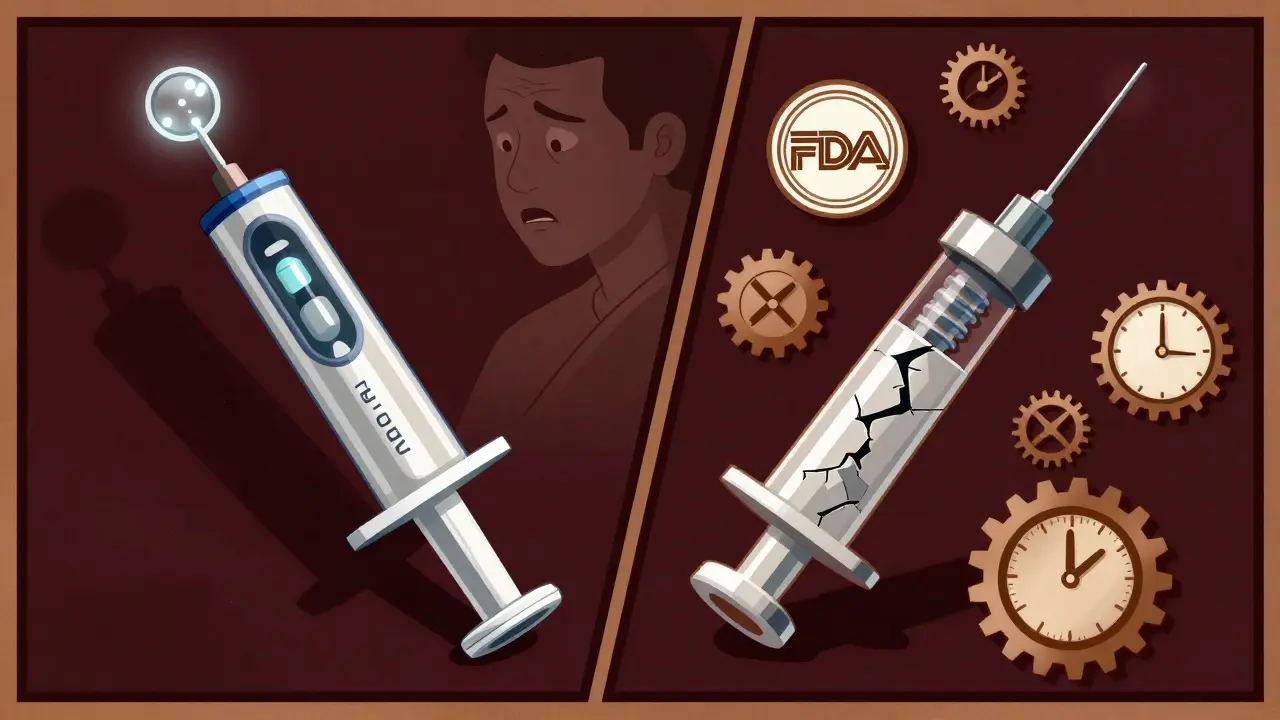
Why So Few Generics Exist
You’d think with so many branded combination products on the market, generics would flood in. But they haven’t. Here’s why:- Only 38% of complex generic combination products have more than one manufacturer approved
- Just 17 companies control 83% of all approved generic combination products
- While 92% of regular generic drugs get approved within 10 months, only 47% of combination product ANDAs do
- Branded combination products still hold 68% of the market
Real Problems Real People Face
This isn’t just a regulatory issue. It’s a real-world problem. Pharmacists report that 68% have dealt with substitution confusion. Over 40% get at least one patient complaint per month. One Reddit thread about EpiPen generics had 287 comments. A pharmacist wrote: "The auto-injector device is considered part of the product, so even if you have a generic epinephrine, you need the specific generic auto-injector approved for substitution-which often doesn’t exist yet." Doctors see delays too. A 2024 AMA survey found 57% of providers had treatment delays because patients couldn’t get the right combination. On average, each delay lasted 3.2 business days. That’s time without medication. For someone with asthma, diabetes, or severe allergies, that’s dangerous. Patient advocacy groups documented 217 cases in 2023 where people couldn’t access a therapeutic equivalent. That number rose 29% from the year before.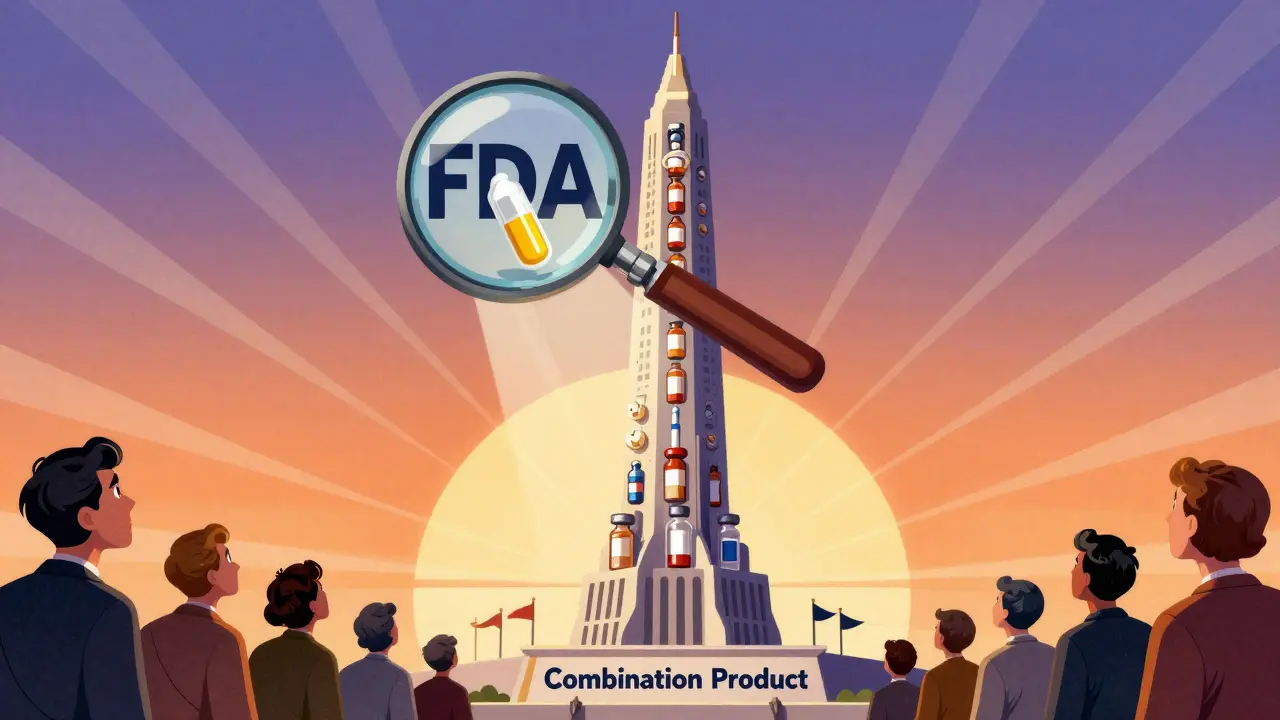
What’s Changing?
There’s some progress. In April 2024, the FDA released new guidance on how to submit comparative analyses for generic combination products. It’s clearer. It’s more detailed. That’s a good sign. States are stepping in too. California and Massachusetts passed laws to update substitution rules so pharmacists can switch combination products more easily-when they’re truly equivalent. The FDA launched "Complex Generic Initiative 2.0" in June 2024. The goal? Cut approval times by 30% by 2026. They’ve hired 32 new reviewers just for these products. Industry analysts predict generic penetration in this space could rise from 19% to 35% by 2027. That’s still low. But it’s movement.What This Means for You
If you’re prescribed a combination product-like an inhaler, insulin pen, auto-injector, or infusion pump-don’t assume you’ll get a generic. Ask your doctor and pharmacist:- Is there a generic version of the entire product, not just the drug?
- Has the generic device been approved by the FDA for substitution?
- Will my insurance cover it, or will I pay more?
The Bigger Picture
The global market for drug-device combination products is growing fast-projected to hit $214 billion by 2028. But if we want patients to benefit from lower costs, we need generics that actually work. The system isn’t broken. It’s just outdated. The rules were made for single-component drugs. Now, medicine is evolving. Devices are smarter. Drugs are more targeted. And they’re bundled together more than ever. The challenge isn’t just technical. It’s legal, economic, and human. We need laws that match reality. We need manufacturers willing to invest. And we need patients who understand that sometimes, "generic" doesn’t mean "cheaper"-it means "equivalent." And equivalence takes more than just matching a chemical formula. It takes matching the whole system.Can I use a generic drug with a brand-name device?
No, not unless the FDA has approved that specific combination. Even if the drug is generic, the device is part of the product. Using a generic drug with a brand-name device (or vice versa) hasn’t been tested for safety or effectiveness together. This could lead to under-dosing, overdosing, or device failure.
Why are generic combination products so expensive?
Developing a generic version of a combination product costs $2-4 million and takes 2-3 years longer than a regular generic. The extra cost comes from human factors testing, device comparisons, and regulatory complexity. Because so few companies can afford it, competition is low, and prices stay high.
Are there any generic combination products available?
Yes, but they’re rare. Some generic inhalers and insulin pens are approved. Auto-injectors like EpiPen generics are still limited. Only 12% of the combination product market is generic, compared to over 90% for regular pills. The FDA has approved about 150 generic combination products since 2010, but most are in respiratory or diabetes care.
Why doesn’t my pharmacist substitute my combination product automatically?
Because state substitution laws were written for single-component drugs. Most don’t cover combination products. Pharmacists can’t legally substitute unless the FDA has approved the generic version as interchangeable-and even then, only if the entire product (drug + device) is approved together. Many pharmacists don’t know the rules, which is why confusion is so common.
Is the FDA doing anything to fix this?
Yes. In 2024, the FDA launched the Complex Generic Initiative 2.0, hired 32 new reviewers, and updated guidance to make approval clearer. Fourteen states are updating their substitution laws. The goal is to get more generics approved faster and reduce patient costs. But progress is slow because the science and regulation are complex.
This is why I always ask my pharmacist to double-check the device. I had a near-miss last year when they tried to swap my inhaler. Turns out the generic drug in a different inhaler didn't deliver the same dose. Scary stuff.
Don't assume generic = safe. It's the whole package that matters.
The FDA's regulatory framework for combination products is a relic of 20th-century pharmacology. The PMOA classification system is fundamentally incompatible with modern therapeutics where device dynamics are integral to pharmacokinetics. The 2.1M-3.7M cost barrier isn't a market failure-it's a structural flaw in orphaned regulatory architecture.
I'm so glad someone finally wrote about this. My mom has asthma and has been stuck with the brand-name inhaler for years because the generic wasn't approved with the right device. She pays $150 every month. It's not fair.
I've been a nurse for 22 years and this issue comes up constantly. Patients don't understand why they can't just use the cheaper drug with their existing device. The system is broken but not hopeless. The FDA's new initiative is a step in the right direction. We just need more time and resources.
The regulatory complexity surrounding combination products reflects a broader challenge in healthcare: adapting institutional frameworks to technological evolution. The current paradigm, designed for discrete pharmaceutical entities, is ill-equipped for integrated delivery systems. Systemic reform requires cross-sector collaboration between regulators, manufacturers, and clinicians.
We’ve turned medicine into a bureaucratic obstacle course. The FDA isn’t protecting patients-they’re protecting monopolies disguised as safety. A $3.7 million human factors study to prove a device works? That’s not science. That’s rent-seeking wrapped in a lab coat. The real scandal is that patients are paying for the inefficiency of a system that refuses to evolve.
Why are we even letting big pharma control this? In China they just slap the drug in any device and call it good. Americans are so scared of risk they’d rather pay $200 for a brand-name EpiPen than take a chance on something that might work. We’re not safer-we’re just richer.
In India, we use generic auto-injectors with brand devices all the time. No one dies. Maybe the US overdoes the testing. But I get it-laws are strict here. Still, patients suffer.
The key issue is interoperability. Regulatory bodies treat drug and device as separate entities when they function as one. This fragmentation creates artificial barriers to market entry. Harmonization of approval pathways is not just desirable-it is essential for equitable access.
This is wild. In my country, we just use what works. If the drug is the same, why does the pen matter so much? I think Americans overthink everything. But I get it-laws are different.
Ah yes, the sacred ritual of the $3.7 million usability study. Because nothing says 'patient safety' like spending more on testing than the entire cost of the drug. The FDA is just a high-end consulting firm for Big Pharma. Bravo.
The real tragedy isn’t the lack of generics-it’s that we’ve normalized this. We accept that someone with a life-threatening allergy might go without a functional EpiPen because a device’s button feel isn’t 'identical.' We call this progress. We call this innovation. We call this healthcare. We are so good at making suffering look like policy.
I'm curious-how many of these approved generic combination products actually get prescribed? Or do doctors just default to the brand because they don't trust the generic device?
I work in a clinic. Last week, a 12-year-old came in because her EpiPen expired and her mom couldn’t afford the brand. We had to call three pharmacies. None had the generic device. She left with a note saying 'DO NOT SUBSTITUE' and tears in her eyes. This isn’t policy. This is cruelty dressed up as regulation.