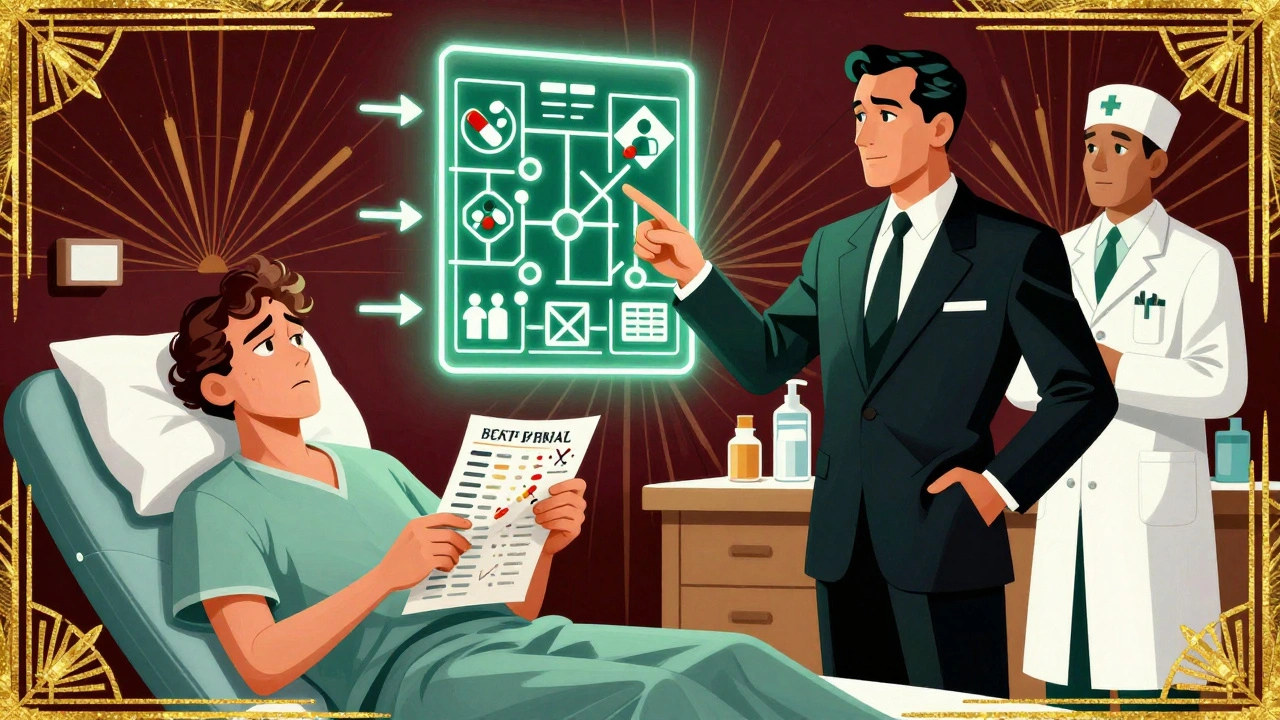
Medication errors don’t happen in a vacuum-they happen when patients move from one care setting to another.
Think about it: a patient leaves the hospital with a new prescription, then sees their primary doctor a week later, picks up meds at the pharmacy, and forgets to tell their home health nurse about a recent change. That’s when things go wrong. According to the Agency for Healthcare Research and Quality (AHRQ), 60% of all medication errors happen during care transitions-like going from hospital to home, or from ICU to a nursing unit. These aren’t small mistakes. They lead to emergency visits, longer hospital stays, and sometimes death.
What exactly is medication reconciliation?
Medication reconciliation isn’t just writing down what drugs a patient takes. It’s a formal process to make sure every medication a patient is on is correctly recorded, reviewed, and confirmed at every point they move between caregivers. The Joint Commission has required this since 2005, and the World Health Organization calls it one of the top safety actions in their Medication Without Harm campaign.
The process has four clear steps:
- Get the most accurate list possible of all medications the patient is currently taking-including doses, frequencies, and reasons.
- Create a new list of medications the patient should be taking after the transition.
- Compare the two lists side by side to spot differences-missing drugs, wrong doses, duplicates, or interactions.
- Make clinical decisions based on that comparison and document why changes were made.
This isn’t optional. If you skip even one step, you’re gambling with someone’s life.
Why do errors happen during discharge?
Discharge is the most dangerous transition. Patients are tired, overwhelmed, and often given new prescriptions without fully understanding them. A 2024 Kaiser Family Foundation survey found that 72% of patients don’t understand why their medication list matters during discharge. Meanwhile, doctors are rushed, nurses are overworked, and pharmacists are left trying to clean up messes after the fact.
The biggest culprits?
- Communication gaps: A patient’s home pharmacy doesn’t get the updated list. The hospital’s EHR doesn’t talk to the community pharmacy system. Only 37% of U.S. hospitals can electronically share medication data with pharmacies.
- Paper-based lists: Patients bring in handwritten lists from home. Some are outdated. Others are scribbled on napkins. One study found that 44% of these lists had at least one error.
- Missing roles: Too many hospitals assign reconciliation to whoever’s available-nurses, residents, even administrative staff. But without clear ownership, it gets dropped.
- Too many meds: Patients on 10 or more medications have a 65% chance of having at least one error during transition. Polypharmacy is a silent killer.
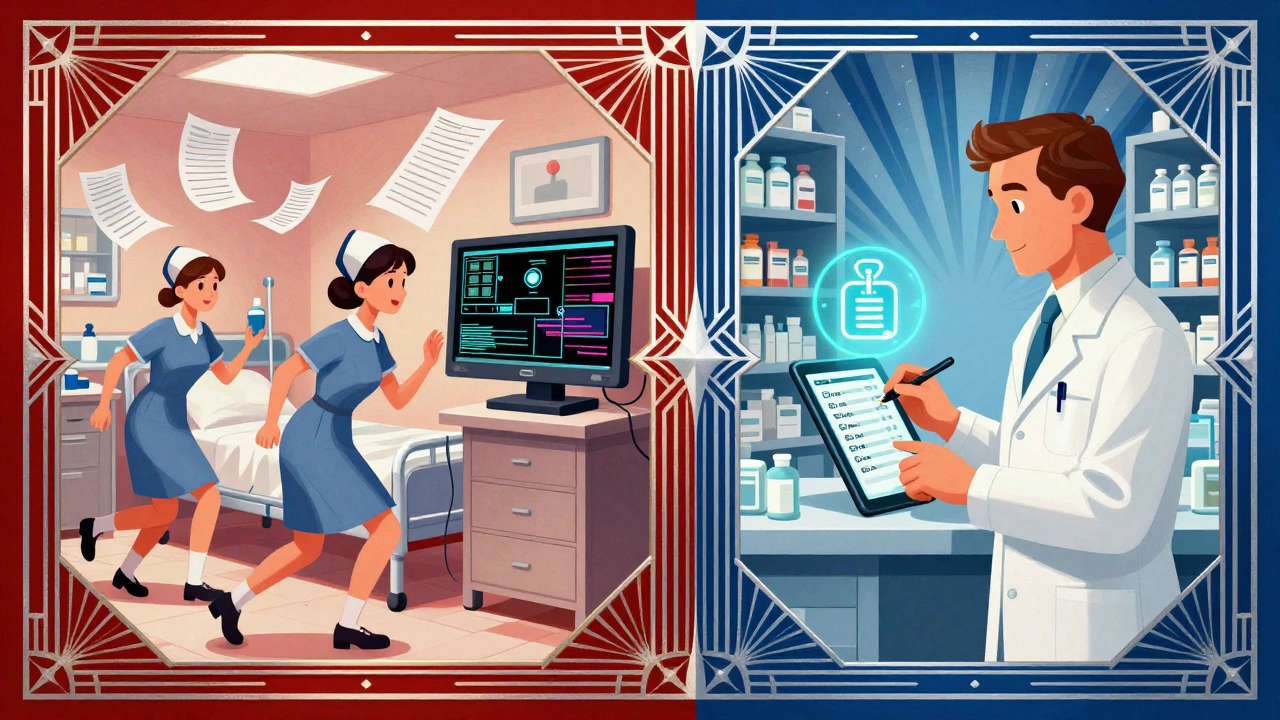
Technology helps-but it’s not a magic fix
Electronic health records (EHRs), computerized order entry (CPOE), and barcode scanning have cut medication errors by nearly half in hospitals, according to a 2022 Cochrane review. But here’s the catch: when hospitals first roll out new EHR systems, medication discrepancies can actually go up by 18% for months afterward. Why? Because staff are learning a new system, shortcuts are taken, and data doesn’t always transfer cleanly.
Even worse, some EHRs make reconciliation harder. One internal medicine resident on the American College of Physicians forum said her hospital’s reconciliation module adds 12-15 minutes per patient during admission. So staff start skipping steps or using workarounds-like copying and pasting old lists instead of verifying them.
Technology works best when it’s part of a bigger system. The AHRQ’s Medication at Transitions and Clinical Handoffs (MATCH) toolkit, updated in 2023, gives hospitals 159 specific steps to fix workflows-not just install software. Hospitals that used the full MATCH toolkit saw a 63% drop in errors. Those that only upgraded their EHR saw just a 41% drop.
Pharmacists are the secret weapon
When pharmacists lead medication reconciliation, results improve dramatically. A 2023 study in the Journal of the American Pharmacists Association found that pharmacist-led programs reduced post-discharge medication errors by 57% and cut 30-day hospital readmissions by 38%.
Why? Because pharmacists are trained to spot drug interactions, duplicate therapies, and inappropriate doses. They know what’s high-risk-like warfarin, insulin, or anticoagulants. One pharmacist in the ASHP survey said, “Catching a duplicate anticoagulant order during discharge that would have caused a major bleed is why I do this work.”
Facilities with dedicated transition pharmacists report 53% fewer adverse drug events. Yet only 28% of hospitals consistently involve patients or pharmacists in the process, according to The Joint Commission’s 2023 survey. That’s a massive missed opportunity.
What does success look like in practice?
Real success means more than checking a box. It means:
- Having a clearly defined role for who does reconciliation at each transition point-admission, transfer, discharge.
- Spending 15-20 minutes per patient on reconciliation. In reality, most staff only get 8-10 minutes. That’s not enough.
- Verifying medication lists with at least two sources. For high-risk drugs like opioids or blood thinners, the 2025 National Patient Safety Goals now require this.
- Using AI tools like MedWise Transition, which was FDA-cleared in August 2024 and reduced discrepancies by 41% in a pilot across 12 hospitals.
- Training staff not just on how to use the EHR, but on how to ask the right questions. One MARQUIS study found that training staff without clear roles actually increased harmful discrepancies by 15%.
How to fix this in your facility
Changing how medication reconciliation is done takes time, but it’s doable. Here’s what works:
- Start with discharge. That’s where the biggest risks are. Assign a pharmacist or trained nurse to review every discharge med list before the patient leaves.
- Build a bridge to community pharmacies. Don’t rely on patients to bring lists. Call or electronically send the updated list to their pharmacy. If your EHR can’t do it, create a simple fax or secure email template.
- Engage patients. Give them a printed, plain-language list of their meds-what they’re for, when to take them, what to watch for. Ask them to read it back to you. Patients who participate feel 85% more confident about their meds.
- Use the MATCH toolkit. Don’t just buy software. Follow the 12-step implementation plan. It’s free. It’s evidence-based. It’s been proven to work.
- Track your numbers. Measure how many errors you catch, how many readmissions you prevent, and how long reconciliation takes. If you’re not measuring, you’re guessing.
What’s next for medication safety?
The WHO just launched Phase 2 of its Medication Without Harm campaign in October 2024, targeting transitions with a goal to reduce harm by 30% by 2027. The 2025 National Patient Safety Goals will require verification of high-risk medications with two sources. And the global market for medication safety tech is growing fast-projected to hit $7.5 billion by 2030.
But technology alone won’t save lives. People will. Nurses who take the extra five minutes. Pharmacists who call the pharmacy. Doctors who listen to patients. Systems that make it easy to do the right thing.
Bottom line
Medication errors during transitions aren’t inevitable. They’re preventable. And the tools to fix them already exist. What’s missing is consistent execution. Every time a patient walks out the door with a medication list that doesn’t match what they’re actually taking, someone failed them. It doesn’t have to be that way.
What is the most common cause of medication errors during discharge?
The most common cause is a breakdown in communication between providers. Patients often leave the hospital with updated meds, but their primary care doctor, pharmacist, or home nurse never receives the new list. Without a formal handoff, doses get doubled, drugs are missed, or dangerous interactions go unnoticed.
Can electronic health records (EHRs) prevent medication errors?
EHRs can reduce errors by up to 32% when used correctly, but they can also cause more errors during rollout. Many systems don’t talk to community pharmacies, and staff often use workarounds like copying old lists instead of verifying them. EHRs work best when paired with clear workflows and trained staff-not as standalone tools.
Why are pharmacists so important in medication reconciliation?
Pharmacists are trained to spot drug interactions, duplicate prescriptions, and inappropriate dosing. Studies show that when pharmacists lead reconciliation, post-discharge errors drop by 57% and readmissions fall by 38%. They’re the only team members whose primary job is to ensure medications are safe and appropriate.
How long should medication reconciliation take per patient?
Experts recommend 15-20 minutes per patient for thorough reconciliation. In practice, many facilities only allocate 8-10 minutes due to time pressures. Rushing the process increases errors. The key is to build it into the workflow, not treat it as an extra task.
What should patients do to help prevent medication errors?
Patients should bring a current list of all their medications-including over-the-counter drugs, vitamins, and supplements-to every appointment. They should ask: “Is this new medication different from what I was taking before?” and “Can I get a printed copy of my updated list?” Those who participate in reconciliation feel 85% more confident about their meds.
Are there any new tools to help with medication reconciliation?
Yes. AI-powered tools like MedWise Transition, cleared by the FDA in August 2024, analyze medication lists and flag potential errors with 41% greater accuracy than manual review. These tools are now being piloted in hospitals across the U.S. and Europe, especially for patients on 10 or more medications.
Honestly, I've seen this play out in my family. My mum came home with a new script for blood pressure meds and forgot to tell her pharmacist. Ended up in the ER. No one was at fault, just the system's broken.
Simple fix: printed list, read back, done.
I’ve been in healthcare for 22 years, and I can tell you-medication reconciliation isn’t a task, it’s a culture. You can’t just slap on an EHR and call it a day. You need trained staff, clear ownership, and accountability. And yes, pharmacists? They’re not ‘support staff’-they’re the last line of defense. If your hospital doesn’t have a dedicated transition pharmacist, you’re not doing safety-you’re doing paperwork.
The EHRs are worse than useless in some places. I work in a rural clinic. Our system won’t talk to the pharmacy network. So we fax. Every. Single. Time. It’s 2025. We’re faxing. And yes, someone always forgets to send it.
I’ve been on both sides-patient and caregiver. When my dad got discharged after his heart surgery, the nurse handed him a folded piece of paper with 14 meds scribbled in pencil. No explanations. No follow-up. He took one wrong dose and ended up back in the hospital. It’s not about tech. It’s about taking five extra minutes to make sure someone understands. That’s all it takes. And it’s free.
Let’s be real: most hospitals treat reconciliation like a checkbox. They don’t care about safety-they care about compliance metrics. And patients? They’re just collateral damage in a broken system designed by bureaucrats who’ve never held a stethoscope. You think AI tools will fix this? Ha. They’re just another profit center for vendors. Real change requires human accountability. Which no one has the guts to enforce.
The MATCH toolkit is free. It’s evidence-based. It’s been proven to reduce errors by over 60%. Yet so many facilities still buy flashy software and skip the hard work of changing workflows. This isn’t a technology problem. It’s a leadership problem. If your leadership doesn’t prioritize patient safety over efficiency metrics, you’re not just failing-you’re endangering lives.
I work in a hospital that finally hired a transition pharmacist last year. Within six months, our 30-day readmissions dropped by 40%. Not because of tech. Because someone actually sat down with each patient, asked what they were taking, checked it against the list, called the pharmacy, and gave them a printed sheet with colors for morning/night. Simple. Human. Effective.
I work in a hospital that still uses paper med lists. One patient brought in a napkin with ‘blood pill’ written on it. No name, no dose. We had to call three pharmacies and her family just to figure it out. This isn’t just negligence-it’s negligence with a side of systemic laziness. We need to stop pretending this is ‘hard’ when the solution is staring us in the face.
I’ve seen EHRs make reconciliation worse. My hospital’s system auto-fills old med lists-so staff copy-paste without checking. I had a patient on warfarin who got duplicated because the system pulled a 3-year-old list. The pharmacist caught it. But why did the nurse not? Training isn’t optional. It’s life-or-death.
I’ve been in this field for over two decades, and I’ve watched the same mistakes happen over and over. It’s not about the tools. It’s about the people. The system rewards speed over safety. Nurses are stretched too thin. Doctors are burnt out. Pharmacists are underutilized. And patients? They’re just expected to figure it out. It’s not just broken-it’s morally bankrupt. And nobody wants to fix it because fixing it means changing how we do business.
Let’s not pretend this is about patient safety. It’s about liability. Hospitals don’t care if you die from a med error-they care if you sue them. That’s why they ‘require’ reconciliation. Not to save lives. To cover their butts. And the AI tools? Just PR spin. The real problem? Staffing shortages. No one’s talking about that. They’re all just selling software.
The notion that patients can be trusted to bring accurate medication lists is a dangerous fallacy. The average patient cannot distinguish between a beta-blocker and a statin. They do not understand pharmacokinetics. To rely on their input as a primary source is not patient-centered-it is negligent. The only responsible approach is for trained clinicians to verify every medication against authoritative sources, independent of patient self-report. Anything less is not care-it is recklessness.