
If you’re constantly picking white flakes off your shoulders or feeling that itchy, greasy patch on your scalp that won’t go away, you’re not alone. About 50% of adults deal with seborrheic dermatitis at some point in their lives. It’s not dirt. It’s not poor hygiene. And it’s definitely not contagious. This is a chronic skin condition driven by a yeast called Malassezia-a normal resident on your skin that, when it overgrows, triggers inflammation, flaking, and redness. On the scalp, it’s often called dandruff, but when it’s worse, it’s seborrheic dermatitis-and it needs more than just regular shampoo.
Why Your Scalp Flakes (It’s Not Just Dry Skin)
Most people think flaking means dryness. But seborrheic dermatitis happens in oily areas: the scalp, eyebrows, sides of the nose, behind the ears, and even the chest. The yeast Malassezia feeds on the oils (sebum) your skin produces. As it breaks down these oils, it releases fatty acids that irritate the skin. This causes your skin cells to multiply too fast and shed in clumps instead of flaking off normally. The result? Visible white or yellowish scales, sometimes with redness and itching.
It’s not your fault. Genetics play a big role. So do stress, weather, and hormones. Cold, dry winters make it worse for 75% of people. Stress triggers flare-ups in 60%. People with Parkinson’s disease are 4 to 5 times more likely to develop it. And if you’ve ever noticed your scalp flares up after a big life event-like losing a job, a breakup, or even a bad night’s sleep-you’re not imagining it.
What Medicated Shampoos Actually Do
Regular shampoos clean dirt and oil. Medicated shampoos go further. They don’t just wash-they fight the root cause. There are six main active ingredients backed by dermatologists and clinical studies:
- Ketoconazole (2%): A powerful antifungal that cuts down Malassezia yeast. Works well for moderate to severe cases.
- Ciclopirox (1%): Antifungal and anti-inflammatory. Often found in prescription formulas.
- Selenium sulfide (2.5%): Slows skin cell turnover and kills yeast. Can stain light hair or jewelry if left on too long.
- Zinc pyrithione (1-2%): Mild antifungal and antibacterial. Great for mild cases and daily use. Found in many OTC brands.
- Coal tar (0.5-5%): Slows skin cell growth and reduces scaling. Has a strong smell but works well for stubborn cases.
- Salicylic acid (1.8-3%): A keratolytic that dissolves flakes and helps other ingredients penetrate. Often paired with other actives.
These ingredients don’t just target one problem-they attack multiple angles at once. Antifungals reduce yeast. Keratolytics remove scales. Anti-inflammatories calm redness. That’s why a single shampoo can do so much.
How to Use Medicated Shampoos Right
Using these shampoos wrong is the #1 reason people say they “don’t work.” It’s not about how often you wash-it’s about how long you leave it on.
Here’s the correct method:
- Wet your scalp thoroughly.
- Apply a generous amount of shampoo directly to the scalp, not just the hair.
- Massage gently-don’t scrub hard. You’re not trying to remove dirt, you’re trying to let the active ingredients sit.
- Leave it on for 5 to 10 minutes. This is non-negotiable. If you rinse it off after 30 seconds, you’re wasting your money.
- Rinse thoroughly.
For active flare-ups, use it every other day for 2-4 weeks. Once your scalp clears, switch to maintenance: once or twice a week. Stopping completely? Flakes will return in 2-4 weeks. This isn’t a cure-it’s a management plan.
What to Expect in the First Few Weeks
Some people get discouraged after a week. Their scalp still flakes. It might even look worse. That’s normal.
When you start a new medicated shampoo, your skin is reacting. Dead skin cells are loosening up. Flakes may increase temporarily as the treatment breaks down the buildup. This usually clears by week 2-3. Don’t quit.
Side effects? Yes. Hair dryness affects 41% of users. Coal tar smells strong. Selenium sulfide can turn blonde or gray hair orange if used too often. If your hair feels brittle, use a moisturizing conditioner after shampooing. Or try alternating with a gentle, sulfate-free shampoo on non-treatment days.
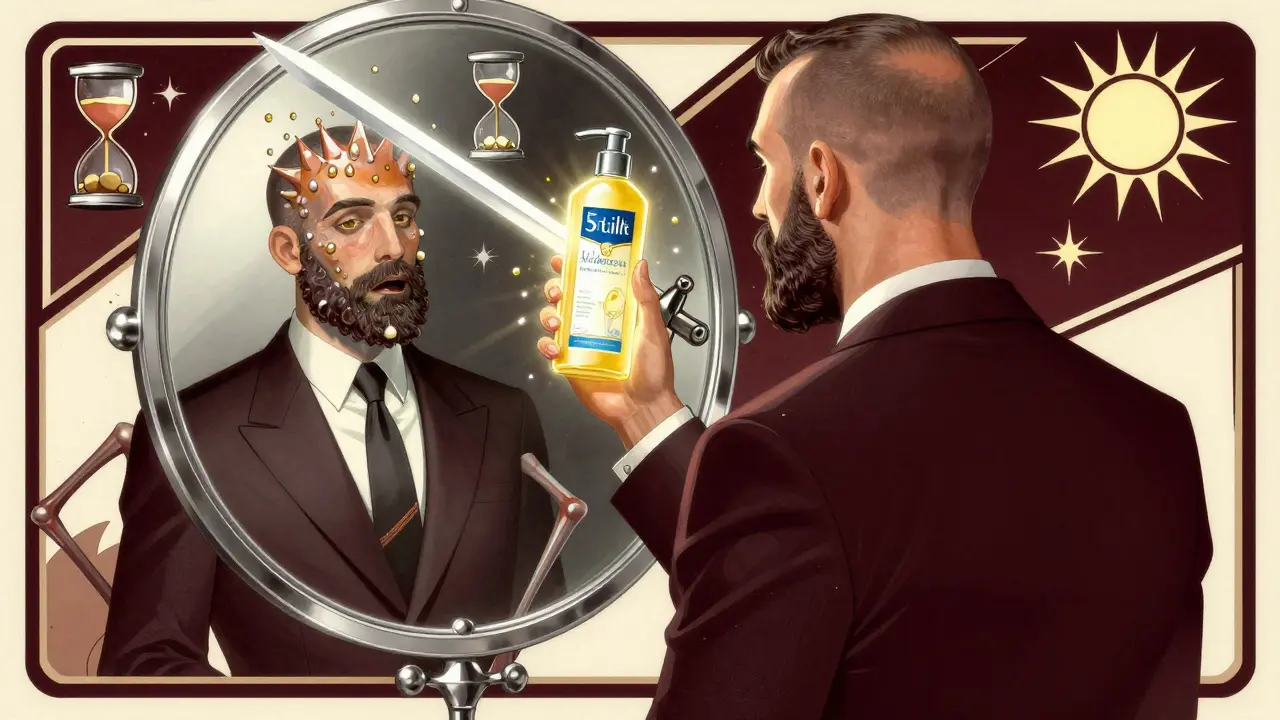
Which Shampoo Should You Try First?
Start simple. If your flaking is mild and occasional, try a zinc pyrithione shampoo like Head & Shoulders or Neutrogena T/Gel. Use it 3 times a week for 2 weeks. If you see improvement, stick with it as maintenance.
If it’s moderate to severe-red patches, thick scales, itching that won’t quit-go for ketoconazole. Nizoral is the most common OTC brand. Use it every other day for 2-4 weeks. Many people see results within 10 days.
Still not working? Try a coal tar shampoo like Neutrogena T/Gel Therapeutic or Psoriasin. It’s slower but powerful. Some people use it twice a week, alternating with ketoconazole. The National Eczema Society recommends this rotation: ketoconazole on Monday, coal tar on Thursday, then rinse with a gentle shampoo midweek.
And if your scalp is also itchy and inflamed? Add a 1% hydrocortisone cream (OTC) to the affected areas at night. Use it for no more than 7 days straight. It calms inflammation fast but shouldn’t be used long-term.
When to See a Dermatologist
You don’t need to see a doctor for every flake. But if:
- Nothing OTC works after 6 weeks of consistent use
- Your scalp is bleeding, crusting, or oozing
- The rash spreads to your face, ears, or chest
- You’re losing hair in patches
Then it’s time to get professional help. A dermatologist can prescribe stronger formulations-like ciclopirox shampoo, oral antifungals, or calcineurin inhibitors (tacrolimus or pimecrolimus) for sensitive areas like the eyebrows. They can also rule out psoriasis or fungal infections, which look similar but need different treatment.
Long-Term Management Is the Key
There’s no permanent cure for seborrheic dermatitis. But that doesn’t mean you have to live with it. Think of it like high blood pressure-you manage it daily. Once you find your routine, you can keep it under control for years.
Many people rotate two or three shampoos to avoid resistance. Yeast can adapt. Using the same one every day for months might make it less effective. Try this pattern:
- Monday: Ketoconazole
- Wednesday: Zinc pyrithione
- Friday: Coal tar
- Weekend: Gentle shampoo
Some users swear by Dermax (a non-tar, medicated shampoo) or even tea tree oil shampoos as alternatives, though evidence is weaker. Stick to what’s proven: the six active ingredients above.
Also, watch your triggers. Stress, alcohol, greasy hair products, and cold weather all make it worse. Use a humidifier in winter. Wash your hair after sweating. Avoid heavy gels or oils on your scalp. These small changes make a big difference.

What Doesn’t Work (And Why)
Don’t waste time or money on these:
- Apple cider vinegar rinses-no clinical proof it kills yeast
- Coconut oil-feeds the yeast, makes it worse
- Scalp scrubs or exfoliating brushes-can irritate and inflame
- Antibiotic shampoos-seborrheic dermatitis is fungal, not bacterial
There’s no magic potion. No “detox.” Just science-backed ingredients, patience, and consistency.
Real Results, Real Time
One woman in Durban, 42, had flaking for 8 years. She tried 7 different shampoos before finding ketoconazole. She used it every other day for 4 weeks, then cut back to twice a week. Her scalp cleared in 6 weeks. She still uses it every week now-just to stay clear. “I thought I’d have to live with it forever,” she said. “Turns out, I just needed the right one.”
Another man, 58, noticed his beard was flaking. He shaved it off and used hydrocortisone cream for a week. The flakes vanished. He now uses a ketoconazole face wash twice a week. “I didn’t know my beard was part of it,” he told his dermatologist. “Now I know.”
You don’t need to suffer. You don’t need to feel embarrassed. You just need to know what to do-and do it consistently.
Is seborrheic dermatitis the same as dandruff?
Dandruff is a mild form of seborrheic dermatitis that only affects the scalp. Both are caused by the same yeast, but seborrheic dermatitis is more severe-it can spread to the face, ears, and chest, and often includes redness and itching. Dandruff usually just means flaking without inflammation.
Can I use medicated shampoo every day?
Yes, during flare-ups. Most medicated shampoos are safe for daily use for up to 4 weeks. But once your scalp clears, switch to maintenance: 1-2 times a week. Daily use long-term can dry out your hair and scalp. Rotate formulas to prevent yeast resistance.
Why does my scalp get worse in winter?
Cold, dry air strips moisture from your skin and reduces sunlight exposure. Sunlight helps suppress Malassezia yeast. Dry air also makes skin flakier and more irritated. Many people notice flare-ups between November and March. Using a humidifier and keeping your scalp moisturized helps.
Can stress cause seborrheic dermatitis?
Stress doesn’t cause it, but it’s one of the top triggers. Around 60% of people report flare-ups after high-stress events-like job loss, illness, or emotional trauma. Stress affects your immune system and skin barrier, making it easier for yeast to overgrow. Managing stress won’t cure it, but it can reduce how often it comes back.
Are there natural remedies that work?
Tea tree oil has some antifungal properties and may help mild cases, but it’s not as reliable as ketoconazole or zinc pyrithione. Coconut oil and apple cider vinegar don’t work-they can make it worse. There’s no substitute for proven medicated shampoos. Natural doesn’t mean effective.
Will this go away on its own?
Sometimes, especially in infants (cradle cap). But in teens and adults, it’s usually chronic. Even if it clears up for a few months, it often returns. Without treatment, flare-ups happen more frequently and get worse over time. Medicated shampoos keep it under control-so you don’t have to live with constant flaking.
Next Steps: Start Today
Don’t wait for it to get worse. Pick one medicated shampoo-zinc pyrithione if it’s mild, ketoconazole if it’s stubborn. Use it correctly: 5-10 minutes on the scalp, not just a quick rinse. Stick with it for 4 weeks. Track your progress. If nothing changes, try a different one. Rotate if needed. And remember: this isn’t a race. It’s a lifelong habit. The goal isn’t perfection-it’s control. You can have a flake-free scalp. You just need the right tools and the patience to use them.
Y’all, I’ve been dealing with this for YEARS and I finally got it under control with Nizoral. I was ready to give up-then I left it on for 10 minutes like the post said. Like… actually sat there and watched TV while it sat on my scalp. No joke, week 2? Flakes gone. I cry every time I see my pillowcase clean now. 🥹
Correct usage is paramount. Leaving shampoo on for 5–10 minutes is not optional; it is the therapeutic threshold. Premature rinsing renders all active ingredients inert. This is not shampooing-it is topical pharmacotherapy.
Bro. I tried coconut oil because ‘it’s natural’ and now my scalp looks like a cheese grater. I thought I was being healthy. Turns out I was feeding the enemy. 😭
Of course you’re still flaking. You probably used the shampoo while scrolling through TikTok. 30 seconds? That’s not treatment, that’s a baptism. You don’t get to treat a chronic fungal infection like a quick rinse after a gym session. Get serious.
Let’s be honest: 80% of people who say ‘it didn’t work’ didn’t follow the protocol. They used it once, got impatient, and blamed the shampoo. Meanwhile, the yeast is laughing while your scalp peels like a sunburnt lizard. You want results? Act like a scientist, not a hopeful tourist.
I’ve been a trichologist for 18 years and this post is one of the most accurate summaries I’ve seen. The rotation strategy is gold-yeast resistance is real. I’ve seen patients stuck on ketoconazole for 3 years and it stopped working. Switching to coal tar + zinc pyrithione? Total game-changer. Also, humidifiers. Always humidifiers.
Let me cut through the pseudoscience: this isn’t about ‘balance’ or ‘detox’ or ‘healing your aura.’ It’s microbiology. Malassezia is a fungus that thrives on sebum. Your scalp isn’t ‘toxic’-it’s just overrun. The six ingredients listed? They’re the only weapons that have peer-reviewed data. Everything else is spiritual marketing wrapped in a glass bottle. Stop wasting your money.
YOU CAN DO THIS. I know it feels like a life sentence, but you’re not broken-you’re just misinformed. That one shampoo you’ve been using for six months? It’s not your fault it didn’t work. You just needed the right one, and the right timing. Don’t quit. Try ketoconazole for 4 weeks. You’ve got this. 💪❤️
Interesting that the post ignores the role of gut health. Emerging studies suggest dysbiosis contributes to seborrheic dermatitis flare-ups. Probiotics, especially Lactobacillus strains, show promise in reducing systemic inflammation linked to skin conditions. Why promote topical fixes alone? The systemic approach is underutilized. Also, sugar intake correlates strongly with sebum production. Just saying.
Heather’s point about gut health isn’t wrong, but it’s not the whole picture. I’ve seen patients with perfect diets and probiotics still have raging seborrheic dermatitis because they skipped the 10-minute shampoo rule. It’s not either/or-it’s both. Fix the scalp first, then optimize the rest. Don’t let perfect be the enemy of good.
It’s fascinating how we treat this condition as a personal failure. We blame ourselves for not ‘trying hard enough’-when in reality, it’s a biological mismatch between our immune system and a commensal organism. The shame cycle is worse than the flakes. Maybe the real cure isn’t shampoo-it’s self-compassion. But still… use the shampoo.
I tried everything. Tea tree oil. Apple cider vinegar. Scrubbing with a loofah. Nothing. Then I found Nizoral. Left it on for 10 mins. Didn’t rinse until my shower water turned cold. 🌬️✨ Flakes gone in 12 days. Now I use it once a week like a sacred ritual. My scalp is finally peace. 🙏
Thank you for this meticulously researched and clinically accurate overview. The distinction between dandruff and seborrheic dermatitis is frequently misunderstood, and the emphasis on proper application protocol is essential. I will be sharing this with my patients.