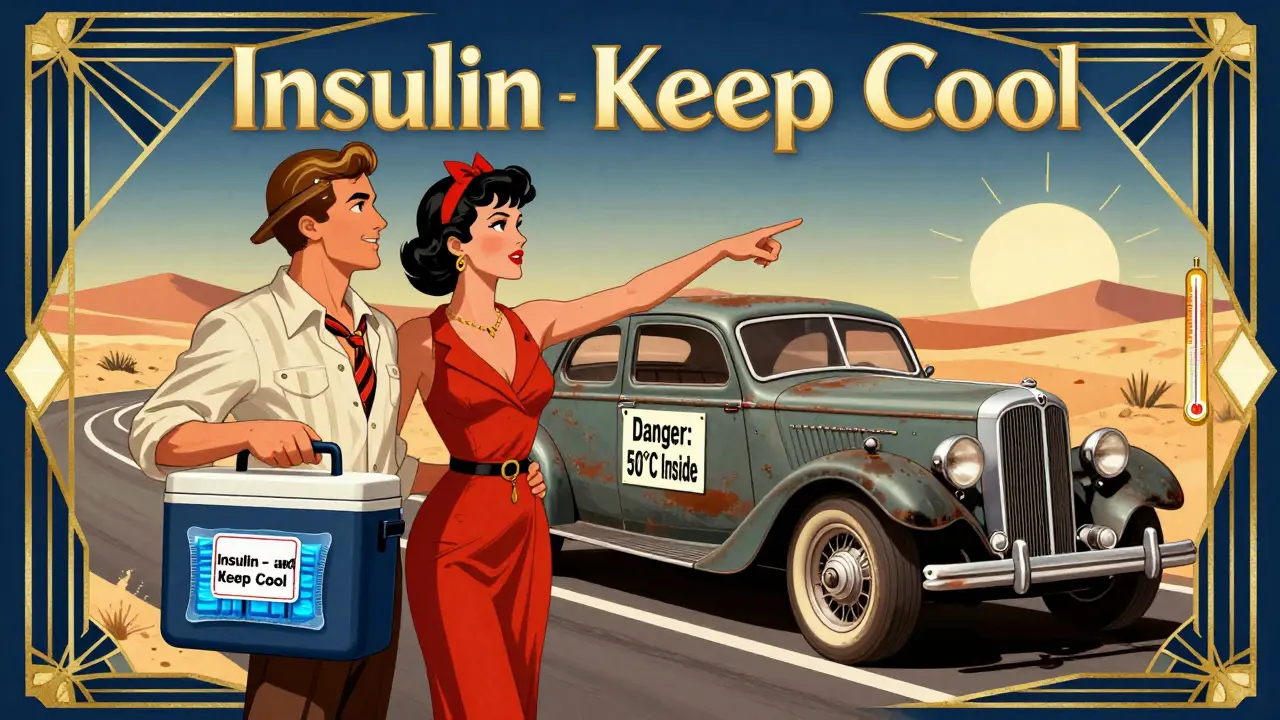
Imagine this: you’re on a road trip in Durban, and the sun is beating down. Your insulin sits in the glove compartment for an hour. By the time you get to the pharmacy, it’s cloudy, useless - and you’re out of options. Or maybe you’re flying north in winter, and your vaccine package freezes solid in the baggage hold. These aren’t rare mistakes. They happen every day. And the cost? Not just money - it’s your health.
Not All Medications Are the Same
Your pills and your insulin don’t play by the same rules. The World Health Organization calls these time- and temperature-sensitive pharmaceutical products (TTSPPs). That means if they get too hot or too cold, they can lose strength, break down, or become completely useless.- Ambient meds (like most tablets and capsules) need to stay between 15°C and 25°C. Think ibuprofen, antibiotics, blood pressure pills. They’re tough - but not invincible.
- Refrigerated meds (2°C to 8°C) include insulin, many vaccines, biologics, and some injectables. These are fragile. Heat above 8°C? Insulin degrades 1.2% per hour. Vaccines like MMR lose 10% potency every hour over 8°C.
- Cryogenic meds (below -150°C) are rare for most people - think specialized cancer drugs or certain vaccines. If you’re transporting these, you’re likely working with a medical team. Skip this section unless you’re a professional.
Most people only deal with the first two. And that’s where most mistakes happen.
Hot Weather? Don’t Let Your Meds Cook
In Durban, summer temps hit 35°C. Inside a car? It’s 50°C. That’s deadly for insulin.Here’s what works:
- Never leave meds in the car. Not even for 10 minutes. A 2023 Varcode survey found 68% of pharmacists saw temperature excursions during summer - almost all from packages left outside delivery doors or in cars.
- Use an insulated cooler bag. A standard lunch-sized insulated bag with two frozen gel packs can keep insulin at 2°C-8°C for up to 8 hours, even in 35°C heat. That’s enough for a day trip.
- Keep it on your person. Put the cooler in your backpack, purse, or carry-on. Your body heat helps stabilize the temperature. Don’t let it sit in the trunk or under a seat.
- Avoid direct sunlight. Even if it’s cool, sunlight through a window can spike the internal temp. Wrap the bag in a towel if needed.
- Check the look. If insulin turns cloudy, clumpy, or has particles - don’t use it. Your pharmacist can confirm degradation. Don’t gamble with your health.
Pro tip: Some travelers swear by the TempAid 2.0 - a portable refrigerated case that holds 2°C-8°C for 48 hours. It’s heavy (3.2 lbs) and costs $150, but if you’re flying or on long trips, it’s worth it. Over 1,200 Amazon reviews give it 4.7 stars.
Cold Weather? Don’t Let Your Meds Freeze
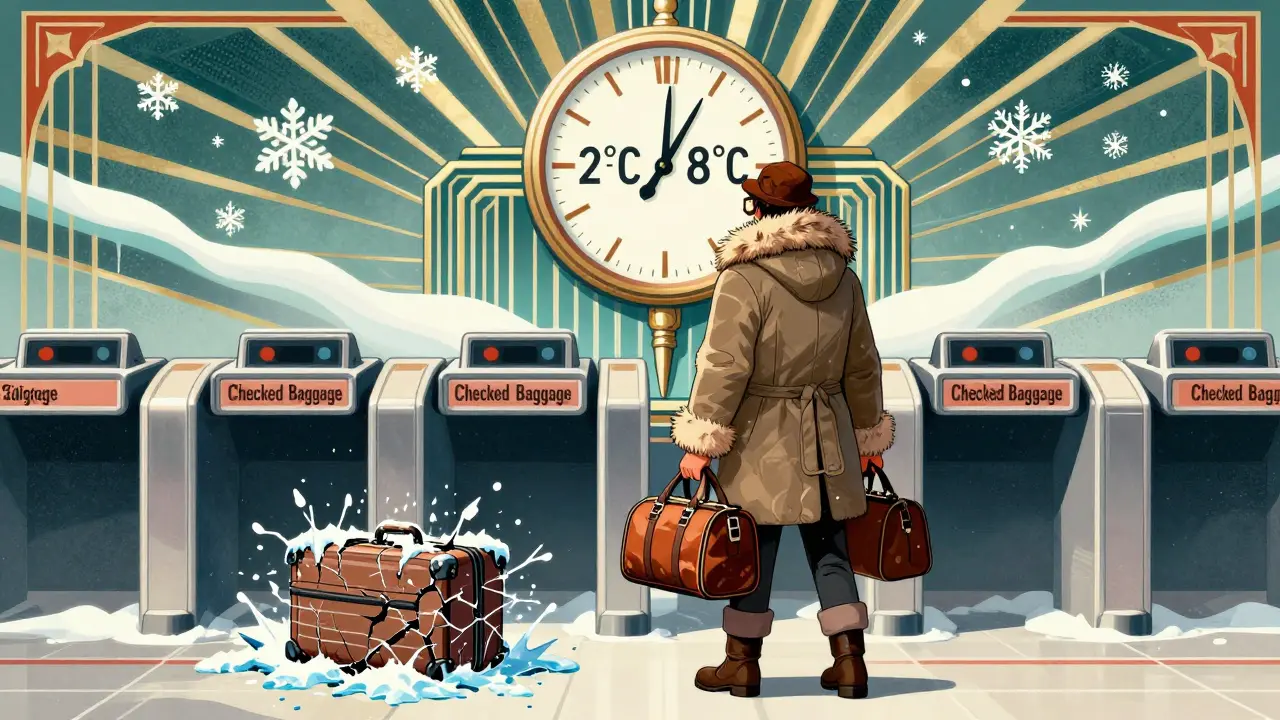
Winter’s trickier than you think. Cold doesn’t just make things uncomfortable - it can destroy meds too.Insulin freezes at -2°C. Vaccines can crack. Ampoules can shatter. The IATA guidelines say: even brief exposure to -20°C during loading can ruin a shipment.
Here’s how to protect your meds in freezing temps:
- Keep meds close to your body. Put your cooler bag inside your coat, not in your suitcase. Your body heat is your best defense.
- Never let meds sit in an unheated car overnight. If you’re parked outside, bring your meds inside with you.
- Use insulation, not heat. Don’t put meds next to a heater or in a hot car to thaw. Use foam inserts, bubble wrap, or even a wool scarf around the cooler. The goal is to slow down the cold, not fight it.
- Avoid direct contact with ice packs. If you’re using gel packs, wrap them in a towel. Direct contact can freeze your medication.
- Watch for condensation. When you bring a cold package into a warm room, moisture forms. That can ruin labels or damage blister packs. Let it warm up slowly - in the bag - before opening.
Logistics managers at Pfizer say winter excursions below range jumped 17% in 2022-2023. Why? People assumed cold weather was safe. It’s not. Freezing is just as dangerous as overheating.
Traveling by Plane? Do This
Airports are a minefield. Checked baggage? Can hit -40°C in the hold. Carry-on? Can get hot near the engines.Follow this checklist:
- Never check temperature-sensitive meds. Ever. Airlines don’t control cargo temperatures. The IATA requires a Time and Temperature Sensitive Label - but that’s for cargo, not your personal meds.
- Carry them in your hand luggage. Keep them in your coat pocket or a small insulated bag you can hold.
- Bring a doctor’s note. It’s not always required, but it helps if security asks. It should list your meds, dosage, and that they’re temperature-sensitive.
- Don’t use dry ice unless you’re trained. Dry ice can cause freezing. Most airlines limit it to 2.5 kg per passenger, and you need approval. For most travelers, gel packs are safer and simpler.
- Ask for a temperature-controlled storage bin. Some airports have them near security. Use them if available.
One Reddit user shared: “My insulin turned cloudy after being left in a 95°F car for 45 minutes. The pharmacist said it was degraded. I had to buy a new vial - and I was 300 miles from home.”
What About Long Trips or Moving Homes?
If you’re relocating or going on a multi-day trip:- Use a validated insulated shipping container. Companies like ColdKeepers make boxes that maintain 2°C-8°C for 72+ hours, even in -20°C to +50°C extremes. These are used by hospitals - and they work.
- Don’t rely on “average temperature.” The FDA says quality is determined by maximum exposure. A 2-hour spike at 30°C can ruin a week’s worth of insulin. Continuous monitoring matters.
- Bring extra meds. Always have a 2-3 day backup. Store it in a different location - like a friend’s house or hotel safe.
- Record your temps. Use a simple digital thermometer with a memory function. Take a photo of the reading every 6 hours. If something goes wrong, you’ll have proof.
Monitoring and Documentation - Don’t Skip This
You wouldn’t drive a car without checking the fuel gauge. Why treat your meds differently?The FDA says: “Periodic checks aren’t enough.” You need continuous data. Real-time GPS loggers cost $50-$100. They record temperature every 15 minutes and send alerts if it goes out of range. A 2022 study found they cut temperature excursions by 92% compared to basic thermometers.
And here’s the kicker: if you don’t have documentation, your meds are considered out of specification - even if they’re fine. IATA and the FDA require temperature records to be kept for 3 years after expiration. For personal use, just take a photo. For clinics or pharmacies, use a data logger.
What to Avoid
- Leaving meds in the car. Even with the AC on.
- Using a regular cooler without gel packs. Ice melts too fast.
- Putting meds in the freezer. Unless it’s a cryogenic drug, freezing ruins most medications.
- Assuming “it’s just for a few hours.” Degradation starts in minutes.
- Ignoring the look and texture. Cloudy insulin? Discolored liquid? Don’t use it.
Final Rule: When in Doubt, Don’t Use It
There’s no way to tell if a medication is still safe just by looking at the label. If you suspect temperature exposure - call your pharmacist. They can tell you if it’s still viable. In many cases, they’ll replace it at no cost if you have documentation.Climate change is making extreme weather more common. The CDC says we’re facing unprecedented challenges for pharmaceutical transport. Your meds are your lifeline. Treat them like it.
Can I use a regular cooler bag for insulin?
Yes - but only if you add frozen gel packs. A standard insulated lunch bag with two gel packs can keep insulin between 2°C and 8°C for up to 8 hours in hot weather. Never use ice cubes - they melt too fast and can leak. Gel packs are designed to release cold slowly and stay contained.
What if my insulin gets too cold?
If insulin freezes, it forms crystals and becomes ineffective. You won’t see it right away, but it won’t work. Never thaw frozen insulin and use it. Discard it and get a new vial. Always keep it away from direct contact with ice or cold surfaces.
Can I bring my meds on a plane in checked luggage?
Never. Checked baggage can reach -40°C in the hold or overheat in the cargo bay. Airlines don’t monitor temperature for personal items. Always carry temperature-sensitive medications in your hand luggage, and keep them with you at all times.
How do I know if my medication is still good after temperature exposure?
Check the appearance. Insulin should be clear (for rapid-acting) or uniformly cloudy (for long-acting). If it’s clumpy, discolored, or has particles, throw it out. For other meds, look for changes in color, smell, or texture. When in doubt, call your pharmacist. They can confirm safety based on exposure time and temperature.
Are there special cases for vaccines like COVID or flu shots?
Yes. Most vaccines need 2°C-8°C. Some mRNA vaccines (like older Pfizer versions) require ultra-cold storage at -70°C - but those are rarely carried by individuals. For standard flu or COVID boosters, treat them like insulin: keep them cool, never freeze them, and never leave them in a car. Always carry them in your carry-on with gel packs.
Next Steps: What to Do Today
- Check your current meds. Are any refrigerated? If yes, get an insulated bag and two gel packs.
- Test your setup. Put your meds in the bag, freeze the packs, and leave it in a hot car for 2 hours. Use a thermometer to see if it stays under 8°C.
- Call your pharmacy. Ask: “What’s your policy if my meds were exposed to extreme temps?” Many will replace them if you report it.
- Take a photo of your meds and the thermometer reading every time you travel. Keep it in your phone.
Your meds are not just pills. They’re your health, your routine, your safety. Don’t let weather take that away.
Just got back from a road trip to Arizona and I did exactly what this says - insulated bag with gel packs in my backpack. My insulin stayed perfect. Seriously, if you’re on meds like this, don’t be lazy. Your life depends on it.
Wow. Finally someone who gets it. Most people think 'cool' means 'safe' - nope. You need *precise* thermal control. I’ve seen people put insulin in a cooler with ice cubes. That’s not storage - that’s medical negligence. The FDA doesn’t care if you ‘meant well.’
Insulated bag with two gel packs works. Tested it in a 40°C car for 6 hours. Stayed at 5.2°C. No leaks. No drama. Just use the right gear. Also - never freeze insulin. Ever. It’s not rocket science.
Have you considered that this entire narrative is manufactured by Big Pharma to sell overpriced TempAid devices? The WHO has no official stance on personal transport - only institutional logistics. And why is no one asking why these drugs are so fragile in the first place? There’s a deeper issue here.
Lmao. You really think a lunch bag works? My cousin’s insulin froze on a flight because he used a 'cool bag.' He ended up in ER. Use a real cooler. Or don’t travel. Simple.
Oh my god, I just realized… what if someone *steals* your bag? What if the airline loses it? What if the gel packs leak and ruin your clothes? What if your thermometer breaks? What if the pharmacist is busy and you can’t call? WHAT IF YOU DIE???
Bro, you don’t need to spend $150 on some fancy gadget. I just wrap my insulin in a towel and stick it in my chest pocket. Body heat keeps it warm in winter, and my hoodie blocks sun in summer. Done. Stop overcomplicating life.
Just had to replace 3 vials after a 3-hour layover in Atlanta where my bag sat by the gate. The temp hit 42°C. I didn’t even know. My pharmacist said it was degraded. Now I carry a $20 digital thermometer. Take photos. Document everything. Don’t be me.
In India, we use clay pots wrapped in wet cloth to keep things cool - ancient tech, still works. Same principle: evaporation cools slowly. You don’t need gadgets. Just understand heat transfer.