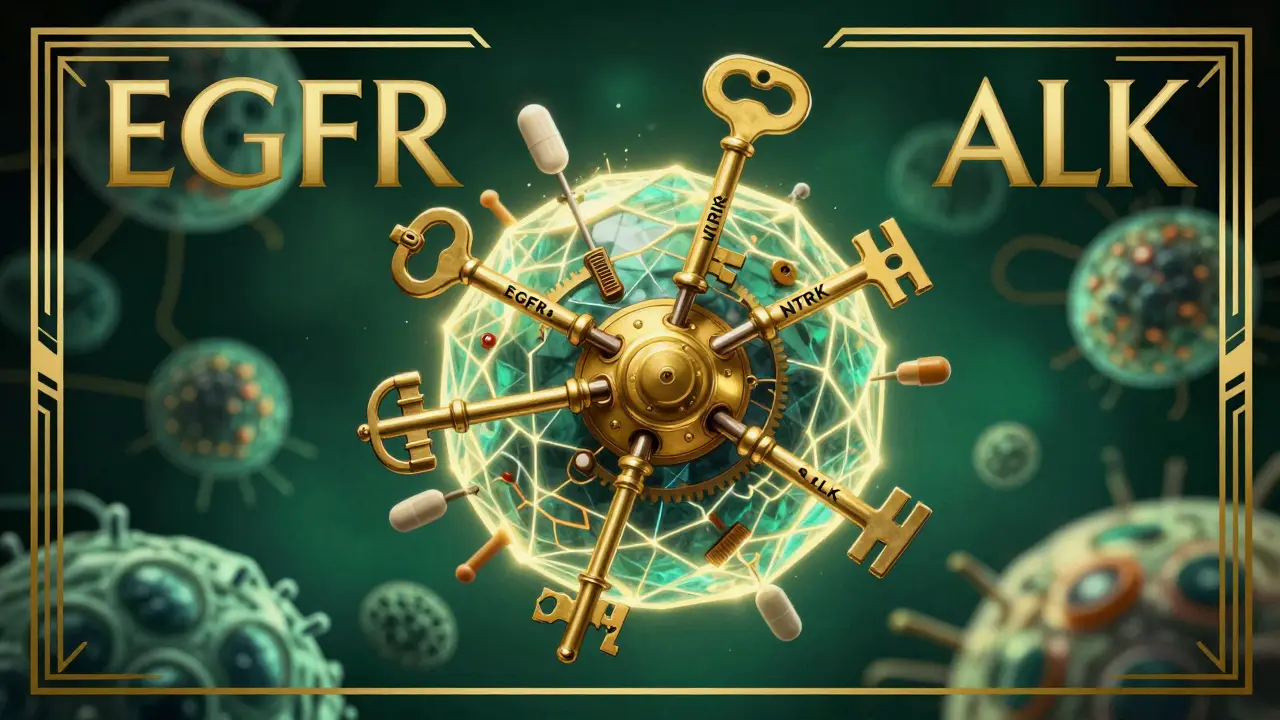
For decades, cancer treatment meant one thing: chemotherapy. Harsh, broad, and punishing. It didn’t care if you were fighting lung cancer or breast cancer - if your cells were dividing, they got hit. But today, something different is happening. Targeted therapy is turning cancer care on its head. Instead of attacking all fast-growing cells, it hunts down the exact genetic mistakes that make a tumor tick. This isn’t science fiction. It’s happening now, in hospitals from Durban to Detroit.
How Targeted Therapy Works
Think of cancer cells like broken machines. They don’t just grow out of control - they have specific broken parts. Maybe it’s a mutated gene called EGFR, or a fusion in the NTRK gene. Targeted therapies are designed like keys that fit only those broken locks. They block signals that tell cancer cells to multiply, starve them of fuel, or trigger their self-destruction - all without wrecking healthy tissue.
The first big win came with imatinib (Gleevec) in 2001. Before it, chronic myeloid leukemia was often fatal within a year. After imatinib? 89% of patients were alive after 12 months. That’s not a small improvement - it’s a revolution. Today, over 68 targeted drugs are approved, each tied to a specific genetic flaw. Some, like larotrectinib, work across cancer types. If your tumor has an NTRK fusion - whether it’s in your lung, colon, or salivary gland - this drug can shrink it by 75%.
Biomarker Testing: The Gatekeeper
You can’t use targeted therapy unless you know what you’re targeting. That’s where biomarker testing comes in. It starts with a biopsy. Not just any biopsy - one that’s sent for next-generation sequencing (NGS). Panels like FoundationOne CDx or MSK-IMPACT scan 300 to 500 cancer-related genes at once. They look for mutations, fusions, and amplifications that match approved drugs.
But it’s not simple. You need at least 20-50 nanograms of tumor DNA, and the sample must have at least 20% cancer cells. If the tumor is too small or too old, the test fails. Turnaround time? Two to three weeks. And it costs around $5,500. Insurance doesn’t always cover it. In fact, 55% of patients in one 2022 survey said their insurance denied the test. Some waited over a month just to get approval.
And even when you get the results, not everything is clear. One in five reports show a “variant of unknown significance” - a genetic change nobody knows if it matters. That leaves doctors guessing. Worse, only 13.8% of cancer patients actually have a match. That means for most, targeted therapy isn’t an option - yet.

Why It’s Better (When It Works)
When targeted therapy works, the difference is staggering. Take osimertinib for EGFR-mutant lung cancer. In a major trial, patients lived 18.9 months without their cancer worsening - compared to 10.2 months on chemo. That’s nearly 9 extra months of life, with fewer side effects. Grade 3-4 toxicities? 15-30% with targeted drugs. With chemo? 50-70%.
Patient stories back this up. One woman with stage IV lung cancer wrote on a cancer forum: “After starting osimertinib, my tumor shrank 80% in eight weeks. I could walk my dog. I didn’t throw up. I slept through the night.” That’s not a statistic - that’s a life.
And then there’s the basket trial model. The NCI-MATCH trial tested drugs based on genetics, not tumor location. A patient with ovarian cancer got a drug meant for melanoma - because both had the same BRAF mutation. And it worked. This is the future: cancer classified by DNA, not by organ.
The Dark Side: Resistance, Cost, and Access
But here’s the catch. Most patients develop resistance. Within 9 to 14 months, the cancer finds a way around the drug. Maybe it mutates again. Maybe it grows new blood vessels. Maybe it hides in a part of the body the drug can’t reach. That’s why 70-90% of patients eventually stop responding.
Then there’s cost. A single month of targeted therapy can run $15,000 to $30,000. Chemo? $5,000 to $10,000. For many, that’s not just expensive - it’s catastrophic. A 2023 University of Chicago study found 40% of patients on targeted drugs faced financial hardship. Some skipped doses. Others sold possessions. One Reddit user described “molecular frustration” - her tumor had an NTRK fusion, making her eligible for larotrectinib. But her insurer denied coverage because it wasn’t “standard for her cancer type.” The drug works across tumors. The system doesn’t.
And access? It’s a luxury. In the U.S., 65% of advanced cancer patients get genomic testing. In Europe? 22%. In Asia? Just 8%. Even in top hospitals, only 32% of community centers have molecular tumor boards. Most oncologists don’t have the time, training, or tools to interpret complex genetic reports. One 2023 ASCO survey showed institutional reports scored 2.8 out of 5 for clarity. Foundation Medicine’s? 4.2.

What’s Next?
The field is moving fast. Liquid biopsies - blood tests that detect tumor DNA - are now FDA-approved. Guardant360 can spot resistance mutations months before a scan shows growth. That means doctors can switch drugs before the cancer spreads.
AI is stepping in too. IBM Watson for Oncology matched molecular tumor board decisions 93% of the time in a 2024 study. That’s not replacing doctors - it’s helping them keep up.
And researchers are chasing the next frontier: tumor suppressor genes. These are the brakes that failed. TP53, PTEN - they’re broken in 80% of cancers. But no drug can fix them. Yet. Dr. Levi Garraway of Genentech says this is the next big battle. If we learn how to restore these lost brakes, we could help far more patients.
Is This for Everyone?
No. Right now, targeted therapy helps a minority. But it’s changing the rules. What matters isn’t where the cancer started - it’s what’s broken inside it. And as testing gets cheaper, faster, and more widely available, that number will grow.
For now, if you or someone you know has advanced cancer, ask: “Has my tumor been genomically tested?” If not, push for it. If insurance says no, appeal. There are nonprofits like the Personalized Oncology Alliance that help community clinics run molecular tumor boards for free. And if you have a rare mutation, clinical trials might be your best shot - even if insurance won’t cover the drug.
Targeted therapy isn’t a cure-all. But for the right person, at the right time, it’s turning terminal into manageable. And that’s more than hope - it’s progress.
What is targeted therapy in cancer treatment?
Targeted therapy is a cancer treatment that uses drugs to block specific genetic mutations driving tumor growth. Unlike chemotherapy, which attacks all rapidly dividing cells, targeted therapies focus only on cancer cells with identifiable molecular flaws - like EGFR, ALK, or NTRK mutations. This precision reduces damage to healthy tissue and often leads to better outcomes.
How is targeted therapy different from chemotherapy?
Chemotherapy kills all fast-growing cells - cancerous and healthy - causing side effects like hair loss, nausea, and low blood counts. Targeted therapy, by contrast, only attacks cancer cells with specific genetic markers. Patients often experience fewer and milder side effects. For example, grade 3-4 toxicities occur in 15-30% of targeted therapy patients versus 50-70% with chemo.
Do all cancer patients qualify for targeted therapy?
No. Only about 13.8% of cancer patients have a currently actionable genetic mutation matched to an approved drug. Most solid tumors still lack identifiable targets. Testing via next-generation sequencing (NGS) is required to find these mutations, but access, cost, and tissue quality limit who can be tested. Even among those tested, many have variants of unknown significance, making treatment decisions harder.
What is biomarker testing and why is it important?
Biomarker testing uses advanced genomic tools like FoundationOne CDx or MSK-IMPACT to scan a tumor’s DNA for mutations, fusions, or amplifications linked to targeted drugs. It’s essential because targeted therapies only work if the patient’s tumor has the specific genetic flaw the drug was designed to block. Without testing, these drugs are ineffective - with response rates as low as 2-5% in unselected patients.
Why do targeted therapies stop working?
Cancer cells evolve. After months or years of treatment, they develop new mutations or activate alternative pathways to bypass the drug’s effect. This is called acquired resistance. It happens in 70-90% of patients within 9-14 months. Liquid biopsies now help detect these changes early by spotting resistance mutations in blood before tumors grow on scans.
Are targeted therapies affordable?
No, not for most. A single month of targeted therapy can cost $15,000-$30,000, compared to $5,000-$10,000 for chemotherapy. Insurance often denies coverage for testing or drugs, especially for off-label use. A 2023 study found 40% of patients on targeted therapy experienced financial hardship - skipping doses, selling assets, or delaying care. Access remains unequal across countries and income levels.
Can targeted therapy be used for any type of cancer?
Yes - but only if the tumor has the right mutation, not the right location. Drugs like larotrectinib and entrectinib are approved for any solid tumor with an NTRK fusion, regardless of whether it’s in the lung, breast, or thyroid. This is called tissue-agnostic approval. The FDA first approved this model in 2018 with pembrolizumab for MSI-H tumors. It’s changing how we classify cancer: by genetics, not anatomy.
What’s the future of targeted therapy?
The future lies in combination therapies, earlier detection via liquid biopsies, and targeting previously untouchable genes like TP53 and PTEN. AI tools are helping interpret complex genomic reports, and global initiatives like NCI’s RESPOND aim to fix racial disparities in testing access. By 2030, experts predict 40% of cancer patients will receive biomarker-driven treatment. But equity in access remains the biggest challenge.
Targeted therapy? Cool. But let's be real - this is just another way for Big Pharma to charge $30k a month while the system ignores people who can't afford it. I don't need a PhD to know that.
If your tumor has a mutation, good for you. If not? Too bad. We're not fixing healthcare. We're just making it fancier.
I've been following this for years, and honestly, the emotional weight of this isn't captured enough. I had a cousin who got osimertinib after chemo failed. She went from bedridden to hiking in the Rockies in six months. But then her insurance denied the next round because her cancer 'wasn't the right kind' even though the mutation matched. It's not just science. It's a moral crisis. We're classifying people by their DNA and then deciding who gets to live based on paperwork. The fact that 55% of patients get denied testing? That's not a system glitch. That's a choice. And we're all complicit when we call it 'progress' without calling out who's left behind.
In India, we don't even have access to basic chemo in rural areas. And now you're talking about $5,500 genetic tests? This isn't medicine. This is a luxury for the West. We have mothers dying of cervical cancer because they can't afford Pap smears. Meanwhile, you're celebrating drugs that work on 13% of people. This isn't innovation. It's inequality dressed up in lab coats.
Stop calling this progress. Call it what it is: a privilege.
Ask your doc if you've been tested. If not, push for it. Simple.
LOL so now we're supposed to be impressed because a drug works on 13% of people? That's not science. That's a marketing campaign.
Chemo kills you slowly. Targeted therapy kills you slowly while charging you $20k a month. And don't even get me started on the 'basket trials' - you're treating ovarian cancer with a melanoma drug because someone had a mutation? That's not precision. That's genetic roulette.
And the AI? IBM Watson? Yeah, it matched decisions 93% of the time. Guess what? The doctors were already wrong 7% of the time. So now we're trusting a machine that's wrong 7% of the time to fix a system that's broken 100% of the time? Brilliant.
i mean… i got tested and they found a vus (variant of unknown significance) and the dr just shrugged. like… cool? so now i'm just a data point?
also the cost? my insurance said no to the test then said yes to the drug but only after i paid $8k out of pocket. then they changed their mind. again.
i think they just want us to suffer quietly while they patent the next 10 drugs. also i typed this on my phone so sorry for the typos lol
It's funny how everyone acts like this is some revolutionary breakthrough.
We've been here before. Remember the 'personalized medicine' hype in the 2000s? It didn't change anything. Now we're just doing the same thing with fancier words and higher prices.
And don't get me started on the 'you can walk your dog' stories. That's not progress. That's a placebo effect wrapped in a clinical trial.
I'm not saying it doesn't help some. I'm saying we're pretending it helps more than it does. And that's dishonest.
Bro, you know what's wild? In India, we have 1.4 billion people and maybe 3 labs that can do NGS properly. And yet, we're supposed to be impressed by a $5500 test? 😂
I work in oncology and let me tell you - 90% of our patients never even see a biopsy report. The rest? They get a 20-page PDF with 50 variants and zero guidance.
And don't even get me started on the 'basket trials' - it's like saying 'if your car has a spark plug, you can drive it on Mars'. 🤡
Also, I just read this on my phone at 3am after my third shift. So if my spelling is off... well, that's life. 😴