
When a patient switches from a brand-name drug to a generic, they expect the same effect - no more, no less. But for NTI generics, that expectation isn’t just about convenience. It’s about survival. Narrow Therapeutic Index (NTI) drugs like warfarin, phenytoin, and levothyroxine have a razor-thin line between helping and harming. A 5% difference in blood concentration can mean the difference between preventing a seizure or triggering one. That’s why global regulators don’t treat these drugs like ordinary generics. Their approval rules are stricter, their testing more intense, and their consequences far more serious.
What Makes NTI Drugs Different?
NTI drugs aren’t just any medications. They’re the ones where tiny changes in how much of the drug enters your bloodstream can lead to dangerous outcomes. Warfarin, used to prevent blood clots, is a classic example. Too little, and you risk a stroke. Too much, and you could bleed internally. Phenytoin, an anti-seizure medication, works the same way. Even small shifts in absorption or metabolism can cause toxicity or treatment failure. These aren’t hypothetical risks. In 2021, a recall of a generic antihypertensive drug due to nitrosamine impurities showed how easily quality control can fail - and how deadly it can be when it does.
The FDA defines NTI drugs as those where small differences in dose or blood concentration may lead to serious therapeutic failures or adverse reactions. That’s not a suggestion. It’s a mandate. And regulators around the world have responded with different, often conflicting, rules.
How the FDA Approves NTI Generics
In the United States, the FDA doesn’t use the standard 80-125% bioequivalence range for NTI drugs. It tightens the limits - sometimes to 90-111% or even tighter, depending on the drug. For quality control, the acceptable assay range is 95-105%, compared to 90-110% for regular generics. That means every batch must be nearly identical to the original. The agency also requires more rigorous testing: healthy volunteers instead of patients, multiple-dose studies, and detailed dissolution profiles.
Since 2010, the FDA has published over 100 drug-specific guidance documents for NTI products. These aren’t suggestions. They’re blueprints. Companies applying for approval must follow them exactly. And even then, the rejection rate for NTI generics is 22% higher than for non-NTI drugs. Why? Because the margin for error is so small. One study found that 67% of U.S. pharmacists have been asked by doctors to avoid substituting generics for NTI drugs - especially for epilepsy and thyroid medications.
Europe’s Patchwork System
In Europe, the picture is more complex. The European Medicines Agency (EMA) offers three paths: the Centralized Procedure, the National Procedure, and the Mutual Recognition Procedure. The Centralized Procedure is faster - around 210 days - and results in approval across all EU countries. But only a small fraction of generics use it. Most go through national routes, where each country sets its own rules.
That creates confusion. A generic approved in Germany might not be automatically accepted in Spain. Pharmacists report that 58% of them struggle to keep up with substitution rules across borders. Some countries, like Spain, force price cuts: the first generic must be priced at least 40% below the brand. Others, like Denmark and the UK, have looser controls. The result? A fragmented market where patients might get the same drug, but under different names, with different quality expectations.
Despite the chaos, the EMA is moving toward more centralization. In 2022, 68% of new generic applications used the Centralized Procedure - up from 42% in 2018. That’s a sign regulators know the old system doesn’t work for NTI drugs.
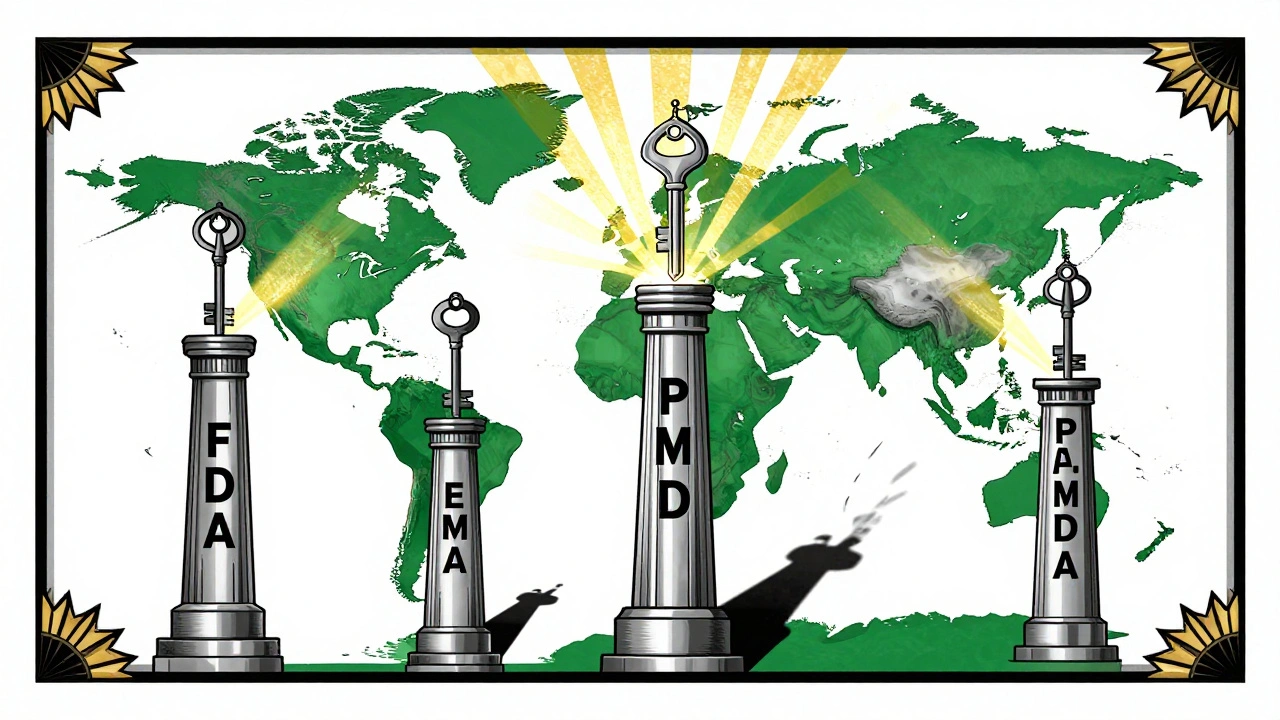
Canada, Japan, and the Global Players
Canada takes a flexible but strict approach. It allows foreign reference products - meaning a generic company can use a brand-name drug from the U.S. or Europe as its benchmark - as long as it proves the formulation, solubility, and physicochemical properties match exactly. That’s smart. It avoids redundant testing and speeds up approval.
Japan’s Pharmaceuticals and Medical Devices Agency (PMDA) has detailed guidance for topical NTI drugs, which are especially tricky due to skin absorption variability. Their standards are among the most detailed in the world.
Meanwhile, countries like Brazil, Mexico, and South Korea lack specific NTI guidelines. That’s a red flag. When a generic manufacturer in one of these countries exports to the U.S. or EU, their product may not meet the required bioequivalence standards - even if it’s approved locally.
Real-World Consequences
Regulations aren’t just paperwork. They affect real people. In 2023, a pharmacist on Reddit shared that three patients experienced thyroid level swings after switching to a new generic levothyroxine - despite FDA approval. That’s not rare. A 2021 study of 12,500 patients across 15 European countries found that when strict bioequivalence rules were followed, 94.7% had equivalent clinical outcomes. But when rules were loose? Results varied wildly.
Doctors know this. That’s why many still prescribe by brand name for NTI drugs. In North Carolina, pharmacists must get explicit consent from both patient and doctor before substituting. Connecticut, Idaho, and Illinois have similar rules for anti-epileptic drugs. Twenty-six U.S. states have special laws for NTI substitution. That’s not because doctors distrust generics. It’s because they’ve seen what happens when the numbers don’t add up.
Cost, Time, and the Business Side
Developing an NTI generic isn’t cheap. It costs $5-7 million and takes 18-24 months - nearly double the time and cost of a regular generic. Why? Because you need more volunteers, more testing cycles, more analytical validation, and more data to prove equivalence. Companies like Teva, Mylan, and Sandoz dominate this space because they have the resources to navigate the maze.
And it’s worth it. The global NTI generics market hit $48.7 billion in 2022 and is projected to grow to $72.3 billion by 2027. The U.S. accounts for 42% of sales; Europe, 34%. But growth is slow. The high rejection rate and complex regulations scare off smaller players. Only the biggest companies can afford to play.
Where Is This All Headed?
There’s movement toward harmony. The International Generic Drug Regulators Pilot (IGDRP), launched in 2012, includes regulators from the U.S., EU, Canada, Japan, and others. They’re sharing data, aligning methods, and trying to reduce duplication. The ICH M9 guideline, adopted in 2023, will help by allowing biowaivers for certain NTI drugs based on their solubility - saving time and money.
The FDA’s GDUFA III, effective in 2023, adds stronger post-market monitoring for NTI drugs. That means more random testing, more recalls if things go wrong, and more transparency. By 2025, the FDA plans to use population bioequivalence - a new method that looks at how a drug behaves across different patient groups, not just healthy volunteers. That’s a big step toward real-world accuracy.
Experts agree: global collaboration is the only way forward. Dr. Jessica Greene of the University of Minnesota predicts that better coordination through IGDRP could cut approval times by 25-30% over the next decade. But that depends on countries giving up some control. The U.S. wants tighter standards. Europe wants faster access. Japan wants precision. Finding common ground isn’t easy.
What This Means for Patients
For patients, the message is simple: don’t assume all generics are equal. If you’re on warfarin, levothyroxine, or phenytoin, ask your pharmacist: Is this the same formulation I’ve been taking? If you notice changes in how you feel - fatigue, dizziness, irregular heartbeat - speak up. Keep a log. Share it with your doctor.
Regulators are trying. But the system is still uneven. The best protection you have is awareness. Know your drug. Know your dose. Know your brand. And don’t let a change in packaging fool you. For NTI drugs, the smallest difference can have the biggest impact.
I’ve been on levothyroxine for 12 years, and I swear, the generic switch in 2020 felt like someone turned down the volume on my life. Fatigue, brain fog, heart palpitations - I thought I was going crazy. Turns out, the new batch had a different filler. Took three months to get my doc to switch me back. Now I only take the brand. I know it’s expensive, but my thyroid doesn’t negotiate.
And don’t get me started on pharmacists who just swap it without asking. It’s not a box of cereal. It’s my nervous system we’re talking about.
Let me be perfectly clear-this whole NTI generics debacle is a direct result of America’s obsession with cost-cutting at the expense of competence! The FDA’s 90-111% range? That’s still a 21% swing! In my day, we didn’t let pharmaceuticals be treated like discount toilet paper! The EU’s mess? That’s what happens when you let bureaucrats from 27 countries argue over semantics! And Japan? They’ve got more guidelines than a military manual! But here’s the real crime: we’re outsourcing our health to companies in Brazil and India who don’t even know what a dissolution profile is! This isn’t innovation-it’s negligence dressed up in regulatory jargon! We need a national emergency declaration, not another pilot program! The FDA’s GDUFA III? A Band-Aid on a severed artery!
There’s something deeply human in how we treat these drugs-like they’re just chemical equations, when in reality, they’re lifelines. The fact that a 5% shift can tip someone from stability to crisis… it’s not just pharmacokinetics. It’s dignity. It’s autonomy. It’s the quiet terror of waking up and not knowing if your body will let you breathe normally today.
And yet, we keep treating this like a supply chain problem. We don’t need more data points-we need more humility. The patients aren’t variables. They’re people who’ve learned to read their own symptoms like poetry. Maybe the real innovation isn’t in bioequivalence models-it’s in listening to them.
Oh please. You’re all acting like NTI generics are some kind of miracle drug conspiracy. The FDA approves over 1,000 generics a year. If people are having issues, it’s because they’re paranoid or they don’t take their meds right. My cousin took generic warfarin for three years and never had a problem. You think your thyroid is special? Newsflash: your body doesn’t care if it’s branded or generic. It cares if you’re consistent. Stop blaming Big Pharma and start taking responsibility. Also, why do people think ‘brand name’ means ‘better’? That’s just placebo effect dressed in white coats.
India produces 40% of the world’s generic pharmaceuticals. We have the most rigorous quality control systems in the developing world. The fact that Western regulators still distrust our products is not about science-it’s about colonial mentality. Our labs follow ICH guidelines. Our engineers are PhDs from IITs. We export to the EU, Canada, and the US daily. If a batch fails, it’s not because we’re incompetent-it’s because someone in a bureaucratic office in Washington or Brussels refuses to accept that the world has changed.
Stop infantilizing Indian manufacturers. We don’t need your approval to do good work. We need your respect.
ok so i just found out my mom’s generic levothyroxine was made in a factory that had a rat infestation in 2022?? and the FDA didn’t recall it?? 😭 i’m not even kidding. i looked up the lot number. now i’m scared to even open my pill bottle. what if they put rat hair in it?? i’m gonna start taking it in front of a mirror with a flashlight. someone help me. 🥲
One thing’s for sure: this isn’t just about drugs. It’s about trust. Trust in regulators. Trust in manufacturers. Trust in your pharmacist. And honestly? We’ve broken that trust in too many places. But here’s the good part-we can rebuild it. By demanding transparency. By supporting companies that publish their dissolution data. By pushing for patient registries that track outcomes. This isn’t about fear. It’s about agency. We don’t need to stop generics. We just need better ones. And we’re closer than we think.
They’re putting microchips in the pills to track us